|
NASA spacecraft are monitoring an
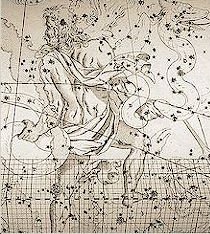
interstellar wind coming from the constellation Ophiuchus.
by Dr Tony Phillips
Every year in December,
something happens that can throw your horoscope out of whack. The
sun enters Ophiuchus, the little-known 13th house of the zodiac.
You've probably heard
of Capricorn, Aquarius, Pisces, Aries, Taurus, Gemini, Cancer, Leo,
Virgo, Libra, Scorpio and Sagittarius. The sun passes through these
constellations, one by one, throughout the year. They're the ancient
signs of the zodiac.
But Ophiuchus?
Modern astronomers
don't divide the sky the same way ancient astronomers did. According
to modern star maps, the sun cuts through a 13th constellation,
Ophiuchus the Serpent Bearer, between Nov. 30th and Dec. 17th. Astrologically
speaking, if you were born between those dates you're no longer
a Sagittarian, you're an Ophiuchi! But that's another story....
This story is about
what really happens when the sun enters the zodiac's 13th
house: An interstellar wind hits our planet.
It's a helium-rich
breeze from the stars, flowing into the solar system from the direction
of Ophiuchus. The sun's gravity focuses the material into a cone
and Earth passes through it during the first weeks of December.
We're inside the cone now.
"There's no danger
to anyone on Earth," says space physicist George Gloeckler
of the University of Maryland. "The helium breeze is a thousand
billion billion times (1021 times) less dense than Earth's
atmosphere. It cannot penetrate to the surface of our planet."
Nevertheless, astronomers
are keen to study it.
The breeze is a telltale
sign of what lies outside the solar system. Interstellar space,
the "void" between the stars, is not empty. It's filled
with gigantic clouds of gas and dust. These clouds are the birthplace
of stars and planets; they're also the debris left behind when stars
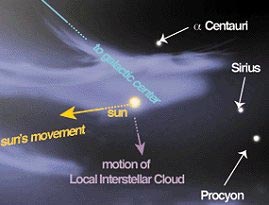
explode. The solar system is running into one. Astronomers call
it the Local Interstellar Cloud. The sun's magnetic field holds
much of the cloud at bay, but some of the cloud's gas does penetrate - hence
the breeze.
NASA's ACE (Advanced
Composition Explorer) spacecraft, located at the first Lagrange
point directly between Earth and the Sun, is perfectly situated
to study this breeze. "When Earth moves through the focusing
cone (the region of space where the sun's gravity focuses the breeze),
so does ACE," explains Gloeckler, who is one of ACE's Lead
Co-investigators. "We've been through the cone seven times - once
a year since the spacecraft was launched in 1997."
ACE's mission is to
study the solar wind, the hot breeze from our own star, so the spacecraft
is well equipped to study the interstellar breeze, too. An instrument
onboard ACE called SWICS detects helium ions in the breeze, measuring
their density, temperature and direction of flow. Using these measurements,
along with data from other spacecraft (chiefly SOHO and Ulysses),
Gloeckler and colleagues have calculated the properties of the Local
Interstellar Cloud.
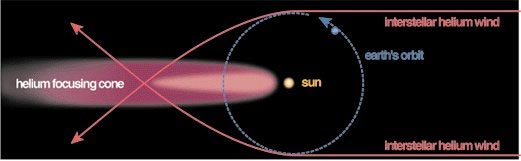
Credit: American Scientist. More
The
Sun's gravity deflects the interstellar helium breeze
and causes it to pile up downstream from the sun. This
concentration is helpful to spacecraft observing the wispy-thin
flow.
|
It's a hot cloud, the gas temperature
is 6000 C, about the same as the temperature of the sun's surface.
It's also very wispy, only 0.264 atoms per cubic centimeter. The
sun's magnetic field has little trouble deflecting this diaphanous
material before it crosses the orbit of Pluto. Only a trickle (0.015
atoms per cubic centimeter) penetrates the inner solar system.
One day the solar system
might run into something more massive. There are clouds in the galaxy
thousands of times denser than the Local Interstellar Cloud. University
of Chicago astronomer Priscilla Frisch has studied what might happen
if we plowed into one of those. Writing in the magazine American
Scientist she reports, "a cloud with 1,000 atoms per cubic
centimeter could compress the sun's magnetic field to within a few
AU of the sun. (1 AU or "one astronomical unit" is the
distance between the sun and Earth). Planets such as Saturn, Uranus,
Neptune and Pluto would be fully exposed to interstellar atoms and
molecules. Interstellar gas would overwhelm the solar wind at 1
AU," transforming the space-environment of our planet.
More
An
artist's concept of the Local Interstellar Cloud.
|
The first signs of such a transformation
could be the helium breeze thickening or shifting directions, heralding
something new to come.
ACE has already detected
changes. "We see strange gusts, ebbs and flows," says
Gloeckler. "We doubt these variations are interstellar."
Instead, the sun is probably responsible. The helium breeze must
blow through the much denser solar wind, which can push the breeze
around. Sunspots also affect the breeze. Ultraviolet radiation shining
from sunspots ionizes the breeze and changes the way it appears
to instruments like SWICS.
"What we're doing
now," explains Gloeckler, "is learning how solar activity
affects the breeze. When we can reliably account for the sun, in
detail, then we can use these measurements to diagnose interstellar
space."
What's out there? What's
coming? The answer lies in a breeze from the stars of the 13th house.
|