|
Rationing and recycling will be an essential
part of life on the International Space Station. In this article,
we explore where the crew will get their water and how they will
(re)use it.
by Dr Tony Philips and Patrick
Barry
Future astronauts poised to blast off
for an extended stay on the International Space Station (ISS) might
first consider dashing to the toilet for a quick splash at the lavatory,
or better yet, a luxurious hot shower. Once on board the ISS, spacefarers
are in for a steady diet of sponge baths using water distilled from
-- among other places -- their crewmates breath!
If you're squeamish, read no farther,
because the crew will eventually include lab rodents -- and they'll
be breathing, too. All of the denizens of the space station lose
water when they exhale or sweat. Such vapors add to the ambient
cabin humidity, which is eventually condensed and returned to the
general water supply.
Sometimes it's better not to
think about where your next glass of water is coming from!
Rationing and recycling will be an
essential part of daily life on the ISS. In orbit, where Earth's
natural life support system is missing, the Space Station itself
has to provide abundant power, clean water, and breathable air at
the right temperature and humidity -- 24 hours a day, 7 days a week,
indefinitely. Nothing can go to waste.
The International
Space Station
|
In this article, we will examine how
the Space Station's Environmental Control and Life
Support System (ECLSS), under continuing development
at the Marshall Space Flight Centre, will help astronauts use and
reuse their precious supplies of water.
Making a Splash in Space
Before recycling can begin, there has
to be some water to start with.
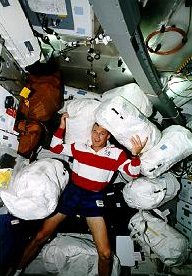
Shuttle pilot
Terry Wilcutt with 7 contingency water containers destined
for the space station Mir.
|
"We have plenty of water on the Space
Station now," says Jim Reuter, leader of the ECLSS group at the
Marshall Space Flight Centre. "The Russian module Zarya is packed
with contingency water containers (CWCs) that were carried over
from the Space Shuttle during assembly missions earlier this year.
They look like duffle bags and each one holds about 90 lbs."
"But it's expensive to ferry water
from Earth," he added. "We have to recycle. There's already a Russian-built
water processor in orbit that collects humidity from the air. Here
at Marshall we're building a regenerative system that will be able
to recycle almost every drop of water on the station and support
a crew of seven with minimal resupplies."
The ECLSS Water Recycling System (WRS),
developed at the MSFC, will reclaim waste waters from the Space
Shuttle's fuel cells, from urine, from oral hygiene and hand washing,
and by condensing humidity from the air. Without such careful recycling
40,000 pounds per year of water from Earth would be required to
resupply a minimum of four crewmembers for the life of the station.
Not even research animals are excused
from the program.
"Lab animals on the ISS breath and
urinate, too, and we plan to reclaim their waste products along
with the crew's. A full complement of 72 rats would equal about
one human in terms of water reclamation," says Layne Carter, a water-processing
specialist.
It might sound disgusting, but water
leaving the space station's purification machines will be cleaner
than what most of us drink on Earth.
"The water that we generate is much
cleaner than anything you'll ever get out of any tap in the United
States," says Carter. "We certainly do a much more aggressive treatment
process (than municipal waste water treatment plants). We have practically
ultra-pure water by the time our water's finished."
Mimicking Mother Earth
On Earth, water that passes through
animals' bodies is made fresh again by natural processes. Microbes
in the soil break down urea and convert it to a form that plants
can absorb and use to build new plant tissue. The granular soil
also acts as a physical filter. Bits of clay cling to nutrients
in urine electrostatically, purifying the water and providing nutrients
for plants.
Water excreted by animals also evaporates
into the atmosphere and rains back down to the Earth as fresh water
-- a natural form of distillation.
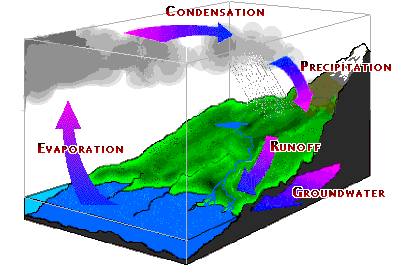
When water
evaporates from the ocean and surface waters, it leaves behind
impurities. In the absence of air pollution, nearly pure
water falls back to the ground as precipitation.
|
Water purification machines on the
ISS partly mimic these processes, but they do not rely on microbes
or any other living things.
"While you try to mimic what's happening
on Earth -- which is so complicated if you really think about it
-- we have to use systems that we can control 100 percent," said
Monsi Roman, chief microbiologist for the project. ECLSS depends
on machines - not microbes - because, "if a machine breaks, you
can fix it."
The water purification machines on the ISS will cleanse wastewater
in a three-step process.
The first step is a filter that removes
particles and debris. Then the water passes through the "multi-filtration
beds," which contain substances that remove organic and inorganic
impurities. And finally, the "catalytic oxidation reactor" removes
volatile organic compounds and kills bacteria and viruses.
Every Drop Counts
Once the water is purified, astronauts
will do everything possible to use it efficiently. "On the ground,
people flick on the faucet and they probably waste a couple of litres
of water just because it's free and the water pressure is high,"
notes Carter.
"On the ISS, the water pressure will
be about half what you might experience in a typical household,"
Carter said. "We don't use faucets on the ISS, we use a wash cloth.
It's much more efficient. If you're an astronaut, you'll wet the
wash cloth with a spray nozzle and then use the cloth to wash your
hands."
On the space station, people will wash
their hands with less than one-tenth the water that people typically
use on Earth. Instead of consuming 50 litres to take a shower, which
is typical on Earth, denizens of the ISS will use less than 4 litres
to bathe.
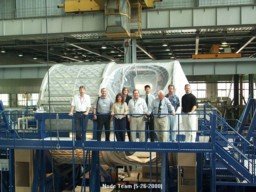
One of the
"nodes" that will become a part of the Space Station. The
ECLSS life support equipment will be housed in Node 3, which
is scheduled to be attached to the station in October 2005.
|
Even with intense conservation and
recycling efforts, the Space Station will gradually lose water because
of inefficiencies in the life support system.
"We will always need resupply, because
none of the water reprocessing technology that is available right
now for space flight ... is 100 percent efficient. So there's
always some minimal loss," said Marybeth Edeen, deputy assistant
manager of environmental control and life support at NASA's Johnson
Space Centre
Water is lost by the Space Station
in several ways: the water recycling systems produce a small amount
of unusable brine; the oxygen-generating system consumes water;
air that's lost in the air locks takes humidity with it; and the
CO2 removal systems leach some water out of the air, to name a few.
Lost water will be replaced by carrying
it over from the Shuttle or from the Russian Progress rocket. The
Shuttle produces water as its fuel cells combine hydrogen and oxygen
to create electricity, and the Progress rocket can be outfitted
to carry large containers of water.
NASA scientists will continue to look
for ways to improve the life support systems of the Space Station,
reducing water losses and finding ways to reuse other waste products.
If the water recycling systems can be improved to an efficiency
of greater than about 95 percent, then the water contained in the
Station's food supply would be enough to replace the lost water,
Edeen said.
"It takes processes that are slightly
more efficient than we have developed for the space station to do
that," Edeen said. "Those are the next generation water processing
systems. Those are being developed now, but they're not ready
for space flight yet."
The ECLSS life support system will
join the Space Station as part of Node 3, which is scheduled to
launch in October 2005. Until then, the environment inside the ISS
will be maintained primarily by life support systems on the Russian
Zvezda Service Module.
|


