|
'Like
a muscle-bound movie hero, it withstands attacks from acid baths,
high and low temperatures, and even radiation doses. Then, in a
science fiction sequel, it dispenses lifesaving medications and
reshapes a planet for new settlers.' In this article we explore
Surviving Life on Mars.
by
Dave Dooling
Like a muscle-bound
movie hero, it withstands attacks from acid baths, high and low
temperatures, and even radiation doses. Then, in a science fiction
sequel, it dispenses lifesaving medications and reshapes a planet
for new settlers.
And in true
Hollywood fashion, the star of this epic had humble beginnings,
living in cow pats and elephant dung, and coming to the attention
of scientists when it refused to die in food sterilisation tests.
You need a microscope
to see this miniature future hero listed as Deinococcus radiodurans
and known to its fans as Conan the Bacterium.
"Deinococcus
radiodurans (DR) beats most of the constraints for survival
of life on Mars - radiation, cold, vacuum, dormancy, oxidative damage,
and other factors," said Dr. Robert Richmond, a research biologist
at NASA's Marshall Space Flight Centre. With other scientists, he
is investigating the possible use of DR to serve human exploration
to inhospitable locations.
Humble origins
Richmond and his colleagues see DR as playing the part of possible
Martian microbes in simulations to help direct the search for life
on Mars. Next, it could be genetically altered to produce medicines
for astronauts in the short-term, rather than hauling an entire
pharmacy along on the trip, and restructuring Mars for human habitation
in the long-term.
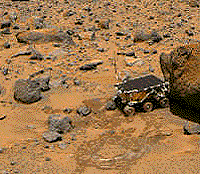
NASA and Jet Propulsion Laboratory
"Is
anybody home?" The Sojourner Mars Rover nuzzles up to Yogi,
a rock near the Mars Pathfinder lander.
|
With R. Sridhar
of Howard University Medical Centre in Washington, DC and Dr. Michael
J. Daly of the Uniformed Services University of the Health Services
in Bethesda, Richmond presented a paper at a Conference in Denver
on DR.
Daly and his
co-workers, in an article in Science Magazine, announced
that they had completed sequencing the genome of DR. This opens
the way for exploitation of its genes for use by future explorers
on Mars.
"Radiodurans'
beginnings are thought to be from early Earth," Richmond said, and
paralleled a time when the environment may have also approximated
that existing on Mars for a few hundred million years. Given the
presumed sharing of debris generated from meteorite impacts amongst
the early planets, origins of DR might even be accidentally common
between Mars and Earth. "By nature, it is selected to survive radiation
damage very well," DR can withstand without loss of viability a
dosage that is 3,000 times greater than what would kill a human.
"The fact that you can genetically engineer these things is the
key to the utility of this bug."
It's heady stuff
for a primitive organism.
But DR has a
feature that is considered all-important in aerospace: redundancy.
Its genetic code repeats itself many times so that damage in one
area can be recognised and quickly repaired. Coupled with its range
of other survival characteristics, DR has been dubbed an polyextremophile
by Richmond, Sridhar, and Daly.
Extremophiles
have been known to scientists for decades but often were regarded
as laboratory oddities. The discovery of what appears to be nanobacteria
(or nanobes, smaller than microbes) in a meteorite from Mars (see
our article 'Life
on Mars?') catapulted extremophiles into the spotlight as a
model for possible lifeforms on Mars.
The debate over
whether the meteorites forms ever were nanobes (or just non-living
imitations) led to discoveries of probable nanobes living in such
odd places as human kidney stones and in limestone 4 kilometres
under the surface of the Earth.
A common
link?
"We have a new door opening on the possibilities of lifeforms,"
Richmond said, "not just new species but whole new life forms that
could connect to the origins of life on Earth and could be a common
link to the possible beginnings of life on Mars."
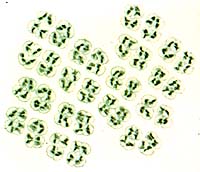
M. Daly
A growing bacteria
|
Most extremophiles
have optimised themselves for one or two extreme conditions and
settled into wonderful ecological niches like the hot springs of
Yosemite. Radiodurans has been dubbed a polyextremophile because
it can endure many extremes, including the most dangerous space
hazard, radiation.
"Radiation-induced
DNA damage is an oxidising type of damage," Richmond said. It happens
when radiation energises an atom enough to break a chemical bond
and then act like an atom of oxygen and bind with another atom.
Such free radicals have been implicated in a range of cancers and
genetic mutations.
DR though, is
hypothesised by Daly to resist such damage by virtue of repair specialised
to utilise its redundant strands of DNA. This also means that it
should resist damage from the chemistry of Mars, which chemical
experiments done by the labs aboard the two Viking landers indicate
may be highly oxidative.
DR was discovered
in the 1950s. Scientists experimenting with radiation to kill bacteria
and preserve food for long periods found that something kept growing
back after treatment.
It remained
a laboratory oddity for several years until the arrival of genetic
engineering, the science of altering an organism's basic biological
code, sometimes by splicing into it portions of another organism's
code. Daly's group is inserting specialised genes to help in eliminating
dangerous chemicals from waste sites. An established example of
the value of such genetic engineering is found with E. coli,
the bacteria found in the human gut, that has been engineered to
produce large quantities of human insulin, which once had to be
refined from human cadavers.
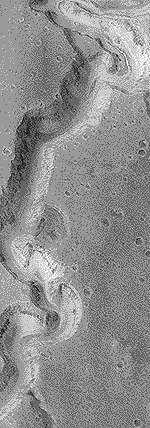
NASA and Jet Propulsion Laboratory
The 200-meter-wide (660 ft) Nanedi Valley is one of several
sites on Mars
that show evidence that the planet once had running water.
|
"Daly has been
active in developing DR as a special model for bioremediation to
clean radioactive supersites left over from the Cold War," Richmond
explained. Some of those sites contain radioactive materials that
are not easily removed by other microbes. While some other bacteria
are being genetically engineered to thrive in toxic conditions while
converting hazardous waste into reusable effluent, none can resist
radiation the way D. radiodurans can.
Already, Daly
and his colleagues have devised DR variants that can clean up mercury,
a deadly heavy metal, and toluene, a dangerous solvent. This work
was sponsored by the US Department of Energy.
The capability
to insert genes also makes D. radiodurans a candidate for
Mars pharmacists and to become "the plow that broke the plains"
on Mars.
But first, it
may help the search for life on Mars as a stand-in for Martian microbes
in simulated Mars environments.
The
changing face of Mars
Mars has gone through radical changes in our perception
as a haven for life. After Sir Percival Lowell and a number of science
fiction stories popularised Mars as a dying planet, US space probes
in the 1960s and 1970s rewrote the book to show Mars as long dead,
perhaps never alive.
Then came the
discoveries hidden inside ALH84001(see our article 'Life
on Mars?'). Soon thereafter, images and data from the Mars Global
Surveyor, Mars Pathfinder, and Sojourner Rover spacecraft showed
Mars indeed has significant quantities of water, and once had running
water.
While Mars has
become more tantalising, it is far from Eden. So the question is,
if life was there, or is there, what are the best places to find
it? Spacecraft surveying the planet to determine where water might
survive beneath the surface, or where it once may have existed,
are addressing this.
Even within
those regions, you have to figure out which spots are best since
a lander will have limited time and resources compared to the open
wilds of Mars. One approach is to culture DR in Mars simulations
on Earth.
"We are restricted
in the search for life right now to Earth-based microbes," Richmond
explained. "We have to ask, What are the restraints on life that
those microbes will have to surmount in order to plausibly exist
on other planets?"
Extremophile
habitats on Earth cover a range of conditions: temperatures near
boiling or below freezing; a nearly total lack of water, or water
that ranges from alkaline to acidic or salty; non-carbon foods;
and a lack of oxygen. One of the tricks that less durable lifeforms
use to survive such tough times is to hibernate as spores.
"The restraints
become temporal, too," Richmond explained. "Dormancy has to carry
on for thousands or millions of years" if a life form is to last
until conditions on Mars become hospitable for growth, somewhat
like the floral seeds waiting in the desert for the rare fall of
rain.
And that's where
radiation resistance comes in handy. While radiation issues are
usually associated with nuclear power or exposure to the space environment,
it is not commonly recognised as being inescapable. We are exposed
through our entire lives to potassium-40, radon, carbon-14 and other
radioactive sources. Living in the mountains or flying also increases
exposure slightly.
Surviving
a long winter's nap
But the total dosage from these is small during our
lifespans, so the impact normally is insignificant. However, for
an organism in hibernation for a million years or so, the cumulative
exposure can be like sitting inside a reactor for several minutes.
That's why crawling
under a rock to escape solar ultraviolet light on Mars is not a
perfect strategy. The rock itself emits trace quantities of radiation
over time.
"Within responsible
imagination, no long-dormant lifeform can be expected on the surface
of Mars due to combined build up of damage over time caused by both
incoming space radiation plus the background radiation," Richmond
said. The best hope is that life got started some billions of years
ago when conditions were more hospitable, and that a few microbes
adapted to extreme conditions or learned how to hibernate below
the surface.
"But if they
wake up too late, they run into the ultimate restriction, too much
radiation damage that has accumulated if it's not repaired," Richmond
said. "At that point, the population is dead."
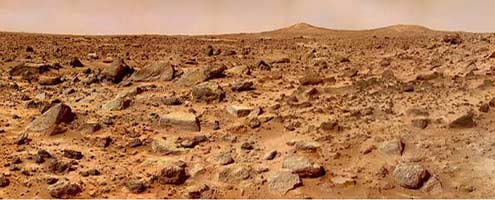
NASA and Jet propulsion Laboratory
"Water,
water, everywhere, and not a drop to drink." Mars Pathfinder
landed in what was once a flood plain, as geologists deduce
from the way rocks are arranged. Whatever water is left on
Mars, though, is in polar ice caps and subsurface ice.
|
So even if something
like DR evolved on early Mars, it is possible that winter has lasted
too long for any survivors to reawaken in the artificial spring
of a petri dish.
Even so, DR
may yet travel to Mars as a Pharmacist's Mate First Class.
"Because of
genetic engineering, you might do a lot with this bug to enhance
the survivability of man in extraterrestrial environments," Richmond
said. Altering the human genome to take on survival characteristics
like DR is far too complex a task at the moment. But D. radiodurans
could be altered to serve man.
"The interesting
things about the drugs we use is that about two-thirds are natural
products or derived from natural products," Richmond said. "Anything
that is a natural product ultimately comes down to a gene and can
be genetically managed, in theory."
Living
off the land - after you reshape it

NASA
Colonise Mars?
|
Richmond, Sridhar,
and Daly suggest that DR can be genetically manipulated to produce
various drugs that humans might need while exploring Mars, then
put on ice during the mission. If someone became ill, treatment
would start with drugs in from a small supply kept on hand, while
the appropriate bugs were awakened to produce a regular supply.
With such an approach, the issues of shelf life for drugs could
also be circumvented. This would also reduce the weight that a spaceship
would have to haul to Mars and back.
Engineered versions
of RD could help humans to set up camps or homesteads on Mars through
recycling waste - producing clean water and oxygen - and perhaps
even food supplements. "Its own food stock might even be Mars,"
Richmond suggested, giving new meaning to "living off the land."
Again, the bug's genetic design might help ensure a renewable grocery
store for explorers.
The ultimate
step would be the popular notion of terraforming, reshaping the
environment of Mars to make it more hospitable to humans. Terraforming
was first performed by ancient lifeforms that converted Earth's
environment from a carbon dioxide atmosphere and calcium-rich seas
to the more hospitable world we have today. Because these early
lifeforms spoiled their home, they now survive in what we consider
to be extreme environments.
Mars, too, is
considered to be an extreme environment. But with a little help
from D. radiodurans, it may be made more accessible and,
eventually, attractive. After all, as the old saying goes, "The
difficult we do now. The impossible takes a little longer."
|

