|
The Cassini spacecraft has photographed an
extraordinary dark cloud on Jupiter twice as big as Earth itself.
by Dr Tony Phillips
For more than a century
astronomers thought that the Great Red Spot was the biggest thing
on Jupiter. Not anymore. Images from NASA's Cassini spacecraft have
revealed something at least as large.
The Great Dark Spot.
"I was totally blown
away when I saw it - a dark cloud twice as big as Earth swirling
around Jupiter's north pole," says Bob West, a planetary scientist
at the Jet Propulsion Laboratory.
West has been chasing
this cloud for some time. He first saw it - "just a glimpse," says
West - in an ultraviolet (UV) picture of Jupiter taken by the Hubble
Space Telescope in 1997. But it only appeared in one image out of
many spanning a period of years. "I didn't know what to make of
it," he recalls.
Now he knows. "The
Cassini spacecraft was en route to Saturn in 2000 when it passed
by Jupiter and had a good view of the planet's north pole," says
West. "At first there was nothing unusual - just ordinary polar clouds.
Then the Dark Spot emerged." For weeks Cassini's UV-sensitive cameras
watched as the cloud grew into an oval the size of the Great Red
Spot itself. It swirled, darkened and changed shape until, as Cassini
was departing, it began to fade again.
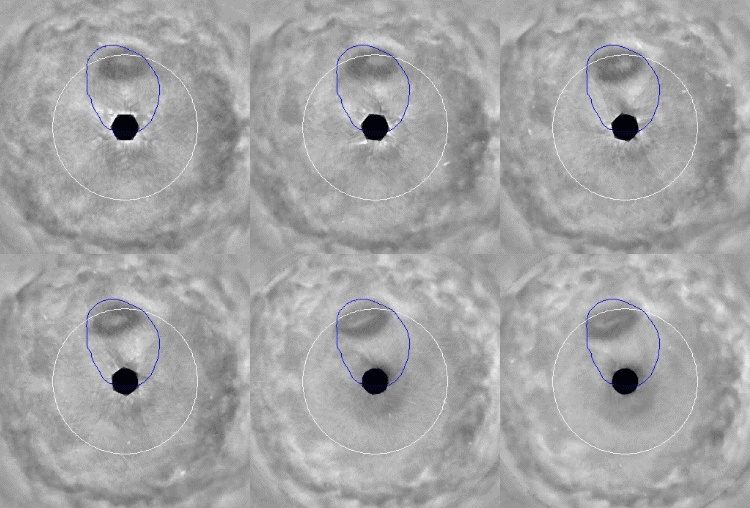
more
This composite
of Cassini ultra-violet (UV) images reveals the "Great Dark
Spot" swirling near Jupiter's north pole. Jupiter's auroral
zone is denoted by the blue curve.
|
"The Dark Spot is ephemeral,"
says West. That's probably why Hubble saw it only once. And if Cassini
had arrived a month or two later, it might not have seen the Dark
Spot at all. Instead, Cassini's cameras monitored the cloud for
11 straight weeks, and those data have allowed West to draw some
conclusions.
"The Great Dark Spot and the Great Red Spot are entirely different,"
he says. The Great Red Spot is deep. "It's a high-pressure storm
system rooted in Jupiter's troposphere far below the cloudtops.
The Great Dark Spot is apparently shallow and confined to Jupiter's
high stratosphere."
West believes the Dark
Spot is a curious side-effect of auroras on Jupiter.
"Jupiter has Northern
Lights just as Earth does, although on Jupiter they are hundreds
to thousands of times more powerful," says West. Auroras happen
when electrons and ions rain down on the polar atmosphere and cause
the air to glow where they hit. Here on Earth, auroras are usually
sparked by solar wind gusts. The solar wind can also trigger auroras
on Jupiter, but it's not necessary: On Jupiter, the planet itself
energizes Northern Lights. "Jupiter's magnetic field is a huge reservoir
of charged particles," explains West. "These particles are accelerated
poleward by the 11-hour rotation of Jupiter and its magnetic field.
Thus, auroras on Jupiter are almost always active."
"High-energy electrons
that hit Jupiter's atmosphere not only cause auroras, but also break
apart methane (CH4), which is more abundant on Jupiter
than it is on Earth," says West. "Fragments of methane molecules
combine with ambient hydrogen to form acetylene C2H2.
That's the basic building block. Acetylene combines with other carbon-
and hydrogen-containing molecules to build even more complex molecules,
which eventually condense into dark droplets."
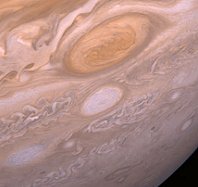
more
The Great
Red Spot is a long-lasting storm rooted deep in Jupiter's
atmosphere.
|
If West is right, the
Great Dark Spot is a haze of hydrocarbon-rich droplets floating
in the uppermost layers of Jupiter's stratosphere. Such a haze would
be prominent in UV images because hydrocarbon droplets are strong
absorbers of UV radiation. Indeed, the Great Dark Spot is invisible
to the human eye. "It can only be seen in UV light."
His idea fits the facts,
but West remains puzzled: "There was no strong auroral display when
the Great Dark Spot intensified in late 2000. What caused it to
appear when Cassini was flying by? We don't know. This shows us
that Jupiter's stratosphere is a more interesting place than we
once thought."
Furthermore, it can
teach us something about our own planet.
West explains: "This
dark spot is trapped by a polar vortex - a jet stream that encircles
Jupiter's north pole." Fast-moving winds in the vortex act like
an atmospheric wall, keeping the Dark Spot corralled at high latitudes.
Similar vortices encircle Earth's polar
regions. Our planet's Arctic vortex is disrupted somewhat by northern
land masses, but the Antarctic vortex is better organized. It plays
a key role in confining the ozone hole - much as Jupiter's polar
vortex confines the Great Dark Spot.
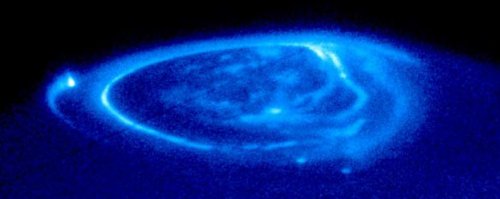
more
A Hubble
Space Telescope image of Northern Lights on Jupiter.
|
"Monitoring the Dark
Spot could help us understand how planetary vortices work." For
such studies, two planets are clearly better than one.
Meanwhile, West would
be delighted just to see the Dark Spot again. "It's elusive," he
says. But he's ready to be blown away ... any time.
|

