|
|
Dynamic Pulsating Eruptions
 |
|
One of the most explosive forms of volcanism may be the result of deep-seated magma rising rapidly to very shallow depths, triggering earthquakes and violent eruptions.
by Stephen Sparks
The eruption of the Soufriere Hills, Montserrat in the Caribbean began
in July 1995. Over 0.3 cubic kilometres of lava erupted over the next
3 years, causing widespread disruption to the island community. This
eruption became the focus of intense international scientific study
and some major advances in understanding how volcanoes work have emerged
as a result. By March 1998 the volcanic activity had diminished. The
volcano continued to rumble with occasional explosions and emissions
of ash, but the activity was sufficiently low for the islanders to
rebuild their lives and the scientists monitoring the eruption could
start to concentrate on analysing the huge amounts of data. Here I
describe some of the exciting new results that are emerging as this
research begins to pay off. New ideas stimulated by Soufriere Hills
and others similar volcanoes like Mount St Helens, USA are beginning
to transform our understanding of how these highly dangerous volcanoes
work.
Scientists have long imagined that a large body of magma in a chamber exists permanently a few kilometres beneath a volcano. It was believed that in the periods of dormancy this magma body slowly cooled and crystallised, and a mixture of crystals and molten rock erupted from time to time. When a larger eruption began this magma moved to the surface and either exploded or erupted as lava. The processes that occur during the journey of the magma to the surface were not really considered in any great detail. However the observations and ideas emerging from work on the Soufriere Hills and other volcanoes indicate that this kind of simplistic model may be wrong.
Volcanologists now believe that a large magma chamber didn’t exist at all under the Soufriere Hills. Its lavas contain features that suggest they were formed from a mixture of old solidifying magma invaded by an upsurge of fresh hot magma from much deeper in the Earth. They contain small blobs of dark basaltic rock that represents the telltale sign of deep, hot magma rising up into the volcano to remelt the in situ crystalline rocks and trigger a new eruption. Similar features have also been observed on many other volcanoes such as Mount Unzen in Japan and various volcanoes in the Andes. It seems that hot basaltic magma rapidly rises from great depth and invades the hot core of the volcanoes just a few kilometres beneath the surface. Here it transfers its heat and some of its gas, mostly water vapour, into the surrounding rocks. They then remelt, producing a crystal rich magma and an immediate eruption.
|
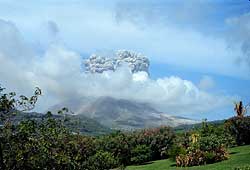
Soufriere Hill exploding -part I |
|
|
Photo - Barry Voight
|
|
Recently Jon Blundy from Bristol University, England teamed up with Kathy Cashman from the University of Oregon, US to study Mount St Helens, Washington state. Together they became convinced that many of the crystals in the lavas of Mount St Helens were formed not in some large magma chamber, but as a consequence of the decrease in pressure as the magma moved up from a much greater depth. As pressure decreases magma releases its dissolved gas, rather like gas escaping when a champagne or beer bottle is opened. The loss of gas causes the magma to solidify and crystallize. Like the volcanologists working on Monserrat, Blundy and Cashman also concluded that the existence of a magma chamber beneath Mount St Helens was perhaps an
illusion. During my own work on the Soufriere Hills eruptions I had also become convinced that a great deal of crystallization seen in the lavas occurred due to the loss of gas during magma ascent and that this feature might be the key to understanding the dynamics of the volcano. The escaping, bubbling gas may have caused the rising magma to turn from a mobile fluid into a strong stiff solid.
|
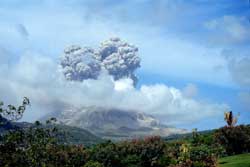
Soufriere Hill exploding - part II |
|
|
Photo - Barry Voight
|
|
|
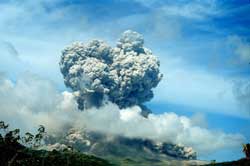
Soufriere Hill exploding -part III |
|
|
Photo - Barry Voight
|
|
What was needed to help understand the dynamics was a mathematical model of the magma’s rise to the Earth’s surface, the formation of the gas bubbles, the growth of crystals and the huge change in physical properties of the magma. Fortunately I started a very fruitful collaboration with Oleg Melnik from the Institute of Theoretical Mechanics at Moscow University who was already interested in volcanic flows and who was able to help me develop sophisticated and elegant mathematical models. Imagine a fluid with some gas dissolved at very high pressure, around 1000 atmospheres or more, coming up a very long tube, perhaps 5 km long. The tube has a diameter of about 30 metres and the fluid is a mixture of crystals and molten silicate rock at a temperature of about 850°C. At the top of the tube the pressure drops and all the gas dissolved in the fluid escapes and the material rapidly turns into a solid with a melting temperature of around 1100°C. During its journey up the tube the viscosity increases a billion times and the fluid turns into a strong stiff solid, creating a large blockage a few hundred metres below ground. Here earthquakes can occur as the material breaks up under the pressure of the escaping gases. Below the solidified and degassed magma pressure builds up and can sometimes lead to explosive failure of the magma. This model predicts many of the volcanic features we see on real volcanoes, including the pressurisation and eruptive cycles.
|
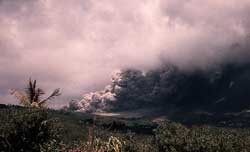
Pyroclastic flow down Soufriere Hill |
|
|
Photo - Stephen Sparks
|
|
I would also like to explain a little about the some remarkable observations that have emerged from detailed geophysical studies of the Soufriere Hills. Volcanoes breath and we were fortunate to have an instrument known as a tiltmeter placed by Barry Voight of Penn State University close to the active vent. This instrument is fundamentally an electronic spirit level and records very tiny changes of angle caused when the volcano either swells or subsides as the internal pressure changes. The data from the tiltmeter showed that the volcano pressure went up and down in regular cyclic patterns and that both earthquakes and eruptions were directly related to these cycles. In a typical cycle, lasting from a few hours to just over a day, the pressure inside the volcano went up and many shallow earthquakes were triggered. Despite the volcano swelling with new rising magma just a few hundred meters below the surface there was little surface activity. Each cycle would then climax with the shallow earthquakes dying away, the pressure reaching a maximum and some kind of volcanic event, such as a pulse of lava extrusion or, more dramatically, a large explosion. The pressure would then subside until a new cycle of pressurisation began. The cycles could be very regular for weeks on end. Since dangerous volcanic activity always occurred at the top of the cycle we were able to use our measurements to make short-term predictions and to help the Monserrat authorities manage the continuing crisis. For example, we were able to accurately identify the downward depressurising part of a cycle and allow telephone technicians to enter the danger zone in a safe period and make essential repairs at the exchange.
|
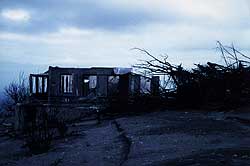
Devastation in Montserrat |
|
|
Photo - Stephen Sparks
|
|
There is a long way to go though. In November 1999 a new lava dome started to form at Soufriere Hills and there may yet be more activity. Volcanoes are never easy to anticipate. We are only just beginning to explore the consequences and complexities of this model for dynamic pulsating volcanism. By using mathematical modelling to help interpret the geophysical signals that are monitored in the field we may be able to improve the scientific basis for forecasting eruptions for this type of volcano.
|
| Stephen Sparks is Professor of Geology at the Department of Earth Sciences, Bristol University, UK. He is a specialist in the physics of volcanic processes and has worked on many active volcanoes throughout the world He has served on a number of occasions as Chief Scientist of the Montserrat Volcano Observatory. He is currently president of the International Association of Volcanology and Chemistry of the Earth’s Interior.
Stephen Sparks and David Lea's education video, "Monserrat's Andesite Volcano" is available from the Geological Society.
With thanks to Barry Voight at the Penn State University for his photos.
Copyright © FirstScience.com
|
|
|
