|
Solar power collected in space
and beamed to Earth could be an environmentally friendly solution
to our planet's growing energy problems.
by Steve Price
It's December 2000 and the governor
of California flips a switch illuminating the state Christmas tree
on the capital lawn. Twenty minutes later, he orders aides to pull
the plug. Why? Statewide power shortages.
The United States energy secretary
ordered a dozen out-of-state power companies to sell electricity
to California to avert blackouts. But it's not just California.
In metropolitan areas across the country,
residents are being asked to limit power consumption during peak
periods of the day. Last November, in the midst of the closest US
presidential election in history, Tom Brokaw referred to the electricity
shortages as "The Real Power Struggle."
So what's going on here?
"The United States consumption of energy
is almost flat," says Dr. Neville Marzwell, technical manager of
the Advanced Concepts & Technology Innovations program at NASA's
Jet Propulsion Laboratory. "But, we are decommissioning nuclear
plants across the country and they are not being replaced." Twenty-three
states have joined California in deregulation of the power industry,
a step which is forcing companies to take a longer look at investing
billions in construction of new power plants.
With the world's population projected
to skyrocket to 10 billion people by the year 2050, supplying cheap,
environmentally friendly electricity to meet basic needs will be
a daunting challenge.
"We need new sources of electrical
power," said John Mankins, Manager of Advanced Concepts Studies
at NASA Headquarters Office of Space Flight, "and we have been studying
a variety of space solar power concepts. Tremendous advances have
been made in many relevant technologies in the last fifteen years."
NASA
|
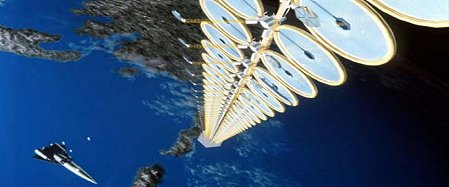
Imagine
providing the Earth or a moon base with harnessed solar
power, or ravelling in space without returning to Earth
for fuel. That's the idea behind space-based solar power
generators such as this SunTower.
|
|
|
NASA's involvement in space solar power,
or SSP for short, began after the oil embargo of the mid-1970's
when the space agency (working under the leadership of the US Department
of Energy) began to study alternative energy sources that might
result in less dependence on foreign oil.
Proposed space solar power systems
utilise well-known physical principles -- namely, the conversion
of sunlight to electricity by means of photovoltaic cells. Giant
structures consisting of row after row of photovoltaic (PV) arrays
could be placed either in a geostationary Earth orbit or on the
Moon. A complete system would collect solar energy in space, convert
it to microwaves, and transmit the microwave radiation to Earth
where it would be captured by a ground antenna and transformed to
usable electricity.
According to an April 2000 article
in the Electric Power Research Institute (EPRI) Journal, photovoltaic
arrays in a geostationary Earth orbit (at an altitude of 22,300
miles) would receive, on average, eight times as much sunlight as
they would on Earth's surface. Such arrays would be unaffected by
cloud cover, atmospheric dust or by the Earth's day-night cycle.
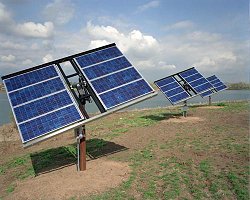
Credit: National Renewable Energy Laboratory.
Space solar arrays would enjoy
more exposure to the Sun than similar arrays do on our cloud-covered
planet.
|
When the idea was first proposed more
than 30 years ago, PV technology was still in its infancy. The conversion
efficiency rate -- the fraction of the sun's incident energy converted
into electricity -- was only 7 to 9 percent.
"We now have the technology to convert
the sun's energy at the rate of 42 to 56 percent," said Marzwell.
"We have made tremendous progress."
Even so, launching thousands of tons
of solar arrays into space will be expensive. But there may be a
way to reduce the needed area of the arrays -- by concentrating
sunlight.
"If you can concentrate the sun's rays
through the use of large mirrors or lenses you get more for your
money because most of the cost is in the PV arrays," said Marzwell.
A drawback to concentrated sunlight
is that it is hot. Focused radiation that's not converted to electricity
turns into heat -- enough to damage the arrays if there's too much
excess warmth. Marzwell and his colleagues at JPL are studying ways
to capture waste heat and convert it to electricity by means of
thermal voltaic processes. Special coatings on the mirrors and lenses
can also reject portions of the sun's spectrum that PV arrays don't
use, further reducing excess heat.
Once the Sun's energy is captured in
space, what do you do with it?
One possibility is to convert stored
solar energy to microwave radiation and beam it down to a combination
rectifier-antenna, called a rectenna, located in an isolated area.
The rectenna would convert the microwave energy back to DC (direct
current) power. According to Marzwell, the dangers of being close
to the microwave beam would be similar to the dangers of cell phone
transmissions, microwave ovens or high-power electrical transmission
lines.
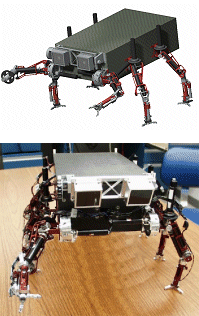
NASA
Who will assemble and maintain
an orbiting solar array? Possibly robots like these, under
development at NASA. "We don't need humans for assembly anymore,
except to supervise," said Marzwell.
|
"There is a risk element but you can reduce
it," said Marzwell. "You can put these small receivers in the desert
or in the mountains away from populated areas."
Lasers are also under consideration
for beaming the energy from space. Using lasers would eliminate
most of the problems associated with microwave but under a current
treaty with Russia, the US is prohibited from beaming high-power
lasers from outer space.
All in all, the positive aspects of
such a system appear to outweigh the negative ones. Space-based
solar power offers energy from an unending source with no emissions
and very little environmental impact.
According to Marzwell, using today's
technology a space solar power system could generate energy at a
cost of 60 to 80 cents per kilowatt-hour. This estimate includes
construction costs for the first system.
"We believe that in 15 to 25 years
we can lower that cost to 7 to 10 cents per kilowatt hour," said
Marzwell. The market price today is around 5 to 6 cents per kilowatt-hour.
"With funding and support, we can continue
developing this technology," said Marzwell. "We offer an advantage.
You don't need cables, pipes, gas or copper wires. We can send it
to you like a cell phone call -- where you want it and when you
want it, in real time."
Mankins agreed. With a dedicated effort
and resources, he says, space solar power --just a dream today--
could become a reality in the decades ahead.
|