|
Seed pods from a commercial gardening experiment
aboard the ISS are back on our planet. The far-out pods could hold
the key to long-term habitation of space.
by Dr Tony Phillips and Patrick
L. Barry
When the space shuttle Atlantis returned
to Earth in July 2001, it brought home some unusual cargo - seed
pods grown in space. They were the harvest of an 8-week-long commercial
gardening experiment on board the International Space Station (ISS).
Astronauts on the ISS have been tending a batch of fast-growing
Arabidopsis plants (better known as "mustard weed") to discover
whether plants can complete their entire seed-to-seed life cycle
in a weightless environment.
Video from the experiment shows that
seed pods were produced by the space-borne plants. But scientists
aren't yet certain what's inside the pods.
"We are waiting for retrieval of the
payload to see whether or not seeds are indeed inside the seed pods,"
says Weijia Zhou, Principal Investigator for the ADVANCED ASTROCULTUREtm
plant growth chamber that harboured and nourished the seedlings
on the ISS. "Personally, I have a very high confidence level that
they will have seeds," he added.
Zhou is the Director of the Wisconsin
Centre for Space Automation and Robotics (WCSAR), a NASA Commercial
Space Centre that built the growth chamber. "This research is a
joint endeavour between WCSAR and Space Explorers, Inc. (SEI),"
explains Zhou. SEI is a private company specialising in the development
of educational products for schools. Data from the ADVANCED ASTROCULTURETM
experiment will allow SEI to complete an Internet-based multimedia
program called Orbital Laboratory, which students and educators
can use to study plant biology in classrooms.
If normal, healthy seeds were produced
as Zhou suspects, the experiment will be a good sign that future
astronauts can grow multiple generations of plants in space. Such
self-perpetuating gardens will be a practical necessity for humans
as they explore and colonise the solar system. Hardy space plants
could provide fresh food, oxygen, and even clean water for explorers
living for long stretches aboard orbiting outposts or on the Moon
and Mars.
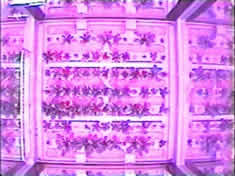
Image courtesy NASA Marshall Space Flight Centre.
A top-down view
of the ADVANCED ASTROCULTURETM
plant growth chamber on the ISS, 28 days into the experiment.
The leafy heads of the Arabidopsis plants are visible
in the reddish light, which is a frequency (colour) of light
that plants can utilise for photosynthesis.
|
Now that the plants are back on Earth,
scientists at WCSAR will analyse them to learn if growing in the
weightless environment of free-fall had any ill effects
"Most importantly, we need to see how
many seeds were produced," Zhou says. Comparing the fecundity of
the space-grown plants to a control group grown under identical
conditions on the ground will tell researchers whether the conditions
of growth - such as temperature, moisture, and fertiliser concentrations
- were indeed optimal.
"The second thing we need to do is
conduct a final chemical analysis of the seeds to find out if there
was a different phytochemistry involved," Zhou says. (Phytochemistry
is a term for the chemical make-up of a plant.) If there is a difference,
it would likely be caused by the weightless environment where the
plants were gardened, he added.
These seeds will be preserved for use
in a similar experiment to be flown to the ISS by a shuttle flight
currently scheduled for November 2001. Half of the seeds in that
experiment will be from this space-grown batch, and the other half
will be regular Earth-grown seeds. Comparing the plants and seeds
produced in this follow-up experiment will tell scientists whether
the conditions of space have any effect on subsequent generations
of plants.
Eventually gardens could become a routine
part of space travel. "NASA has announced a plan to sustain a long-term
human presence in space," notes Zhou. What are those astronauts
going to eat? "Are they going to eat all dehydrated food, or are
they going to get some fresh salad crops?" he asks.
Salads and vegetables are not only
good nutrition, but they could also offer an important psychological
boost to diners who have spent a long time in space. Eating reconstituted
foods from plastic bags is bound to grow tiresome eventually. Fresh
lettuce or broccoli might be a welcome change - even for kids.
Plants in space won't only be a source
of food -- they'll have other jobs to do as well, playing a critical
role in cutting-edge life support systems.
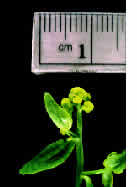
An Arabidopsis
plant with tiny seed pods at the top. The small size of the
plant was part of the reason researchers chose it for the
experiment aboard the ISS, where physical space is at a premium.
|
On Earth, photosynthetic organisms
like plants and algae provide a natural life support system for
the planet's many life forms. Plants and algae use energy from light
to split water molecules into hydrogen and oxygen. Then they combine
the hydrogen with carbon dioxide to make sugars, which serve as
food. Oxygen is released into the air as "waste." This serves as
a perfect compliment to other life forms such as animals and fungi,
which use the oxygen and respire carbon dioxide.
Taking a cue from nature, scientists
at NASA's Johnson Space Centre and Kennedy Space Centre are pioneering
next-generation "bioregenerative" life support systems, which use
plants rather than machines to perform the chemistry of life support.
Not only do plants release precious
oxygen, they can also help recycle drinking water. After some processing,
nutrient-rich waste-water can be used to water and fertilise the
plants. Much of the water absorbed by the roots will evaporate from
the leaves as pure water vapour. Condensing this water vapour. out
of the air creates virtually pure, distilled water that can be used
for drinking.
While elegant in theory, the fine details
of such a system must be worked out before plants and people can
live in a successful space-symbiosis. Learning to grow many generations
of plants in space is an early step toward that goal.
Many research teams at NASA and NASA-sponsored
university projects are experimenting with plant growth for space
missions, but Zhou's team is the only one at the moment that's actually
growing plants in space from seed to seed.
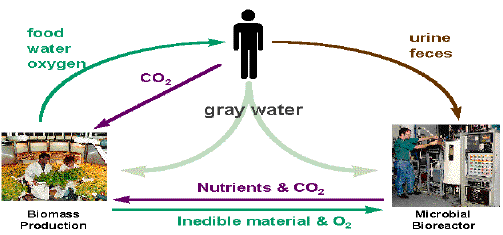
By mimicking
the cycles of nature, "bioregenerative" life support systems
may someday provide food, oxygen, and water to spacefarers
for long-term missions.
|
"What WCSAR and industry are doing
is rather unique," Zhou says. But researchers hope it will soon
be common. Fast-growing plants that thrive from generation to generation
in orbit will surely produce the seeds from which human exploration
of space will spring.
|

