|
By Anthony Little and David Perrett
What makes a face beautiful? What makes people seek out and desire
to mate with the owners of beautiful faces? In recent years, scientists
have turned to the theory of evolution to help us understand why
some faces are judged to be more attractive than others.
According to the evolutionary view, the attractiveness of individuals
is directly linked to their value as mates. A "high-value" mate
is someone who best enhances your reproductive success. Going back
into the evolutionary past of the human race, someone who noticed
the cues to the value of a potential partner, and intentionally
selected a high-value mate, would leave behind more children. These
children would tend to inherit genes for attentiveness.
Attention to attractiveness is thus part of our evolutionary design.
This scientific analysis is reflected in the fact that our magazines
and television screens are filled with attractive people. It's obvious
that both women and men are highly concerned with good looks in
a partner.
The same is true across the animal kingdom. A diverse range of
species relies on external factors to attract mates, such as the
size, shape, and colour of their feathers, fur and antlers. Why
has evolution accentuated these particular characteristics? A variety
of mechanisms may be responsible. The most obvious is that attractiveness
is associated with the quality of an individual's genes.

PhotosToGo
A
peacock provides a peahen with nothing but a set of genes
for their potential offspring. He must convince her that his
genes are the very best available
|
The testosterone link
One link between "good genes" and attraction could be the masculine
face-shape.
We can all spot the difference between the faces of grown men and
women, and researchers have identified the reasons why. Boys and
girls have similar face shapes. At puberty, hormones act on their
faces to masculinise or feminise them and produce distinctive features
of mature men and women. Testosterone provokes the growth of certain
facial features - such as the jaw and cheekbones - so boys' faces
grow more than girls'. Female faces remain relatively childlike.
High levels of oestrogen in growing girls prevents the growth of
facial bone, and leads to increased thickness of lips and fat deposition
in the cheek area.
Theoretically, men with more 'masculine' faces should be more attractive,
because there are evolutionary costs involved in developing such
characteristics. The reason comes back to the testosterone levels
associated with the very male face-shape. Testosterone decreases
the effectiveness of the body's immune system, and so only healthy
individuals with high quality immune systems can afford to produce
the hormones required to produce masculine characteristics.
The quality of our immune systems is linked to our genes. So an
attractive masculine face should reflect the attractiveness of underlying
good immunity genes.
Macho-face and baby-face
Faces with masculine features - such as a large jaw and prominent
cheekbones - appear dominant, and dominance is associated with male
reproductive success in many species, including humans.
University
St.Andrews
These
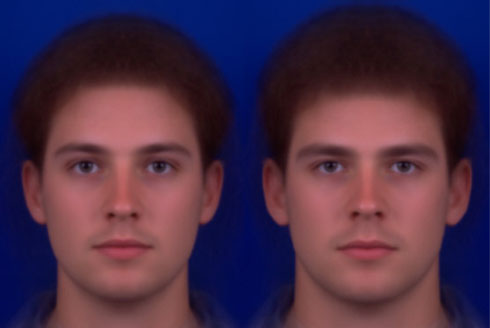
faces are averages of 20 males. The face on the left has been
moved towards a typical female shape, and that on the right
towards a typically male shape
|
For example, surveys show that male teenagers with dominant facial
features report sexual intercourse at an earlier age than less dominant
looking adolescents. In some situations facial dominance can predict
career success. Researchers have found, for instance, that the facial
dominance of graduates from a military academy predicts their final
rank at the end of their careers. Increasing testosterone also has
negative effects. Married men with high testosterone are more likely
to suffer troubled relationships and to have extramarital affairs.
At the other extreme are feminine or 'baby-like' faces, characterised
by smaller chins, high eyebrows and larger eyes. Both men and women
with baby-like faces are seen as being warmer, more honest, and
more sincere - but also more naïve and less physically strong. In
simulated court trials, baby-faced individuals are less likely to
be found guilty of charges involving intentional criminal behaviour.
They are also given lighter sentences. Both results reflect the
effects of attributed naïvety and honesty.
These stereotypes appear to reflect reality. Researchers have found
that the more baby-faced a man looks, the more he perceives himself
as approachable and warm, and the lower he ranks in terms of aggression.
In other tests, people whose faces were rated as being 'less honest'
were more likely to volunteer for experiments that involved them
in deception than people who were judged to look more honest.
Reading a face
Our research here at the University of St Andrews has demonstrated
that people both in the UK and Japan prefer a feminised male face-shape
to a masculinised one. This finding probably reflects the fact that
people read different personalities into subjects' face shapes.
They tend to associate feminised male faces with positive traits
such as honesty, warmth, co-operation and skill as a parent. Conversely,
traits such as dominance are associated with masculinised face shapes.
The personality of a potential partner is an important factor in
reproductive success, so it's not surprising that the personality
people 'read' from a face influences their perception of how attractive
that face is. Femininity in male faces may be attractive because
it is associated with positive personality traits.
But the matter is not as simple as that. Other studies have shown
that people find masculinity and dominance in male faces to be attractive.
The contradictory findings may reflect the costs and benefits of
masculine and feminine faced males. A high status/testosterone partner
may offer good immunity genes but such a partner may possess negative
personality traits and be more likely to desert the female who chooses
him.
A resolution to this conflict could be that very attractive male
faces possess a combination of both masculine and feminine features.
The most attractive faces could indicate both a dominant and a co-operative
partner.
Manly men and short-term relationships
We all know - often to our cost - that relationships are very variable
in duration: some last for a long period time, while others are
over in a single night. How long a relationship lasts is dependent
on the choices of both the individuals involved in it - and that
may be reflected in face shapes.
Masculine-faced males are thought to make poor parents but have
high quality genes, so they may make bad long-term partners but
be attractive in the short-term. Conversely, feminine-faced males
are seen as better parents and more co-operative, and so we might
expect that they would make attractive long-term partners.
We recently tested this idea with an experiment conducted on British
television, which involved over 18,000 participants. We presented
images of a masculine-faced male and a feminine-faced male, along
with two dating adverts. The viewers had to link each male with
one of the adverts. The only difference in the adverts was the potential
length of the relationship sought: short-term or long-term.
We found that people associated the masculine-faced male with this
advert:
Attractive, young (single) professional, back in town for short
period, likes pubbing, clubbing, being funny and plenty of sports,
would like to meet someone for fun and laughter.
And they associated the feminine-faced male with this advert:
Attractive, sporty, young, single, male with good sense of humour,
professional job, looking to settle, into pubs, clubs etc, seeks
someone fun for love and to cherish forever.
The results show that people think men with masculine faces are
more likely to pursue short-term relationships, while more feminine-faced
men are thought to be interested in long-term relationships. Why?
Possibly people think that masculine-faced males are likely to invest
less in relationships than feminine-faced men. Or women may select
more masculine-faced males for short-term relationships.
Time of the month
Other research at St Andrews suggests a reason why females may
show preferences for masculinity in some studies and femininity
in others: they employ a mixed mating strategy, which varies with
their menstrual cycle.
According to the St Andrews results, women prefer more masculine
faces at peak fertility in their cycle - when they are most likely
to become pregnant. This implies that women are more attentive to
good immunity genes when they are most likely to conceive, and at
this time they are less interested in the long-term potential investment
from feminine-faced males.
Work on the timing of affairs has shown that flings or affairs
tend to coincide with a woman's peak fertility. Putting together
the two findings - masculine male faces are more attractive at peak
fertility when affairs are most likely and they are also associated
with short-term relationships - suggests that women may be making
the best of both worlds. They take a more feminine male partner
for long-term investment, while occasionally having affairs or short-term
relationships with masculine males to provide good immunity genes
for some of their children.
More to see on DVD
Find out just how different men and women are in Discovery’s acclaimed DVD ’Science of the Sexes’ now on sale for only $4.95

|