|
Researchers have discovered a weird new phase
of matter called fermionic condensates.
by Patrick L Barry and Dr Tony
Phillips
We learned it in grade
school. There are three forms of matter: solids, liquids and gases.
But that's not even
half right. There are at least six: solids, liquids, gases, plasmas,
Bose-Einstein condensates, and a new form of matter called "fermionic
condensates" discovered by NASA-supported researchers.
"This is a very exciting
time," says University of Colorado/NIST physicist Deborah Jin, lead
scientist for the group who produced the first fermionic condensate
in Dec. 2003. "My group works extremely hard these days. Both
the excitement of a major advance and the competition to be first
have been driving forces."
Most second graders
can recite the properties of ordinary solids, liquids, and gases.
Solids resist deformation. They're stiff and they can crumble. Liquids
flow, they're hard to compress, and they assume the shape of their
container. Gases are less dense, they're easy to compress, and they
not only assume the shape of their container ... they expand to
completely fill it.
News of their landmark
achievement appeared in the January 24-30th 2004 online
edition of Physical Review
Letters.
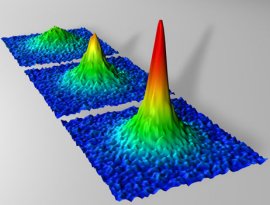
Copyright Markus Greiner. More
False-colour
snapshots of a growing fermionic condensate.
|
The fourth form of
matter, the plasma, is gas-like, made of atoms that have been ripped
apart into ions and electrons. The sun is made of plasma, as is
most of the matter in the universe. Plasmas are usually very hot,
and you can keep them in magnetic bottles.
The fifth form, the
Bose-Einstein condensate (BEC),
discovered in 1995, appears when scientists refrigerate particles
called bosons to very low temperatures. Cold bosons merge to form
a single super-particle that's more like a wave than an ordinary
speck of matter. BECs are fragile, and light travels very slowly
through them. (Read "A
New Form of Matter" to learn more about BECs.)
Now we have fermionic
condensates--so new that most of their basic properties are unknown.
Certainly they're cold. Jin created the substance by cooling a cloud
of 500,000 potassium-40 atoms to less than a millionth of a degree
above absolute zero. And they probably flow without viscosity. Beyond
that...? Researchers are still learning.
"When you find
a new form of matter," notes Jin, "it takes a while to
understand it."
Fermionic condensates
are related to BECs. Both are made of atoms that coalesce at low
temperatures to form a single object. In a BEC, the atoms are bosons.
In a fermionic condensate the atoms are fermions.
What's the difference?
Bosons are sociable;
they like to get together. As a rule of thumb, any atom with an
even number of electrons + protons + neutrons is a boson. So, e.g.,
ordinary sodium atoms are bosons, and they can merge to become Bose-Einstein
condensates.
Fermions, on the other
hand, are antisocial. They are forbidden (by the "Pauli Exclusion
Principle" of quantum mechanics) to gather together in the
same quantum state. Any atom with an odd number of electrons + protons
+ neutrons, like potassium-40, is a fermion.
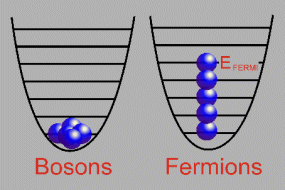
more
Bosons
are social; fermions are antisocial.
|
Jin's group found a
way around the antisocial behaviour of fermions. They used a carefully
applied magnetic field to act like a fine-tunable "Cupid."
The field causes loner atoms to pair up, and the strength of that
pairing can be controlled by adjusting the magnetic field. Weakly
paired potassium atoms retain some of their fermionic character,
but they also behave a bit like bosons. A pair of fermions can merge
with another pair--and another and another--eventually forming a
fermionic condensate.
Jin suspects that the
subtle pairing of atoms in a fermionic condensate is the same pairing
phenomenon seen in liquefied helium-3, a superfluid. Superfluids
flow without viscosity, so fermionic condensates should do the same.
A closely related phenomenon
is superconductivity. In a superconductor, paired electrons (electrons
are fermions) can flow with zero resistance. There is intense commercial
interest in superconductors because they could be used to produce
cheaper, cleaner electricity, and to build high-tech marvels like
levitating trains and ultra-fast computers. Unfortunately, superconductors
are difficult to handle and study.
Fermionic condensates
might help.
The biggest problem
with today's superconductors is that -135°C is the warmest temperature
at which any of them can operate. The liquid nitrogen or other cryogenics
needed to cool the wires down make any apparatus using superconductors
expensive and bulky. Engineers would rather work with superconductors
at room temperatures.
"The strength of pairing
in our fermionic condensate, adjusted for mass and density, would
correspond to a room-temperature superconductor," notes Jin. "This
makes me optimistic that the fundamental physics we learn through
fermionic condensates will help others design more practical superconducting
materials."
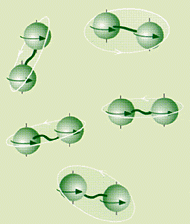
Pairs
of fermions can get together and act like bosons. In this
diagram, the spins of paired particles are aligned. In
Jin's work they are opposite.
|
NASA has many uses
for superconductors. For instance, gyros that keep satellites oriented
could use frictionless bearings made from superconducting magnets,
improving their precision. Also, because superconductors can carry
the same amount of current as copper in a much smaller wire, the
superconducting electric motors aboard spacecraft could be 4 to
6 times smaller than ordinary motors, saving precious volume and
weight.
Others speculate that
superconductors could play a role in a permanent Moon base, such
as the one in President Bush's recently announced vision for future
human exploration of space. Superconductors would be a natural choice
for ultra-efficient power generation and transmission, because ambient
temperatures plummet to -173 °C during the long lunar night.
And during the months-long journey to Mars, a "table top" MRI machine
made possible by superconducting wire would be a powerful diagnosis
tool to help ensure the health of the crew.
The Moon. Mars. There's
no telling where fermionic condensates might take us. Definitely
beyond grade school....
Writer's note:
This story mentions six phases of matter: solids, liquids, gases,
plasmas, BECs and fermionic condensates. Physicists debate the total.
You could add to the list many other forms such as liquid crystals,
glasses, ferromagnets, paramagnets and so on. Do fermionic condensates
rightly belong among the major categories, like liquids and solids,
or with less fundamental subdivisions such as liquid crystals? This
question will be answered in the months and years ahead as researchers
learn more about the properties of coalescing fermions.
|

