|
Astronomers have learned that the centre of our Milky Way galaxy
harbours a long-sought black hole. But the finding has raised even
more questions than before.
by Trudy E Bell
In the most suspenseful detective stories,
the mystery deepens even as the plot reveals more clues. So has
it been in real life for astrophysicists investigating the centre
of our Milky Way galaxy. They hoped that NASA's Chandra X-ray Observatory
would reveal a long-suspected black hole there - and indeed it did.
But Chandra's revelations have raised new questions that baffle
scientists perhaps even more than before.
A black hole is an object both so massive and
so compact that not even light itself can escape its staggering
gravity. For decades, theorists have argued that giant stars (ones
at least 10 times as massive as our Sun) routinely end their lives
as supernovas - catastrophic explosions that spray matter light-years
through interstellar space, leaving behind only a dense remnant
of the original star. If the remnant exceeds about 3 solar masses,
it will become a black hole.
In 1974, Astronomer Royal Sir Martin
Rees proposed that supermassive black holes - ones with a million
or even a billion solar masses - might exist within the centres
of some galaxies. The galaxies he had in mind have impressively
active nuclei (centres) that shine as brightly as 30 billion or
more Suns. They glow, unsteadily flickering, at all wavelengths
from radio to gamma rays, and they spew powerful jets of charged
particles into space. Rees reasoned that black holes gobbling matter
were the sources of such turmoil.
"There's no other way we can think
of that active galactic nuclei (AGNs) could put out so much energy,"
says Donald Kniffen, Chandra program scientist at NASA's Office
of Space Science at NASA headquarters. "The only accepted theory
is black holes." Furthermore, there's a dawning awareness that active
galaxies aren't the only ones that might harbour such "monsters
in the middle." Ordinary galaxies like the Milky Way have them,
too.
more
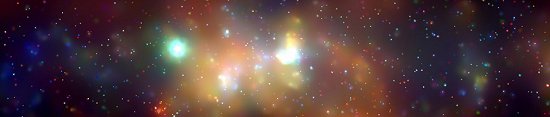
A Chandra
X-ray Observatory image of the central region of our Milky
Way galaxy. A supermassive black hole lurks inside the bright
white patch near the centre of the image.
|
In 1974, even as Rees was speculating
about black holes in active galaxies, American radio astronomers
Bruce Balick and Robert Brown were observing the relatively quiet
centre of our own galaxy. There they discovered a compact and variable
radio source that looked much like a faint quasar - a type of far-away
AGN that astronomers normally find near the edge of the observable
Universe. But this object was "only" 26,000 light-years away, in
our own cosmic backyard! Because it appeared to be inside a large,
extended radio source already known as Sagittarius A, they named
it Sagittarius A* (pronounced "A-star").
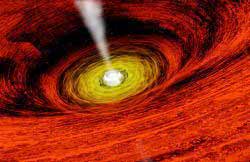
X-ray
telescopes like the Chandra X-ray Observatory can detect the
fiery glow from super-heated gas swirling into a black hole.
|
Over the next two decades, astrophysicists
painstakingly observed Sagittarius A* at radio, optical, and near-infrared
wavelengths. The breakneck speed (up to 1400 km/second) of gas and
stars swirling around in the centre of the Milky Way began to convince
them that something small yet massive - some 2.6 million solar masses
- was indeed lurking in our galaxy's centre Was it a supermassive
black hole, or just millions of closely packed more-or-less ordinary
stars?
Only X-ray observations could provide
definitive evidence - both because X-rays are a characteristic final
silent scream of matter as it is engulfed forever by a black hole,
and only X-rays can penetrate the thick gas and dust obscuring our
direct view of the galactic centre Thus, a race was on to be the
first to detect X-rays from Sagittarius A*.
Just months after its launch in July, 1999,
Chandra succeeded. The Great Observatory had pinpointed a source
of X-rays that coincided with Sagittarius A*. Astrophysicists, announcing
their findings in January 2000, were ebullient at this observational
evidence for a supermassive black hole in the Milky Way's nucleus.
Just one problem: the X-rays were only a fifth the intensity that
theory predicted. In other words, Sagittarius A* was faint - strange,
given that active galactic nuclei are so brilliant.
Whatever could the discrepancy mean?
Follow-up radio and X-ray observations led astronomers
to an answer: Ten thousand years ago a supernova exploded very close
to Sagittarius A*. The fast-expanding gases swept away much of the
local interstellar gas and dust, preventing material from falling
into the Milky Way's supermassive black hole, thereby "starving"
it. Less material falling into the black hole meant fewer X-rays
being emitted.
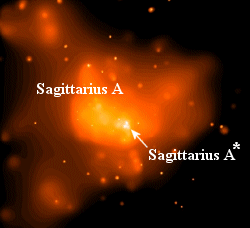
more
Chandra X-ray Observatory images of Sagittarius A and A*.
|
Nevertheless, some material is still
infalling. In 2001, right before Chandra's vigilant X-ray eye, Sagittarius
A* suddenly brightened. Within minutes it was 45 times its normal
intensity. Then it faded back to its pre-flare level about three
hours later. The energy released corresponded to the black hole
suddenly having engulfed a chunk of material with the mass of a
comet or asteroid! Moreover, from the specific way the X-rays brightened
and dimmed, astrophysicists calculated that Sagittarius A* was only
about 15 million kilometres across-less than a quarter the diameter
of the orbit of the planet Mercury around our Sun. This observational
evidence of small size coupled with enormous mass seemed to clinch
the case for its being a supermassive black hole.
Still, a key mystery remains: Where did the
Milky Way's supermassive black hole come from? For that matter,
where do any supermassive black holes come from?
"These are excellent questions," Kniffen declared.
"Theorists are puzzling over this. One thought is that supermassive
black holes formed when galaxies originally formed. Another thought
is that a stellar-mass black hole could start accreting matter and
eventually grow into a supermassive one. A third
possibility is that supermassive black holes grow from clusters
of smaller black holes that merge." Or maybe it's something else
entirely.
Recently, Chandra may
have discovered an important link between stellar-mass black holes
and the supermassive type: a 500 solar mass black hole in the nearby
irregular galaxy M82. But it is puzzling, too, because the black
hole is not centred in M82's nucleus. Will it eventually "sink"
to the centre of M82 and grow to become supermassive? No one knows.
And so the mystery continues.
At every turn another clue appears, some questions are answered,
and new ones take their place.
"We're just scratching the surface
of this topic," says Kniffen. If only Sherlock Holmes were an astronomer....
|

