|
When humans return to the Moon and
travel to Mars, they'll have to be careful of what they inhale.
by Trudy E Bell and Dr Tony
Phillips
This is a true moon
story.
In 1972, Apollo astronaut
Harrison Schmitt sniffed the air in his Lunar Module, the Challenger.
" It smells like gunpowder in here," he said. His commander
Gene Cernan agreed. "Oh, it does, doesn't it?"
The two astronauts
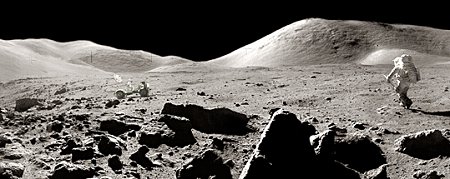
had just returned from a long moon walk around the Taurus-Littrow
valley, near the Sea of Serenity. Dusty footprints marked their
entry into the spaceship. That dust became airborne - and smelly.
Later, Schmitt felt
congested and complained of "lunar dust hay fever." His
symptoms went away the next day; no harm done. He soon returned
to Earth from the moon, looking at the phases of the moon from afar,
and the anecdote faded into history.
But Russell Kerschmann
never forgot that day or time. He's a pathologist at the NASA Ames
Research Center studying the effects of mineral dust on human health.
NASA is now planning to send people back to the Moon and on to Mars.
Both are dusty worlds, extremely dusty. Inhaling that dust, says
Kerschmann, could be bad for astronauts.
"The real problem
is the lungs," he explains. "In some ways, lunar dust
resembles the silica dust on Earth that causes silicosis, a serious
disease." Silicosis, which used to be called "stone-grinder's
disease," first came to widespread public attention during
the Great Depression when hundreds of miners drilling the Hawk's
Nest Tunnel through Gauley Mountain in West Virginia died within
half a decade of breathing fine quartz dust kicked into the air
by dry drilling - even though they had been exposed for only a few
months. "It was one of the biggest occupational-health disasters
in U.S. history," Kerschmann says.
This won't necessarily
happen to astronauts, he assures, but it's a problem we need to
be aware of - and to guard against if they are going back.
Quartz, the main cause
of silicosis, is not chemically poisonous: "You could eat it
and not get sick," he continues. "But when quartz is freshly
ground into dust particles smaller than 10 microns (for comparison,
a human hair is 50+ microns wide) and breathed into the lungs, they
can embed themselves deeply into the tiny alveolar sacs and ducts
where oxygen and carbon dioxide gases are exchanged." There,
the lungs cannot clear out the dust by mucous or coughing. Moreover,
the immune system's white blood cells commit suicide when they try
to engulf the sharp-edged particles to carry them away in the bloodstream.
In the acute form of silicosis, the lungs can fill with proteins
from the blood, "and it's as if the victim slowly suffocates"
from a pneumonia-like condition.
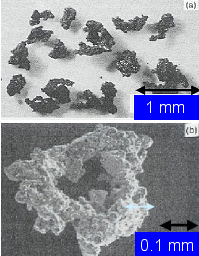
Microscopic
images of Moon Dust
|
Lunar dust, being a
compound of silicon as is quartz, is (to our current knowledge)
also not poisonous. But like the quartz dust in the Hawk's Nest
Tunnel, it is extremely fine and abrasive, almost like powdered
glass. Astronauts on several Apollo moon missions found that it
clung to everything and was almost impossible to remove; once tracked
inside the Lunar Moon Module, some of it easily became airborne,
irritating lungs and eyes.
Martian dust could
be even worse. It's not only a mechanical irritant but also perhaps
a chemical poison. Mars is red because its surface is largely composed
of iron oxide (rust) and oxides of other minerals. Some scientists
suspect that the dusty soil on Mars may be such a strong oxidizer
that it burns any organic compound such as plastics, rubber or human
skin as viciously as undiluted lye or laundry bleach.
"If you get Martian
soil on your skin, it will leave burn marks," believes University
of Colorado engineering professor Stein Sture, who studies granular
materials like Moon - and Mars-dirt for NASA. Because no soil samples
have ever been returned from Mars, "we don't know for sure
how strong it is, but it could be pretty vicious."
Moreover, according
to data from the Pathfinder mission, Martian dust may also contain
trace amounts of toxic metals, including arsenic and hexavalent
chromium - a carcinogenic toxic waste featured in the docudrama movie
Erin Brockovich (Universal Studios, 2000). That was a surprising
finding of a 2002 National Research Council report called Safe
on Mars: Precursor Measurements Necessary to Support Human Operations
on the Martian Surface.
The dust challenge
would be especially acute during windstorms that occasionally envelop
Mars from poles to equator. Dust whips through the air, scouring
every exposed surface and sifting into every crevice. There's no
place to hide.
To find ways of mitigating
these hazards, NASA is soon to begin funding Project Dust, a four-year
study headed by Masami Nakagawa, associate professor in the mining
engineering department of the Colorado School of Mines. Project
Dust will study such technologies as thin-film coatings that repel
dust from tools and other surfaces, and electrostatic techniques
for shaking or otherwise removing dust from spacesuits.
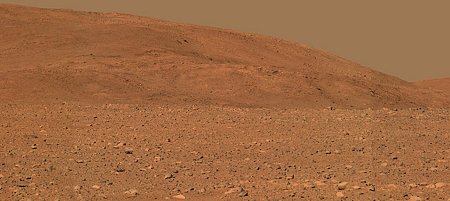
The
Columbia Hills under dusty-salmon skies on Mars
(You can also read our related information article
Mars
Via The moon
|
These technologies,
so crucial on the Moon and Mars, might help on Earth, too, by protecting
people from sharp-edged or toxic dust on our own planet. Examples
include alkaline dust blown from dry lakes in North American deserts,
wood dust from sawmills and logging operations, and, of course,
abrasive quartz dust in mines.
The road to the stars
is surprisingly dusty. But, says Kerschmann, "I strongly believe
it's a problem that can be controlled."
|