|
With the help of Earth-watching satellites,
scientists can identify high-risk "hot spots" for deadly diseases
like malaria before outbreaks strike.
by Patrick L Barry
Last year more than
a million people died of malaria, mostly in Sub-saharan Africa.
Outbreaks of Dengue Fever, hantavirus, West Nile Fever, Rift Valley
Fever, and even Plague still occasionally strike villages, towns,
and whole regions. To the dozens or hundreds who suffer painful
deaths, and to their loved ones, these diseases must seem to spring
upon them from nowhere.
Yet these diseases
are not without rhyme or reason. When an outbreak of malaria occurs,
often it is because environmental conditions such as rainfall, temperatures,
and vegetation set the stage for a population surge in disease-carrying
pests. Mosquitoes or mice or ticks thrive, and the diseases they
carry spread rapidly.
So why not watch these
environmental factors and warn when conditions are ripe for an outbreak?
Scientists have been tantalized by this possibility ever since the
idea was first expressed by the Russian epidemiologist E. N.
Pavlovsky in the 1960s. Now technology and scientific know-how
are catching up with the idea, and a region-wide early warning system
for disease outbreaks appears to be within reach.
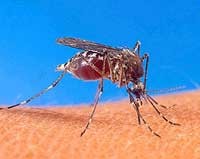
Image courtesy West
Nile Virus Prevention.
Mosquitoes
and other pests are often to blame for the sudden outbreak
of an infectious disease.
|
Ronald Welch of NASA's
Global Hydrology and Climate Center in Huntsville, Alabama, is one
of the scientists working to develop such an early warning system.
"I have been to malarious areas in both Guatemala and India," he
says. "Usually I am struck by the poverty in these areas, at a level
rarely seen in the United States. The people are warm and friendly,
and they are appreciative, knowing that we are there to help. It
feels very good to know that you are contributing to the relief
of sickness and preventing death, especially the children."
The approach employed
by Welch and others combines data from high-tech environmental satellites
with old-fashioned, "khaki shorts and dusty boots" fieldwork. Scientists
actually seek out and visit places with disease outbreaks. Then
they scrutinize satellite images to learn how disease-friendly conditions
look from space. The satellites can then watch for those conditions
over an entire region, country, or even continent as they silently
slide across the sky once a day, every day.
In India, for example,
where Welch is doing research, health officials are talking about
setting up a satellite-based malaria early warning system for the
whole country. In coordination with mathematician Jia Li of the
University of Alabama at Huntsville and India's Malaria Research
Center, Welch is hoping to do a pilot study in Mewat, a predominantly
rural area of India south of New Delhi. The area is home to more
than 700,000 people living in 491 villages and 5 towns, yet is only
about two-thirds the size of Rhode Island.
"We expect to be able
to give warnings of high disease risk for a given village or area
up to a month in advance," Welch says. "These 'red flags' will let
health officials focus their vaccination programs, mosquito spraying,
and other disease-fighting efforts in the areas that need them most,
perhaps preventing an outbreak before it happens."
Outbreaks are caused
by a bewildering variety of factors.
For the mosquito species
that carries malaria in Welch's study area, for example, an outbreak
hotspot would have pools of stagnant water where adult mosquitoes
can deposit their eggs to mature into new adults. These could be
lingering puddles on dense, clay-like soil after heavy rains, swamplands
located nearby, or even rain-filled buckets habitually left outside
by villagers. A malaria hotspot would be warmer than 18°C, because
in colder weather, the single-celled "plasmodium" parasite that actually causes
malaria operates too slowly to go through its infection cycle before
the host mosquito dies. But the weather mustn't be too hot, or the
mosquitoes would have to hide in the shade. The humidity must hover
in the 55% to 75% range that these mosquitoes require for survival.
Preferably there would be cattle or other livestock within the mosquitoes'
1 km flight range, because these pests actually prefer to feed on
the blood of animals.

Image courtesy CDC
Countries affected by endemic malaria are indicated in yellow.
|
If all of these conditions
coincide, watch out!
Documenting some of
these factors, such as soil type and local bucket-leaving habits,
requires initial groundwork by researchers in the field, Welch notes.
This information is plugged into a computerized mapping system called
a Geographical Information Systems database (GIS). Fieldwork is
also required to characterize how the local species of mosquito
behaves. Does it bite people indoors or outdoors or both? Other
factors, like the locations of cattle pastures and human dwellings,
are input into the GIS map based on ultra-high resolution satellite
images from commercial satellites like Ikonos and QuickBird, which
can spot objects on the ground as small as 80 cm across. Then region-wide
variables like temperature, rainfall, vegetation types, and soil
moisture are derived from medium-resolution satellite data, such
as from Landsat 7 or the MODIS sensor on NASA's Terra satellite.
(MODIS stands for MODerate-resolution Imaging Spectrometer.)

In the Mewat region of India livestock are an important part
of the predominantly rural, subsistence economy. The presence
of livestock facilitates the spread of malaria and other
mosquito-borne diseases, because the insects prefer to
feed on the animals' blood.
|
Scientists feed all
of this information into a computer simulation that runs on top
of a digital map of the landscape. Sophisticated mathematical algorithms
chew on all these factors and spit out an estimate of outbreak risk.
The basic soundness
of this approach for estimating disease risk has been borne out
by previous studies. A group from the University of Nevada and the
Desert Research Institute were able to "predict" historical rates
of deer-mouse infection by the Sin Nombre virus with up to 80% accuracy,
based only on vegetation type and density, elevation and slope of
the land, and hydrologic features, all derived from satellite data
and GIS maps. A joint NASA Ames / University of California at Davis
study achieved a 90% success rate in identifying which rice fields
in central California would breed large numbers of mosquitoes and
which would breed fewer, based on Landsat data. Another Ames project
predicted 79% of the high-mosquito villages in the Chiapas region
of Mexico based on landscape features seen in satellite images.
Perfect predictions
will likely never be possible. Like weather, the phenomenon of human
disease is too complicated. But these encouraging results suggest
that reasonably accurate risk estimates can be achieved by combining
old-fashioned fieldwork with the newest in satellite technologies.
"All of the necessary
pieces of the puzzle are there," Welch says, offering the hope that
soon disease outbreaks that seem to come "from out of nowhere" will
catch people off guard much less often.
|

