|
Forget Flowers!...Is Dopamine the main stimulus
for Romantic Love? Charles Pasternak explores the claims Helen Fisher
makes in her new book "Why
We Love: The Nature and Chemistry of Romantic Love".
by Charles
Pasternak
We mark the 14th of
February as St Valentine's Day - a lovers' festival since the 14th
century. Quite what a priest named Valentine, who suffered martyrdom
in Rome during the 3rd century, had to do with love is not at all
clear; if you look up St Valentine in the New Encyclopaedia Britannica
you will find reference only to the massacre, by Al Capone and his
cronies, of unarmed members of a bootlegging gang in Chicago on
the 14th of February 1929. Never mind. Love is what makes the world
go round, according to the 19th century French song, and this is
as good a time as any to consider just what the feeling of love
really is.
Emotions like love
are, according to clinical neurologist Antonio Damasio, 'neither
intangible nor elusive. Contrary to traditional scientific opinion,
feelings are just as cognitive as other percepts. They are the result
of a most curious physiological arrangement that has turned the
brain into the body's captive audience ... To discover that a particular
feeling depends on activity in a number of specific brain systems
interacting with a number of body organs does not diminish the status
of that feeling as a human phenomenon. Neither anguish nor the elation
that love or art can bring about are devalued by understanding some
of the myriad biological processes that make them what they are.
So what does Helen Fisher tell us about the science of love in her
latest book "Why We Love: The Nature and Chemistry of Romantic
Love"?
The crux of her argument is that hormones circulating in the brain
are the trigger:
"...this fire
in the mind is caused by elevated levels of either dopamine or norepinephrine
or both, as well as decreased levels of serotonin."
She supports her hypothesis
by mapping the areas of the brain that 'light up' by fMRI (functional
magnetic resonance imaging) when subjects who are passionately in
love are shown pictures of their adored one. The technique of fMRI
is essentially a scientific follow-up to the well-known reaction
we all experience when a personal comment gets too close: we blush.
The reddening of our face is due to increased blood flow below the
skin; fMRI localises areas of increased blood flow in the brain
when certain bundles of nerve cells respond to a particular stimulus:
raising an arm, being confronted by a frightening situation, concentrating
on a difficult mathematical calculation. Dr Fisher's contention
is that regions of the brain (the caudate nucleus and ventral tegmental
area in particular) in which the main chemical responsible for nerve
transmission is dopamine, are the ones that respond to the stimulus
of romantic love.
In order to recruit appropriate subjects to place inside an MRI
machine, Helen Fisher and her colleagues at the State University
of New York (SUNY) on the Stony Brook campus advertised for students
who had 'just fallen madly in love'. Once inside the machine, they
were shown a series of photographs (through an arrangement with
mirrors: the entire head is within the machine). Some photographs
were neutral, others were of their adored one. Between each picture
the brain was cleared of emotional responses by asking the subject
to mentally count backwards in increments of 7 from a large number
like 4,673.
The results - a correlation
between romantic love and the activity of dopamine-fired neurons
deep within the brain - astonished the author. I would like to share
her enthusiasm, but am constrained by the fact that no images of
caudate nucleus or ventral tegmental area glowing as volunteers
gaze in rapture at their William, Barbara or Bjorn are shown. There
is a 16 page Appendix detailing the ‘Being in Love’
questionnaire that each volunteer had to complete, but no glimmer
of an fMRI scan. We are assured that one of Dr Fisher's colleagues
'did many statistical analyses', but these are not presented either.
Instead we are referred merely to her recent publications. Neither
the Archives of Sexual Behavior nor Neuroendocronology Letters,
however, are likely to be found on the average reader's bookshelf.
I did not locate them in the extensive library of Imperial College
of Science, Technology and Medicine either.
Not that I doubt the
author's findings. They appear to be supported by independent work
of Semir Zeki and his colleagues at University College, London,
that predate the publications of the Fisher group by some two years.
What I am concerned about is Helen Fisher's implication that of
all the pleasurable emotions one might feel, it is romantic love
alone that causes one's dopaminergic neurons to work overtime. I
suspect that had she shown an 18 year old Carmelite nun pictures
of the Virgin Mary, the same result might have been obtained. Indeed
I am ready to jump into her brain scanner and have pictures of caviar
blinis flashed before my eyes, or excerpts from Schubert's String
Quintet in C relayed to my ears: I'll bet my caudate nucleus would
respond as well. In short, I believe that gazing at a picture of
your sweetheart is but one of thousands of pleasurable emotions
that are transmitted along dopaminergic pathways.
The blobs that light
up by fMRI may be no bigger than a pin head, but that still means
that each encompasses some million neurons (nerve cells), communicating
with as many as a thousand others. To establish the precise details
of this network - by methods not yet available - is a Herculean
task to which Dr Fisher does not allude. Instead she writes entertainingly
about topics such as lust (triggered by the hormone testosterone,
that inceases sexual drive in women as well as in men), rejection
and despair. Her story is peppered with quotations, from Aristotle
to Yeats, with more than twenty from Shakespeare alone. No doubt
we should be impressed by her literary erudition. Yet the Oxford
Dictionary of Quotations - that does find a place on my bookshelf
- contains over five hundred references to love, so Dr Fisher's
scholarly contribution is not, perhaps, so remarkable after all.
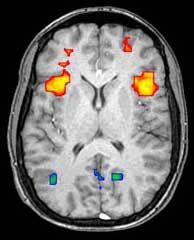
NIMH Laboratory of Brain and Cognition
An fMRI
scan investigating areas of the brain used in working memory
- Similar types of scans were carried out by Dr Fisher in
her research
|
On the other hand there
is no doubt that Helen Fisher writes with a light, breezy touch
and that she presents a comprehensive account of the various emotions
that interact with romantic love. So far as the underlying chemistry
is concerned, that too is presented in a clear manner. But it is
not chemistry that will reveal the working of the mind. No more
than fifty different types of molecule have so far been recognised
to function as neurotransmitters in the human body. Let me remind
you what these chemicals do. The connection between one nerve cell
and the next is a salt water-filled fibre that stops just short
of the nerve cell it is going to innervate. A tiny electric current,
generated in the first cell, passes along the fibre until it reaches
the gap between nerve fibre and the recipient cell. At this point
a chemical substance, the aptly named neurotransmitter, is released.
Neurotransmitter molecules bind to the membrane of the recipient
cell, causing it to respond in a particular manner. Within the brain,
the outcome is generally to transmit current to a further nerve
cell, and so on. There are over a trillion discrete fibers that
connect the hundred billion nerve cells in our brain to each other;
many nerve cells are linked to more than a thousand other cells.
The result is an immensely complicated neural network. No two brains,
not even those of identical twins, have exactly the same cell-to-cell
connections. With a trillion fibres and just fifty types of neurotransmitter
to choose from, it is clear that the vast majority of fibres use
the same neurotransmitter. So it is not chemicals like dopamine
or norepinephrine that distinguish one set of fibres from another.
The discrimination between thoughts of love and every other emotion
must reside in the precise pathways – among a myriad of possibilities
– that are followed when a new feeling, a novel thought, arises
in the brain.
So it is not chemistry but biophysics - or an innovative discipline
yet to be developed - that will elucidate the basis of emotions
like love and hate, calm and anger, pleasure and sorrow, joy and
despair. In the meantime we can do no more than applaud the author's
attempts, and look enviously across the Atlantic: what fun it must
be for a love-struck psychology student at Stony Brook to have the
opportunity of engaging in Helen Fisher's research projects.
[1] Antonio R Damasio: Descartes' Error.
Emotion, Reason and the Human Brain (Picador, London, 1995, p xv).
Available to Buy from Amazon.com
or Amazon.co.uk
[2] Helen Fisher: Why
We Love: The Nature and Chemistry of Romantic Love (Henry Holt and
Company, New York, 2004, £12.28/$25.00) Available to Buy from
Amazon.com
or Amazon.co.uk
|