|
|
The Real Armageddon
 |
|
Will the Universe accelerate out of
sight, or collapse in a fiery Big Crunch? Despite recent reports of
acceleration, the far future cannot be predicted. But the prospects
for life are more dismal than ever.
by Lawrence M. Krauss
A lot has changed in the past thirty
years – and that’s as true of cosmology as it is of everyday
life. New observing technologies and strategies have immeasurably
increased our ability to probe and map the Universe on its largest
scales. Theoretical developments in elementary particle physics
have allowed us to reliably extend our picture of the Universe back
in time, to a point far less than a second after the Big Bang itself.
In spite of these developments, however,
we are now coming to realize that our ability to predict the future
of the Universe is no longer so certain as astronomers thought a
few years ago. Oddly enough, this new-found uncertainty about the
destiny of the Universe itself doesn’t preclude us from making
some definitive statements about the long-term future of life. And
it doesn’t look good.
The startling development at the heart of all of
this is the observation that the Universe is not decelerating, as
it should do in any sensible scheme of things, but rather appears
to be accelerating. The surprise of this discovery is based
on an intuition familiar to anyone who has ever thrown a ball up
into the air. The faster you throw it, the higher it goes. You can
imagine that if you throw it up fast enough, the ball will not come
back. Indeed, a ball thrown from the Earth’s surface with a
velocity in excess of about 7 miles per second will escape from
our planet’s gravitational field and continue to travel outward
indefinitely (although in fact this velocity is not sufficient to
escape from the pull of the Sun).
But, the key point here is that – even as the
ball is escaping - its velocity is always slowing, in response to
the work it has to perform to escape from the Earth. Gravity, at
least for all normal matter, is attractive, and thus it takes work
to pull objects apart.
This reasoning applies to the Universe as a whole.
Since Edwin Hubble’s observations in the 1920s, we’ve
known that the galaxies are moving apart from one another: the Universe
is expanding. Traditionally we have argued that the ultimate determinant
of the galaxies’ future is the amount of mass contained in
and around galaxies. If this mass is large enough, its gravity should
be strong enough to halt the outward movement of galaxies, causing
them to eventually collapse together in a reverse of the Big Bang,
a so-called Big Crunch.

NASA
Will
the Universe end in a fiery Big Crunch? Will this be the real
Armageddon?
|
The new observation of an apparently accelerating
Universe implies that some kind of cosmic ‘antigravity’
is at work. This may sound like the stuff of science fiction, but
it has a basis in physics. If you endow empty space with energy,
the gravitational effect of this energy has the strange property
of producing a new repulsive force throughout all of space. While
this theoretical insight has been known for over a generation, the
common wisdom was that such energy in empty space must be precisely
zero.
In fact, when Einstein first laid out the equations
that govern the large-scale structure of the Universe in 1916, he
introduced the possibility of universal repulsion in the shape of
a quantity called the cosmological constant - without knowing its
significance on the microscopic scale. However, he quickly dispensed
with the idea, calling the cosmological constant his "biggest
blunder".
If the current observations are correct, however,
empty space contributes more energy to the expanding Universe than
is associated with the rest mass of all the galaxies, stars and
planets. It even exceeds the energy bound up in the vast amounts
of dark matter that astronomers believe exists around and between
galaxies. We currently have no sound theoretical understanding of
why this should be the case. Nevertheless, we can ask what the consequences
might be for the future - both of our Universe and of the life within
it.
You might imagine that if the expansion of the Universe
is accelerating, this implies that the Universe will go on expanding
forever. But things are not that simple. We don’t know the
source of the energy of the vacuum and so it may have properties
we are currently unaware of. Here are three possibilities:
- The vacuum energy decreases with
time. The acceleration also slowly decreases, and ultimately the
future of the Universe will once again be determined by the gravitational
attraction of the matter within it.
- The present inferred acceleration
is later proved to be incorrect, but there is still a tiny amount
of vacuum energy. You might suspect that once again an inventory
of all the matter in the Universe should allow us to determine
the ultimate long-term behavior of the expansion. Alas, this is
not the case. If we found there was enough matter for us to be
heading towards a Big Crunch, the energy in the vacuum can have
unexpected effects. Suppose that empty space possesses an amount
of energy only one-thousandth the amount needed to measurably
affect the present expansion. This energy would still eventually
forestall the ultimate collapse of a universe in which matter
currently appears to have the upper hand.
- Finally, and perhaps most unusual
of all, once we realize that empty space has energy, nothing forbids
this energy from being negative. If this is the case, then even
an unimaginably small negative energy in empty space will ultimately
cause the Universe to recollapse, independent of how much matter
now exists therein.
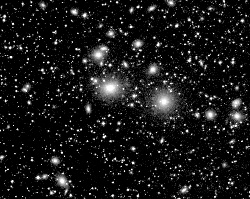
NASA
The
Perseus cluster of Galaxies is accelerating away from us,
every hour the Universe grows a billion miles in every direction
|
A year ago, Michael Turner, of the University of
Chicago, and I demonstrated that there are no observations one can
hope to make in any finite time which will allow us to unambiguously
determine the ultimate future of our expanding Universe. At least
one cosmic mystery therefore appears to remain safe.
The only way out would be to develop a "Theory
of Everything" that precisely predicts, in the absence of experimental
input, all of the fundamental parameters of the Universe. But there
are no signs whatsoever that such a development is in the cards.
We will therefore have to make sure that we, or our descendants,
can hang around long enough to witness the final reel in this cosmic
drama. However, other recent work suggests that while the Universe
may expand forever, life cannot persist forever. (As any salesman
for long
term care insurance will happily tell you)
In fact, an accelerating universe turns out to be
precisely the worst possible universe that anyone can inhabit -
in the long term, at least. My colleague Glenn Starkman and I have
recently described what our descendants would see in the far future.
In an accelerating Universe, distant stars will slowly blink out
of sight, as the space that is carrying them away expands faster
than light-speed. In an imaginable time, about 150 billion years
- during which stars will still be burning and one may imagine life
existing around Earth-like planets - all of the galaxies outside
our local supercluster will become invisible even to the most powerful
telescopes. We will become ever more alone in the Universe.

NASA
The
human race will have ceased to exist before the fate of the
Universe is revealed.
|
Worse still, in a universe dominated by vacuum energy,
life must eventually run out of available stores of energy which
it can use to survive. The vast energy of empty space is inaccessible
for such use, and the accessible energy is carried away too quickly
for us to collect. Like a mariner becalmed on an ocean of salt water
who utters "water, water, everywhere, but not a drop to drink!"
we will be adrift in a cosmic sea of energy without any to spare
for our own metabolism.
What if the acceleration of the Universe eventually
ceases - is there then any hope for life? In 1979, physicist Freeman
Dyson proposed that if we were particularly careful, and hibernated
for longer and longer periods, life could survive with a finite
amount of available energy for an infinite amount of time. On the
other hand, Starkman and I have more recently argued that prospects
for intelligent life, at least, are less hopeful. Quantum mechanics
will ultimately limit the ability of life to perform the computations
necessary for consciousness. This issue is not yet settled, however.
Dyson has not given up, and we are continuing our friendly debate.
We have lots of time for discussion. Even if the
limits we have described on the long-term perdurability of life
eventually come to pass, we are talking about literally billions
of billions of billions of billions of times the present age of
the Universe.
Well before these cosmic limits come to into play,
life on Earth will have to face far more immediate challenges, associated
with the evolution of our planet and the death of the Sun. Having
the foresight and cooperation needed to deal with these global changes
will be more demanding than any other challenge our civilization
has ever faced. Hopefully we will be up to the task – and it
will help to put us on track to tackle whatever future the Universe
may have in store.
Copyright
(c) FirstScience.com |
|
Lawrence
M. Krauss is the Ambrose Swasey Professor of Physics, Professor
of Astronomy and Chairman of the Physics Department at Case Western
Reserve University. The ideas discussed here are adapted from discussions
in his most recently published book, Quintessence: The Mystery
of the Missing Mass in the Universe, and also from his forthcoming
title,
Atom: An Odyssey from the Big Bang to Life on Earth. In
February he was awarded the 2000 Public Understanding of Science
Award from the American Association for the Advancement of Science,
in Washington D.C.
|
|
|

