Was there anything before the Big Bang?
Could we build a time machine? The Theory of Everything could solve
some of the greatest galactic puzzles.
Do you find writing a research project about Albert Einstein difficult? Professional assistance from academic writers on SmartWritingService - research paper service will not disappoint you.By Michio Kaku
Time Magazine chose him as Man of the
Century. Albert Einstein had three great theories. His first theory
of Special Relativity (1905) gave us E = mc², which led to the atomic
bomb and unlocked the secret of the stars. His second great theory
was General Relativity (1915), which gave us space warps, the Big
Bang, and black holes. But many don't realize that his greatest
theory was never finished: "a theory of everything". Einstein's
crowning achievement was to havebeen the unified field theory, an
attempt to "read the mind of God".
But on the third try, Einstein failed. He spent
the last 30 years of his life chasing after an equation, perhaps
no more than one inch long, that would explain all physical phenomena.
Everything from Creation, to supernovas, to atoms and molecules,
perhaps even DNA, people, and love was to be explained by this equation.
If discovered, it was to have been the ultimate achievement of 2,000
years of investigation into the nature of space and matter, ever
since the Greeks asked what was the smallest particle and the smallest
unit of space. Although there are many unresolved questions, today
the leading and, in fact, only candidate for the Theory of Everything
is ‘superstring’ theory, defined in 10 dimensional hyperspace.
Superstring theory, in turn may one day answer some of the deepest
questions of the universe, such as:
- What happened before the big bang?
- Is it possible to build a time machine?
- Can we punch a hole in space?
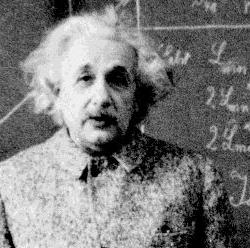
CalTech |
Albert Einstein
never managed to "read the mind of God"
|
Not only has the power of this theory startled
the world of mathematics and shaken the world of physics, it is also
the craziest theory ever proposed.
Four fundamental forces
Today, we realize that the entire universe is governed by four
fundamental forces:
- The gravitational force, which keeps us from
flying into outer space, and prevents our sun (a gigantic hydrogen
bomb) from exploding outward.
- The electromagnetic force, which light up
our cities and energizes our lasers and our computers.
- The strong and weak nuclear forces, which
lights up the stars and galaxies.
Gravity can be described by Einstein's general
relativity theory. Matter warps the space surround it, thereby creating
the "force" of gravity.
Imagine an ant walking on a crumpled sheet of
paper. The ant would say that there was a mysterious "force"
which pulled it left and right. But we know that there is no "force"
pulling the ant; there is only the crumpled sheet of paper pushing
the ant left and right. Gravity does not pull: empty space pushes.
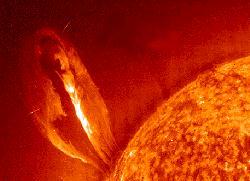
SOHO |
The colossal power
of a coronal mass ejection from our sun
|
The other three forces can be described by the
quantum theory. The quantum theory has a tortured history. Back
in the 1950s, when scores of strange new "fundamental"
particles were flooding out of our atom smashers, J. Robert Oppenheimer
(father of the atomic bomb) was so frustrated that he declared,
"the Nobel Prize in physics shall go to the physicist who does
NOT discover a new particle that year." There were so many
particles, each given strange Greek names, that Enrico Fermi said,
"if I had known there would be so many particles, I would have
become a botanist rather than a physicist."
But after decades of wandering in the wilderness
(and spending billions of tax payers dollars) physicists have unified
these three quantum forces into what is called the Standard Model,
based on a zoo of bizarre particles, called quarks, leptons, Higgs
bosons, Yang-Mills particles, gluons, W-bosons and more. Remarkably,
all known physical phenomenon can, in principle, be described by
these two great theories, relativity and the quantum theory.
CERN |
A segment of the
largest tunnel in the world: the LEP particle accelerator
|
Although these two great theories represent
the two pillars upon which ALL physical knowledge is based, the
fundamental mystery is why these two theories are so different in
almost every way. The first theory is based on the curvature of
smooth surfaces, which describes the world of the very large.
The second theory is based on tiny discrete
packets of energy (called "quanta") and explains the world
of the very small, such as atoms and nuclei.
But why should nature, at the most fundamental
level, create two totally dissimilar theories? Sadly, every attempt
to merge these two theories has failed. Some of the greatest minds
of the century have tackled this problem, only to be unsuccessful.
As physicist Freeman Dyson has pointed out,
the road to the unified field theory is "littered with the
corpses". Neils Bohr once attended a meeting when Nobel Laureate
Wolfgang Pauli was presenting his version of the unified field theory.
Bohr stood up and said, "Mr. Pauli, we in the back are all
convinced that your theory is crazy. But what divides us is whether
your theory is crazy enough!"
This is perhaps the greatest challenge of all
time, to unite all four fundamental forces into a consistent, coherent
picture. At present, the sole candidate for the theory of everything
is superstring theory.
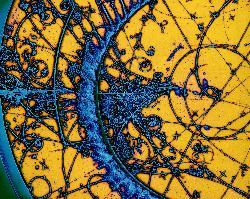
CERN |
Even particles
leave tracks in the BEBC (Big European Bubble Chamber)
|
Superstrings and the 10th Dimension
Superstring theory combines relativity and quantum
in an elegant, intuitive way. First, it describes the myriad of
quantum particles of nature because each particle represents a "note"
on a vibrating string. Think of a violin string. No one says that
A or B is more fundamental than C. What is fundamental is the string
itself.
Superstring theory says that, if we had a supermicroscope
and could peer at an electron, we would see a string vibrating in
a certain mode. The string is extremely small (10 to the minus 33
centimeters!) so that the electron looks like a point particle to
us. If we shake the string, so it vibrates in a different mode,
then the electron can turn into something else, such as a quark,
the fundamental constitute of protons and neutrons. Shake it again,
and the string could vibrate in the mode which describes photons
(the quanta of light). Shake it again and it turns into a graviton
(the quanta of gravity).
In fact, the collective set of vibrations corresponds
to the entire spectrum of known particles. Instead of postulating
millions of different particles, one only has to postulate a single
object, the superstring. The sub-atomic particles are notes on the
superstring. Our bodies are symphonies of strings, and the laws
of physics are the laws of harmony of the superstring.
The superstring theory can also explain gravity.
When the superstring moves in space and time, splitting and rejoining
into other strings, it forces the space-time surrounding it to curl
up, just as Einstein's equations predict. In other words, even if
Einstein never dreamed up general relativity, we might have discovered
it through superstring theory.
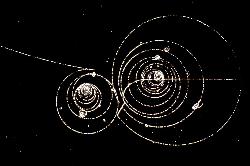
CERN |
Dimensions in the
quantum world: the decay of a kaon leaves tracks behind it
|
Hyperspace
Superstring theory, of course, has its detractors.
Many point out it predicts the universe is defined in 10 dimensional
hyperspace, which sounds more like science fiction than real physics.
It's indisputable that the universe exists in four dimensions (3
spatial dimensions and one time dimension). Every object in the
universe, from the tip of your nose to the farthest star, can be
located by giving just 3 co-ordinates (length, width, and height).
If we also give the time, then we can describe every event in the
universe with just four numbers. For example in New York, we might
say to a friend, "meet me at 42nd street and 5th avenue, on
the 25th floor, at 12:00." Thus, four numbers (42,5,25,12)
completely specifies this event in space-time.
Superstring theory, however, predicts the universe
should exist in 10 dimensions, not four. To explain where the other
six dimensions went, physicists believe that the universe originally
existed in 10 dimensions. However, at the instant of the Big Bang,
for reasons we don't understand, six of the 10 dimensions "curled
up" and collapsed, while the other four dimensions expanded
rapidly. In some sense, our universe expanded at the expense of
a twin universe which collapsed down to microscopic size.
Other critics of superstring theory point out
that an atom smasher powerful enough to test the superstring theory
would have to be the size of the galaxy. The theory is untestable.
I think this criticism is a bit silly. Most science is done indirectly,
not directly. No one has ever been to the sun or seen a black hole,
yet we know what the sun is made of and we have found 20 galactic
black holes in space. Similarly, we might be able to detect echos
of the 10th dimension from the Large Hadron Collider (LHC), now
being build outside Geneva, Switzerland. There is a small hope that
we will be able to find "sparticles," (or superparticles)
which would represent higher vibrations of the superstrings.
Personally, I think that the problem will be
solved by pure mathematics. Once the theory is solved completely,
it should yield not just the origin of the universe, but it should
also perfectly match the masses of the quarks, leptons, Higgs particles
and others.
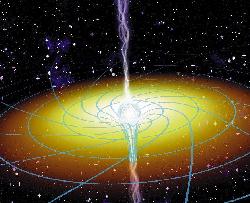
NASA |
Gateway to the
future? A black hole.
|
Time Travel?
Although a quantum theory of gravity has immediate
practical application there is one budding area of physics devoted
to a novel application of quantum physics: time travel. Oddly enough,
Einstein's equations admit the possibility of time travel. But it
may take the full power of the unified field theory to calculate
whether it's really possible or not. Back in 1949, Einstein's next
door neighbor at the Institute for Advance Study, the great mathematician
Kurt Goedel, demonstrated Einstein's own equations allowed for time
travel. If the universe rotated, and you went around the universe,
you could arrive back before you left!
In his memoirs, Einstein pointed out that Goedel's
solution could be dismissed on "physical grounds." Our
universe expands, it doesn't rotate. But this leaves open the possibility
that if the universe rotated, then time travel would be common place!
Since then, literally hundreds of solutions
of Einstein's equations have been found which yield time travel
solutions. They include:
- An infinite, spinning cylinder. This allows
for time travel if one travels around the cylinder.
- Cosmic strings. They allow for time travel
if the cosmic strings collide.
- A spinning black hole. This collapses into
a spinning ring (not a point), so anyone falling through the ring
might actually fall through a wormhole (the Einstein-Rosen Bridge)
which, like Alice's Looking Glass, connects two different regions
of space and time.
- Negative matter. If enough negative matter
were to be found,then it might open up a wormhole large enough
so that a trip through time wouldn't be any more jarring than
a ride on an airplane.
- Negative energy. Similarly, an intense concentration
of negative energy can also open up a wormhole. A crude version
of "warp drive" can be obtained if one stretches the
space in front of you and compress the space behind you via negative
energy.
A Theory of Everything may also help explain
the sticky paradoxes found in time travel stories,such as the grandfather
paradox (what happens if you kill your ancestors before you are
born). Because the entire universe must be quantized, it’s
possible the universe splits in half when you alter the past. The
"river of time" forks into two different rivers.
If you go back in time to save President Kennedy
from being assassinated, you will only save someone else's President
Kennedy. Your own past cannot be changed.
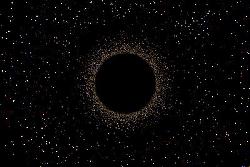
NASA |
A black hole can
be seen by its deflection of starlight
|
But don't expect any amateur inventor to announce
the invention of a time machine anytime soon. Negative matter has
never been seen (it falls up, not down) and you need a fantastic
amount of both negative and positive energy, called the Planck energy
(which is a quadrillion times larger than the energy of the LHC).
When Michael J. Fox jumped into his plutonium-fired De Lorean car
in ‘Back to the Future’, we can calculate that his plutonium
power source does not have enough energy to open a hole in space-time.
Even if we could buld one the stability of these time machines is
in question. We don't know if they will be stable enough to transport
us safely back in time.
Outlook
At present, superstring theory has emerged from
being a fringe theory of physics to becoming one of the dominant
areas of research, generating tens of thousands of papers. The pace
of research is feverish. Edward Witten of the Institute of Advanced
Study, one of the principle researchers in string theory, recently
made another discovery, that there might even be a hidden eleventh
dimension. But the truth is that no one is smart enough to completely
solve the theory and settle intriguing theoretical questions about
what happened before the Big Bang and if time travel is possible.
Perhaps a young person reading this article
will become inspired to solve the greatest problem of fundamental
physics!
Copyright (c)
FirstScience.com


