|
Strange things can happen to the human body
when people venture into space - and the familiar pull of gravity
vanishes.
by Karen Miller
Gravity hurts: you can feel it hoisting
a loaded backpack or pushing a bike up a hill. But lack of gravity
hurts, too: when astronauts return from long-term stints in space,
they sometimes need to be carried away in stretchers.
Gravity is not just a force, it's also
a signal - a signal that tells the body how to act. For one thing,
it tells muscles and bones how strong they must be. In zero-G, muscles
atrophy quickly, because the body perceives it does not need them.
The muscles used to fight gravity - like those in the calves and
spine, which maintain posture - can lose around 20 per cent of their
mass if you don't use them. Muscle mass can vanish at a rate as
high as 5% a week.
For bones, the loss can be even more
extreme. Bones in space atrophy at a rate of about 1% a month, and
models suggest that the total loss could reach 40 to 60 per cent.
Blood feels gravity, too. On Earth,
blood pools in the feet. When people stand, the blood pressure in
their feet can be high - about 200 mmHg (millimetres of mercury).
In the brain, though, it's only 60 to 80 mmHg. In space, where the
familiar pull of gravity is missing, the head-to-toe gradient vanishes.
Blood pressure equalises and becomes about 100 mmHg throughout the
body. That's why astronauts can look odd: their faces, filled with
fluid, puff up, and their legs, which can lose about a litre of
fluid each, thin out.
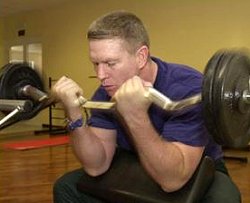
Astronaut Bill
Shepherd prepares for a long stay on the International Space
Station with muscle-building exercises on Earth.
|
But that shift in blood pressure also
sends a signal. Our bodies expect a blood pressure gradient. Higher
blood pressure in the head raises an alarm: The body has too much
blood! Within two to three days of weightlessness, astronauts can
lose as much as 22 percent of their blood volume as a result of
that errant message. This change affects the heart, too. "If you
have less blood," explains Dr. Victor Schneider, research medical
officer for NASA headquarters, "then your heart doesn't need to
pump as hard. It's going to atrophy."
The question is, do such losses matter?
Perhaps not if you plan to stay in
space forever. But eventually astronauts return to Earth - and
the human body has to readjust to the relentless pull of gravity.
Most space adaptations appear to be reversible, but the rebuilding
process is not necessarily an easy one.
"Each of the parameters have their
own normal recovery time," says Schneider. Blood volume, for example,
is typically restored within a few days. "Astronauts get thirsty
when they come back," Schneider explains, "because their body says,
you don't have enough blood in your blood vessels, and that causes
the messengers to say, drink more. Also, the body doesn't urinate
as much."
Muscle, too, can be recouped. Most
comes back "within a month or so, "although it might take longer
to recover completely. "We normally say that it takes a day [of
recovery on Earth] for each day that somebody's in space," says
Schneider.
Bone recovery, though, has proven problematic.
For a three to six month space flight, says Schneider, it might
require two to three years to regain lost bone - if it's going
to come back, and some studies have suggested that it doesn't. "You
really have to exercise a lot,” says Schneider. "You really
have to work at it."
Exercise is the key. But exercising
in space differs from exercising on Earth. Here, gravity's pull
automatically provides a resistive force that maintains muscles
and bones. "[In space] even if you do the same amount of work that
you were doing down here on Earth, you miss that gravity component,"
says Schneider.
Various devices have been developed
to mimic the help that gravity provides. One Russian experiment
provides resistance by strapping jogging cosmonauts to a treadmill
with bungee cords. But that particular combination has not yet proven
effective in preventing bone loss - perhaps because it cannot provide
sufficient loads. "The straps are so uncomfortable that the cosmonauts
can only exercise at 60 to 70 per cent of their body weight,”
says Hargens.
There's also IRED, a NASA-developed
Interim Resistive Exercise Device. IRED consists of canisters that
can provide more than 300 pounds of resistance for a variety of
exercises. IRED's effectiveness is still being monitored, says Schneider.
Yet another promising device attempts
to mimic gravity even more closely. Hargens and his colleagues are
developing a Lower Body Negative Pressure (LBNP) device, a chamber
that contains a treadmill, and that relies, says Hargens, on the
suction of an ordinary vacuum cleaner. "We've found," he says "that
we can provide body weight by applying negative pressure over the
lower body."
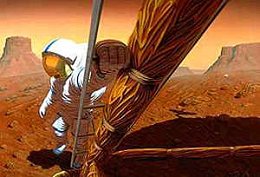
Artist Pat
Rawlings created this beautiful painting (entitled "Inevitable
Descent") of a future astronaut on Mars. Copyright Pat
Rawlings [more]
|
The device, explains Hargens, prevents
much of the loss of cardiovascular function and of muscle. It also
seems to be effective in reducing some indices of bone loss. One
reason is that the LBNP allows astronauts to exercise with an effective
body weight between 100% and 120% of what they would feel on Earth.
Another is that - unlike any previous exercise device - it restores
the blood pressure gradient, increasing blood pressure to the legs.
There's growing evidence, Hargens says,
that the body's systems interact with each other. For example, "you
can't just put high loads on the bone and then expect it to recover
if you're not taking care of the blood flow to that bone as well."
Scientists aren't yet sure how gravity
"signals" the body to keep bones and muscles strong. "We know that,
somehow, gravity is converted from a mechanical signal to a chemical
signal - and we know a lot about these chemical signals," says
Schneider. The mechanical signals, though, remain a mystery.
Solving these problems, says Schneider,
could lead to better therapies for people who aren't using gravity
properly here on Earth. Ageing is the perfect example. Zero-G living
mimics closely the effects of old age. Like astronauts, the elderly
fight gravity less. They're more sedentary, which triggers the loop
of muscle atrophy, bone atrophy, and lower blood volume.
If researchers can identify the signals
that generate strong muscles and bones, it might be possible "to
get new pills and do exercises" that would trigger those signals
here on Earth.
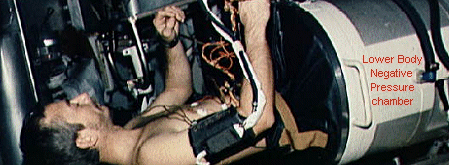
Circa 1973, Skylab astronaut Owen Garriott lies in a Lower
Body Negative Pressure device - a big vacuum cleaner that
simulates the effects of gravity on the lower body.
|
"We've just begun to do research ...
looking at the changes that can happen to humans," says Schneider.
"There are so many wonderful questions."
And the answers? They're waiting for
us ... up there in space, where the absence of weight reminds us
that gravitation isn't all bad. Sometimes it's a struggle, our daily
contest with gravity, but now we know the struggle is good!
|

