|
Using lasers to ping the Moon, researchers
are testing a fundamental assumption of modern physics.
by Dr Tony Phillips and Patrick
L Barry
Four hundred years
ago - or so the story goes - Galileo Galilei started dropping things
off the Leaning Tower of Pisa: Cannon balls, musket balls, gold,
silver and wood. He might have expected the heavier objects to fall
faster. Not so. They all hit the ground at the same time, and so
he made a big discovery: gravity accelerates all objects at the
same rate, regardless of their mass or composition.
Nowadays this is called
"Universality of Free Fall" or the "Equivalence Principle," and
it is a cornerstone of modern physics. In particular, Einstein crafted
his theory of gravity, i.e., the general theory of relativity,
assuming the Equivalence Principle is true.
But what if it's wrong?
"Some modern theories
actually suggest that the acceleration of gravity does depend on
the material composition of the object in a very subtle way," says
Jim Williams, a physicist at NASA's Jet Propulsion Laboratory (JPL).
If so, the theory of relativity would need re-writing; there would
be a revolution in physics.
A group of NASA-supported
researchers are going to test the Equivalence Principle by shooting
laser beams at the Moon.
"Lunar laser ranging
is one of the most important tools we have for searching for flaws
in Einstein's general theory of relativity," says Slava Turyshev,
a research scientist at JPL who works with Jim Williams and others
on the project.
Their experiment is
possible because, more than 30 years ago, Apollo astronauts put
mirrors on the Moon - small arrays of retro reflectors that can
intercept laser beams from Earth and bounce them straight back.
Using lasers and mirrors, researchers can "ping" the Moon and precisely
monitor its motion around Earth.
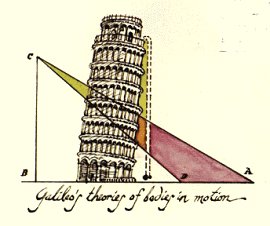
more
A sketch of Galileo Galilei's legendary experiment.
|
It's a modern version
of the Leaning Tower of Pisa experiment. Instead of dropping balls
to the ground, the researchers will watch the Earth and Moon drop
toward the Sun. Like musket balls and cannon balls dropped from
the Tower, the Earth and Moon are made of a different mix of elements,
and they have different masses. Are they accelerated toward the
Sun at the same rate? If yes, the Equivalence Principle holds. If
not, let the revolution begin.
A violation of the
Equivalence Principle would reveal itself as a skewing of the Moon's
orbit, either toward or away from the Sun. "Using masses as large
as the Earth and Moon, we may be able to show this subtle effect,
if it exists," notes Williams.
Scientists have been
pinging the Moon since the Apollo days. So far, Einstein's theory
of gravity - and the Equivalence Principle - has held up to a precision
of a few parts in 1013. But that's not good enough to
test all the theories vying to overthrow Einstein.
Current lunar laser
ranging can measure the distance to the Moon - roughly 385,000 km - with
an error of about 1.7 cm. Beginning this fall, a new facility funded
by NASA and the National Science Foundation will boost this accuracy
10-fold to within only 1 to 2 mm. This jump in accuracy will mean
that scientists can detect deviations from Einstein's theory 10
times smaller than currently possible, which may be sensitive enough
to find the first evidence of flaws.
To achieve that accuracy,
the facility, called the Apache Point Observatory Lunar Laser-ranging
Operation (APOLLO), must time the laser pulses' roundtrip flight
to the Moon within a few pico seconds, or just a trillionth of a
second (10-12). The speed of light is known - it's about
300,000 km per second - so measuring the time of flight for the
laser pulse tells scientists the distance between the APOLLO telescope
and the mirror sitting on the surface of the Moon.
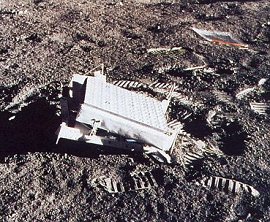
more
A
retro reflector array left on the Moon by Apollo 14 astronauts.
Similar mirrors were emplaced by Apollo 11 and Apollo
15 astronauts, and by a pair of Soviet-era Lunokhod rovers.
|
How does APOLLO's design
achieve this 10-fold improvement? First of all, it uses a larger
telescope than the older facility at the McDonald Observatory in
Texas - 3.5 meters vs. 0.72 meters. The larger mirror lets the APOLLO
facility catch more of the photons of light returning from the Moon,
explains Tom Murphy, a professor at the University of California,
San Diego, and the mastermind behind the design of APOLLO. The smaller
telescope catches, on average, only one returning photon for every
100 out-going laser pulses (each pulse contains more than 1017
photons!); the APOLLO telescope will catch about 5 photons from
each pulse, which greatly improves the statistical strength of the
results.
Several potential disturbances
had to be reckoned with. Earth's atmosphere, for one, can distort
the path of the pulse of laser light, in the same way that it causes
starlight to twinkle and shimmer. And tiny tectonic motions of the
ground beneath the APOLLO observatory, typically a few centimetres
per year, could skew the long-term results. So the project leaders
chose a mountaintop near White Sands, New Mexico, that enjoys a
particularly calm overhead atmosphere and ground that is relatively
stable. In addition, they are installing a super conducting gravimeter
and precision GPS sensor alongside the observatory to detect slow
ground movements, and an array of precision barometers will map
the state of the atmosphere.
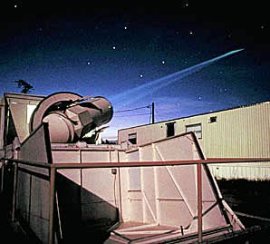
more
Lunar
laser ranging works by firing pulses of laser light at
reflectors on the Moon's surface and catching the returning
photons. Shown here is the laser ranging experiment at
the University of Texas McDonald Observatory.
|
Williams and Turyshev
have recently received a grant from NASA's Office of Biological
and Physical Research to improve JPL's lunar laser ranging analysis
software by an order of magnitude to match the capability of the
New Mexico site. "It will be necessary to deal with many small effects
at the millimetre level," notes Turyshev.
Through careful accounting
of such small effects, the Universality of Free Fall … could fall.
Many physicists would
welcome the news. They've been puzzled for years by a curious incompatibility
between general relativity and quantum mechanics. The two theories,
so successful in their own realms, are like different languages
describing the Universe in fundamentally different ways.
Finding a flaw in
the underpinnings of relativity could lead to a new "Theory of Everything,"
finally combining quantum physics and gravity in one harmonious
framework.
From Pisa, Italy, to
the Moon, to White Sands, New Mexico: this is a far-flung experiment
spanning hundreds of years and hundreds of thousands of miles. Soon,
perhaps, we'll have the answers.
|

