| With
the way things are going, El Niño and its counterpart La Niña may
be blamed for every natural disaster on the planet. Hardly a month
has gone by in the past four years when there hasn’t been a report
tying El Niño or its counterpart La Niña to some devastating event.
by John Weier
The phenomena have already been linked to everything from tornadoes
in the midwestern United States to fires in Indonesia to hurricanes
in Central America. But Earth scientists still have much to learn
about how the phenomena affect weather systems around the world.
Many questions regarding the root cause and physics behind the two
events remain unanswered. Predicting exactly when and with what
force El Niño or La Niña will strike continues to be elusive.
To improve our understanding of El Niño, Raghu Murtugudde and a
team of researchers at NASA’s Goddard Space Flight Center have been
observing algae in the Pacific Ocean. They believe that by watching
the algae’s movements during El Niños and La Niñas they can gain
insight into the processes that drive these events.
Their initial results show promise. Using the first year of data
returned from NASA's new Sea-viewing Wide Field-of-View Sensor (SeaWiFS),
the scientists have found a way to detect the end of El Niño and
the beginning of La Niña a month earlier than anyone else. In the
future, the researchers hope to detect other stages of the phenomenas'
development and then create models to predict the events' occurrence
and their destructive force years in advance.
El Niño’s Effect on Algae
"Observing [the algae] in the oceans is much like putting dye in
a tank and stirring it up to see where things are moving," Murtugudde
said. Algae (phytoplankton) are by far the most abundant form of
plant life in the ocean. They are sensitive to light, temperature,
currents and winds, and their green chlorophyll can be detected
by satellite instruments. Because phytoplankton changes an ocean's
color, they are ideal candidates for tracking currents, detecting
pollution, and observing meteorological events.

Photograph
courtesy of U.S Geological Survey
The
frequent storms along the coast of California were linked
to El Nino
|
For years scientists have known that El Niño and La Niña change
the levels of phytoplankton across the entirePacific basin. During
a normal year, winds gust at a steady rate from east to west across
the Pacific and slowly blow the warm surface waters towards Australia
and the Indonesian Archipelago. Over a period of time, these winds
build up a "warm pool" of water in the western Pacific and leave
the eastern Pacific relatively cool. This layer of warm water smothers
any upwelling currents, which bring cool, nutrient-rich waters up
from the depths of the sea (Njoku et al. 1993). Since phytoplankton
can only survive in these nutrient-filled waters, the plants do
not usually do well in the western Pacific and thrive in the eastern
and central Pacific (Murtugudde et al. 1999).
El Niño and La Niña alter the temperature of the surface waters
across the Pacific. During an El Niño year, the trade winds in the
Pacific die down or reverse direction. The upwelling currents in
the east subside, and the pool of warm water in the western Pacific
spreads out over the entire basin (Njoku et al. 1993). The phytoplankton
in the central Pacific all but disappear, and the population in
the eastern Pacific are lowered significantly. The opposite occurs
during La Niña. The easterly trade winds pick up and blow even more
hot water into the west. The upwelling increases in the central
and eastern regions, causing the phytoplankton concentration to
explode (Murtugudde et al. 1999).
Picking Out a Pattern for El Niño’s End
"With the SeaWiFS satellite, we are able to monitor these changes
in ocean color accurately for the first time," said Murtugudde.
Though researchers have understood phytoplankton’s reaction to El
Niño and La Niña for a couple of decades, there was no way to efficiently
monitor the algae across the entire Pacific basin until the launch
of SeaWiFS. The instrument is designed to measure the amount of
chlorophyll-a (the chemical that makes the phytoplankton green)
bobbing around on the ocean’s surface. The satellite that carries
the instrument moves in a near-circular orbit from pole to pole
and allows SeaWiFS to scan a majority of Earth’s oceans every five
days. The data beamed back to scientists are used to create weekly
maps of the algae.
While the initial purpose for SeaWiFS was to estimate the
amount of carbon dioxide being consumed by algae in the oceans,
Murtugudde and his team decided to use its capabilities to view
changes in algae across the upper layers of the Pacific. The Goddard
team combed the first year of SeaWiFS data to look for any unusual
changes in phytoplankton concentrations that might have occurred
during the transition from El Niño to La Niña. After examining the
image data from January to February 1998, they found something strange:
a band of algae extending across the length of the Pacific just
north of the equator (Murtugudde et al. 1999). While the appearance
of the algae alone suggested a possible end to the El Niño, the
real surprise was in the plants' location. "There was elevated chlorophyll
just to the north of the equator. This never happens. Everything
usually happens on the equator, because the upwelling of the whole
ecosystem in the central Pacific is on the equator," said Murtugudde.
Murtugudde explained that the rotation of the Earth causes currents
on opposite sides of the equator to move away from each other. Any
moving water just north of the equator is pushed further north and
any water just south of the equator goes further south. During a
normal year the currents produce equatorial upwelling and give rise
to beds of algae. When El Niño hits, warm water prevents this upwelling,
as it does in many other parts of the ocean, and the algae die off.
At the end of the cycle the algal bloom should re-establish themselves
at the equator.
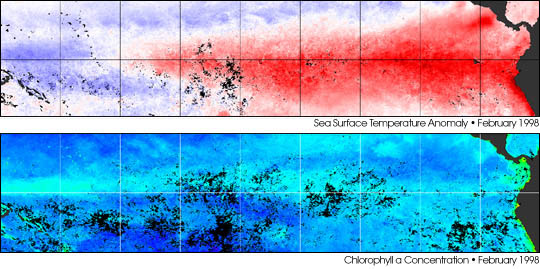
As
indicated by the red region off the west coast of Peru, El
Nino was still going strong in 1998. To scientists surprise
the blue green image revealed phytoplankton were growing to
the North of the Equator
|
In order to understand what was going on, the scientists looked at
measurements of the wind speed and water temperature for March and
April. The readings not only verified the scientists’ suspicions that
the warm waters were retreating to the western Pacific, but also gave
them an explanation for the position of the algae. Apparently, El
Niño-related changes were also creating changes in the air above the
ocean. The winds were not blowing east or west across the equator,
but south, and they were pushing warm surface water into the equator.
"If you blow warm water into the equator, it cannot go further
south. The water tends to pile up there," he said. Since these winds
had blown away the surface waters north of the equator, the upwelling
currents shifted and they ended up emerging 200-300 kilometers away.
Within days the phytoplankton started to grow north of the equator.
Reading the Future in a Bed of Algae
"For the first time we are seeing the transition from El Niño to
La Niña well before other measurements become available," Murtugudde
said. The researchers had to look at sea surface temperature, sea
surface heights and wind speed to verify the results shown on the
SeaWiFS satellite maps in January and February. Though the northerly
winds and lower temperatures existed during these earlier months,
they had not changed enough for the scientists to get a bead on
them using standard monitoring equipment, he explained. "The biology
reacts much more to sub-surface conditions of the ocean than these
other parameters do," Murtugudde said.
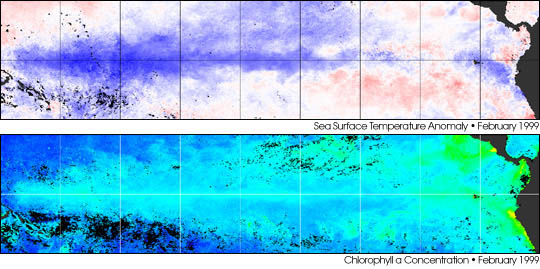
By
February 1999 La Nina had replaced El Nino, and the equatorial
Pacific had strong phytoplankton production.
|
Now that he
and other NASA Goddard scientists have a way to read the patterns
the phytoplankton make, they should be able to detect the end of
the next El Niño a month before other, more conventional detection
devices do. In the future the team plans to look at what happens
to the algae leading up to an El Niño. "It’s quite likely that some
of the biological signatures will appear before the next El Niño.
This time we will keep an eye out for them. With ocean color data
we should be able to see certain things you cannot see with other
measurements," Murtugudde said.
His long-term goal is to gather enough data on events like El Niño
and La Niña to improve weather forecasting systems. Today, scientists
can predict El Niños up to a year in advance, using complex computer
simulations and data from other satellites and buoys. However, estimates
of the exact months when El Niños and La Niñas begin and end are
often very rough. By observing phytoplankton, scientists can track
both the motion of the water on the surface and just beneath the
surface. This should allow for more comprehensive models and more
accurate predictions.
|

