| Inspired partly
by science fiction, NASA scientists are seriously considering space
elevators as a mass-transit system for the next century.
by Steve Price
"Yes, ladies and gentlemen, welcome aboard NASA's Millennium-Two
Space Elevator. Your first stop will be the Lunar-level platform
before we continue on to the New Frontier Space Colony development.
The entire ride will take about 5 hours, so sit back and enjoy the
trip. As we rise, be sure to watch outside the window as the curvature
of the Earth becomes visible and the sky changes from deep blue
to black, truly one of the most breathtaking views you will ever
see!"
Does this sound like the Sci-Fi Channel or a chapter out of Arthur
C. Clarke's, Fountains of Paradise? Well, it's not. It is a real
possibility - a "space elevator" - that researchers are considering
today as a far-out space transportation system for the next century.
David Smitherman of NASA/Marshall's Advanced Projects Office has
compiled plans for such an elevator that could turn science fiction
into reality. His publication, "Space Elevators: An Advanced Earth-Space
Infrastructure for the New Millennium", is based on findings from
a space infrastructure conference held at the Marshall Space Flight
Center last year. The workshop included scientists and engineers
from government and industry representing various fields such as
structures, space tethers, materials, and Earth/space environments.
"This is no longer science fiction," said Smitherman. "We came
out of the workshop saying, 'We may very well be able to do this.'"
A space elevator is essentially a long cable extending from our
planet's surface into space with its center of mass at geostationary
Earth orbit (GEO), 35,786 km in altitude. Electromagnetic vehicles
traveling along the cable could serve as a mass transportation system
for moving people, payloads, and power between Earth and space.
Current plans call for a base tower approximately 50 km tall -
the cable would be tethered to the top. To keep the cable structure
from tumbling to Earth, it would be attached to a large counterbalance
mass beyond geostationary orbit, perhaps an asteroid moved into
place for that purpose.
"The system requires the center of mass be in geostationary orbit,"
said Smitherman. "The cable is basically in orbit around the Earth."
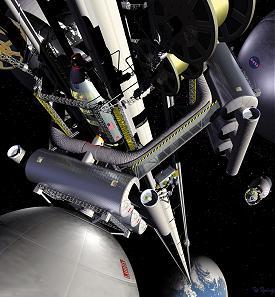
Pat
Rawling
The
space elevator looking down towards Earth.
|
Four to six "elevator tracks" would extend up the sides of the
tower and cable structure going to platforms at different levels.
These tracks would allow electromagnetic vehicles to travel at speeds
reaching thousands of kilometers-per-hour.
Conceptual designs place the tower construction at an equatorial
site. The extreme height of the lower tower section makes it vulnerable
to high winds. An equatorial location is ideal for a tower of such
enormous height because the area is practically devoid of hurricanes
and tornadoes and it aligns properly with geostationary orbits (which
are directly overhead).
Equatorial
base sites are essential for space elevators because they align
properly with geostationary orbits. In Arthur C. Clarke's novel,
Fountains of Paradise, engineers built a space elevator on the mythical
island of Taprobane, which was closely based on Sri Lanka, a real
island near the southern tip of India. Clarke made one important
change to the geography of Sri Lanka/Taprobane: he moved the island
800 km south so that it straddles the equator. At the moment, Sri
Lanka lies between 6 and 10 degrees north. According to Smitherman,
construction is not feasible today but it could be toward the end
of the 21st century. "First we'll develop the technology," said
Smitherman. "In 50 years or so, we'll be there. Then, if the need
is there, we'll be able to do this. That's the gist of the report."
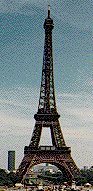
NASA
The
Eiffel Tower first inspired space elevator thoughts in 1895
|
Smitherman's
paper credits Arthur C. Clarke with introducing the concept to a
broader audience. In his 1978 novel, Fountains of Paradise, engineers
construct a space elevator on top of a mountain peak in the mythical
island of Taprobane (closely based on Sri Lanka, the country where
Clarke now resides). The builders use advanced materials such as
the carbon nanofibers now in laboratory study. "His book brought
the idea to the general public through the science fiction community,"
said Smitherman. But Clarke wasn't the first.
As early as 1895, a Russian scientist named Konstantin Tsiolkovsky
looked at the Eiffel Tower in Paris and thought about such a tower.
He wanted to put a "celestial castle" at the end of a spindle shaped
cable, with the "castle" orbiting the earth in a geosynchronous
orbit (i.e. the castle would remain over the same spot on the earth).
The tower would be built from the ground to an altitude of 35,800
kilometers. It would be similar to the fabled beanstalk in the children's
story "Jack and the Beanstalk," except that on Tsiolkovsky's tower
an elevator would ride up the cable to the "castle". Another Russian,
a Leningrad engineer by the name of Yuri Artsutanov, wrote some
of the first modern ideas about space elevators in 1960. Published
as a non-technical story in Pravda, his story never caught the attention
of the West. Science magazine ran a short article in 1966 by John
Isaacs, an American oceanographer, about a pair of whisker-thin
wires extending to a geostationary satellite. The article ran basically
unnoticed. The concept finally came to the attention of the space
flight engineering community through a technical paper written in
1975 by Jerome Pearson of the Air Force Research Laboratory. This
paper was the inspiration
for Clarke's novel.
Pearson,
who participated in the 1999 workshop, envisions the space elevator
as a cost-cutting device for NASA. "One of the fundamental problems
we face right now is that it's so unbelievably expensive to get things
into orbit," said Pearson. "The space elevator may be the answer."
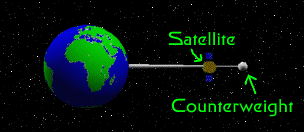
NASA
Building
from a satellite towards Earth was propsed in 1960.
|
One "spinoff"
use of Tsiolkovsky's tower would be the ability to launch objects
into orbit without a rocket. Since the elevator would attain orbit
velocity as it rode up the cable, an object released at the tower's
top would also have the orbital velocity necessary to remain in
geosynchronous orbit.
Building from
the ground up, however, proved an impossible task. It took until
1960 for another Russian scientist, Y.N. Artsutanov, to propose
another scheme for building a space tower. Artsutanov suggested
using a geosynchronous satellite as the base from which to build
the tower. By using a counterweight, the cable would be lowered
from geosynchronous orbit to the surface of the earth while the
counterweight was extended from the satellite away from the earth.
Making a cable 35,000 kilometers long is a difficult task. In 1966,
four American engineers decided to determine what type of material
would be required to build a space tower, assuming it would be a
straight cable with no variations in its cross section. They found
that the strength required would be twice that of any existing material
including graphite, quartz and diamond.
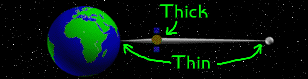
NASA
The
weight of the material needed for this tower would require
24,000 space shuttle trips.
|
Nine years
later another American scientist, Jerome Pearson, designed a tapered
cross section that would be better suited to building the tower.
He suggested using a counterweight that would be slowly extended
out to 144,000 kilometers (half the distance to the moon) as the
lower section of the tower was built. His analysis included disturbances
such as the gravitation of the Moon, wind and moving payloads up
and down the cable. The weight of the material needed to build the
tower would have required 24,000 Space Shuttle trips, although part
of the material could be transported up the tower when a minimum
strength strand reached the ground.
Later, Pearson
thought about building a tower on the Moon. He determined that the
center of gravity needed to be at the L1 or L2 Lagrangian
points, which are special stable points that exist about any two
orbiting bodies where the gravitational forces are balanced. The
cable would have to be 291,901 kilometers long for the L1 point
and 525,724 kilometers long for the L2 point. Compared to the 351,000
kilometers from the Earth to the Moon, that's a long cable, and
the material would have to be gathered and manufactured on the Moon.
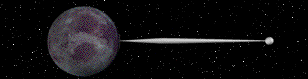
NASA
Another
idea was to build a tower from the Moon.
|
We can determine the orbital velocities that might be attained
at the end of Pearson's 144,000 km tower. At the end of the tower,
the tangential velocity is 10.93 kilometers per second which is
high enough to escape Earth's gravitational field and send probes
to Saturn or Mars. If an object were allowed to slide freely along
the upper part of the tower a velocity high enough to escape the
solar system would be attained.
The space tower is a good concept for science fiction writers,
but until new materials are developed and cheaper ways to reach
orbit are found, the space tower will remain a dream.
The workshop's findings determined the energy required to move
a payload by space elevator from the ground to geostationary orbit
could remain relatively low. Using today's energy costs, researchers
figured a 12,000-kg Space Shuttle payload would cost no more than
$17,700 for an elevator trip to GEO. A passenger with baggage at
150 kg might cost only $222! "Compare that to today's cost of around
$10,000 per pound ($22,000 per kg)," said Smitherman. "Potentially,
we're talking about just a few dollars per kg with the elevator."
During the workshop, issues pertinent to transforming the concept
from science fiction to reality were discussed in detail. "What
the workshop found was there are real materials in laboratories
today that may be strong enough to construct this type of system,"
said Smitherman.
Smitherman listed five primary technology thrusts as critical
to the development of the elevator. First was the development
of high-strength materials for both the cables (tethers) and the
tower.
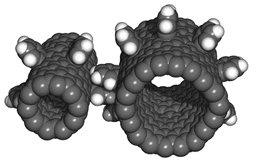
NASA
Carbon
nanotube may be used to build the elevator cables.
|
In a 1998 report, NASA applications of molecular nanotechnology,
researchers noted that "maximum stress [on a space elevator cable]
is at geosynchronous altitude so the cable must be thickest there
and taper exponentially as it approaches Earth. Any potential material
may be characterized by the taper factor - the ratio between the
cable's radius at geosynchronous altitude and at the Earth's surface.
For steel the taper factor is tens of thousands - clearly impossible.
For diamond, the taper factor is 21.9 including a safety factor.
Diamond is, however, brittle. Carbon nanotubes have a strength in
tension similar to diamond, but bundles of these nanometer-scale
radius tubes shouldn't propagate cracks nearly as well as the diamond
tetrahedral lattice."
Fiber materials such as graphite, alumina, and quartz have exhibited
tensile strengths greater than 20 GPa (Giga-Pascals, a unit of measurement
for tensile strength) during laboratory testing for cable tethers.
The desired strength for the space elevator is about 62 GPa. Carbon
nanotubes have exceeded all other materials and appear to have a
theoretical strength far above the desired range for space elevator
structures. "The development of carbon nanotubes shows real promise,"
said Smitherman. "They're lightweight materials that are 100 times
stronger than steel."
The second technology thrust was the continuation of tether
technology development to gain experience in the deployment and
control of such long structures in space.
Third was the introduction of lightweight, composite structural
materials to the general construction industry for the development
of taller towers and buildings. "Buildings and towers can be constructed
many kilometers high today using conventional construction materials
and methods," said Smitherman. "There simply has not been a demonstrated
need to do this that justifies the expense." Better materials may
reduce the costs and make larger structures economical.
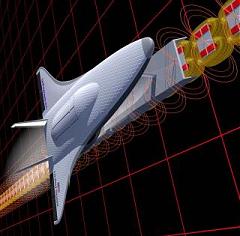
NASA
Maglev
technologies are essential for future space elevators.
|
Fourth was the development of high-speed, electromagnetic
propulsion for mass-transportation systems, launch systems, launch
assist systems and high-velocity launch rails. These are, basically,
higher speed versions of the trams now used at airports to carry
passengers between terminals. They would float above the track,
propelled by magnets, using no moving parts. This feature would
allow the space elevator to attain high vehicle speeds without the
wear and tear that wheeled vehicles would put on the structure.
Fifth was the development of transportation, utility and
facility infrastructures to support space construction and industrial
development from Earth out to GEO. The high cost of constructing
a space elevator can only be justified by high usage, by both passengers
and payload, tourists and space dwellers.
During a speech he once gave, someone in the audience asked Arthur
C. Clarke when the space elevator would become a reality.
"Clarke answered, 'Probably about 50 years after everybody quits
laughing,'" related Pearson. "He's got a point. Once you stop dismissing
something as unattainable, then you start working on its development.
This is exciting!"
|

