|
Can science do anything to bring the dedicated
biscuit dunker into parity with the dunker of doughnuts? Could science,
which has added that extra edge to the achievement of athlete and
astronaut alike, be used to enhance ultimate biscuit dunking performance?
by Len Fisher
Doughnuts might have been designed for
dunking. A doughnut, like bread, is held together by an elastic net
of the protein gluten. The gluten might stretch, and eventually even
break, when the doughnut is dunked in hot coffee, but it doesn’t
swell or dissolve as the liquid is drawn into the network of holes
and channels that the gluten supports. This means that the doughnut
dunker can take his or her time, pausing only to let the excess liquid
drain back into the cup before raising the doughnut to the waiting
mouth. The only problem that a doughnut dunker faces is the selection
of the doughnut.
Biscuit dunkers face much more of a challenge.
If recent market research is to be believed, one biscuit dunk in
every five ends in disaster, with the dunker fishing around in the
bottom of the cup for the soggy remains. The problem for serious
biscuit dunkers is that hot tea or coffee dissolves the sugar, melts
the fat and swells and softens the starch grains in the biscuit.
The wetted biscuit eventually collapses under its own weight.
Can science do anything to bring the dedicated
biscuit dunker into parity with the dunker of doughnuts? Could science,
which has added that extra edge to the achievement of athlete and
astronaut alike, be used to enhance ultimate biscuit dunking performance
and save that fifth, vital dunk?
These questions were put to me by an advertising
company wanting to promote ‘National Biscuit-Dunking Week’.
As someone who uses the science underlying commonplace objects and
activities to make science more publicly accessible, I was happy
to give ‘The Physics of Biscuit Dunking’ a try.
The first question that we asked was
‘What does a biscuit look like from a physicist’s point
of view?’ We decided to be reductionist about biscuits, attempting
to understand their response to dunking in simple physical terms
and leaving the complications until later. When we examined a biscuit
under a microscope, it appeared to consist of a tortuous set of
interconnected holes, cavities and channels (so does a doughnut).
In the case of a biscuit, the channels are there because it consists
of dried-up starch granules imperfectly glued together with sugar
and fat. To a scientist, the biscuit dunking problem is to work
out how hot tea or coffee gets into these channels and what happens
when it does.
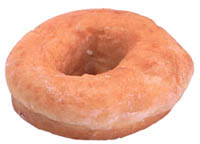
One of the
tasty heroes of our story
|
With this picture of dunking in mind,
I sat down with some of my colleagues in the Bristol University
Physics Department and proceeded to examine the question experimentally.
Solemnly, we dipped our biscuits into our drinks, timing exactly
how long they took to collapse. This was Baconian science, named
after Sir Francis Bacon, the Elizabethan courtier who declared that
science was simply a matter of collecting a sufficient number of
facts to make a pattern.
Baconian science lost us a lot of biscuits,
but did not provide a scientific approach to biscuit dunking. Serendipity,
the art of making fortunate discoveries, came to the rescue when
I decided to try holding a biscuit horizontally, with just one side
in contact with the surface of the tea. I was amazed to find that
this biscuit beat the previous record for longevity by almost a
factor of four.
Paradigm shifts often arise from unexpected
observations, but these observations need to be verified. The more
unexpected the observation, the harsher the testing. In the words
of Carl Sagan: ‘Extraordinary claims require extraordinary
evidence’. No one is going to discard the whole of modern
physics just because someone has claimed that ‘Yogic Flying’
is possible, or because a magician has bent spoons on television.
If levitation did prove to be a fact, though, or spoons could really
be bent without a force being applied, then physics would have to
take it on the chin and reconsider.
One long-lived horizontal biscuit dunk
was hardly likely to require a paradigm shift for its explanation.
For that rare event to happen, the new observation must be inexplicable
by currently known rules. Even more importantly, the effect observed
has to be a real one, and not the result of some one-off circumstance.
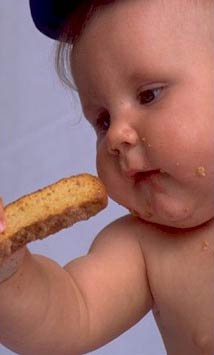
The other
hero of our tale (the biscuit - not the baby)
|
One thing that convinces scientists that
an effect is real is reproducibility – finding the same result
when a test is repeated. The long lived biscuit could have been exceptional
because it had been harder baked than others we had tried, or for
any number of reasons other than the method of dunking. We repeated
the experiments with other biscuits and other biscuit types. The result
was always the same – biscuits that were dunked by the ‘horizontal’
technique lasted much longer than those that were dunked conventionally.
It seemed that the method really was the key. What
was the explanation? One possibility was diffusion, a process whereby
each individual molecule in the penetrating liquid meanders from place
to place in a random fashion, exploring the channels and cavities
in the biscuit with no apparent method or pattern to its wanderings.
The movement is similar to that of a drunken man walking home from
the pub, not knowing in which direction home lies. Each step is a
haphazard lurch, which could be forwards, backwards, or sideways.
The complicated statistics of such movement (called a stochastic process)
has been worked out by mathematicians. It shows that his probable
distance from the pub depends on the square root of the time. Put
simply, if he takes an hour to get a mile away from the pub, it is
likely to take him four hours to get two miles away. If
the same mathematics applied to the flow of liquid in the random channels
of porous materials such as biscuits, then it would take four times
as long for a biscuit dunked by our fortuitous method to get fully
wet as it would for a biscuit dunked ‘normally’. The reason
for this is that in a normal dunk the liquid only has to get as far
as the mid-plane of the biscuit to be fully wetted, since the liquid
is coming from both sides. If the biscuit is laid flat at the top
of the cup, the liquid has to travel twice as far (i.e. from one side
of the biscuit to the other) before the biscuit is fully wetted, which
would take four times as long according to the mathematics of diffusion.
The American scientist E.W. Washburn
found a similar factor of four when he studied the dunking of blotting
paper – a mat of cellulose fibres that is also full of random
channels. Washburn’s experiments, performed some eighty years
ago, were simplicity itself. He marked off a piece of blotting paper
with lines at equal intervals, then dipped it vertically into ink
(easier to see than water) with the lines above and parallel to
the liquid surface, and with one line exactly at the surface. He
then timed how long it took the ink to reach successive lines. He
found that it took four times as long to reach the second line as
it did to reach the first, and nine times as long to
reach the third line. I attempted to
repeat Washburn’s experiment and the biscuits turned out to
be very similar to blotting paper when it came to taking up liquid.
The Washburn equation not only explains
why biscuits dunked by the ‘flat-on’ scientific method
can be dunked for four times as long as with the conventional method
- it can also be used to predict how long a biscuit may safely be
dunked by those who prefer a more conventional approach. Only one
assumption is needed – that the biscuit will not fall apart
so long as a thin layer remains dry and sufficiently strong to support
the weight of the wet bit. But how thin can this layer be? There
was only one way to find out, and that was by measuring the breaking
strength of dry biscuits that had been thinned down. I consequently
ground down a range of biscuits on the physics department’s
belt sander, a process that covered me with biscuit dust and which
caused much amusement among workshop staff.
Whole dry biscuits, I found, could
support up to two kilogram’s of weight when clamped horizontally
at one end with the weight placed on the other end. The thinned-down
dry biscuits were strong in proportion to their weight, and could
be reduced to two percent of their original thickness and still
be strong enough to support the weight of an otherwise saturated
biscuit (between ten and twenty grams, depending on the biscuit
type).
All that was needed now was to calculate
how long the biscuits could be dunked while still leaving a thin
layer, either in the mid-plane of the biscuit for a conventional
dunk or on the upper surface of the biscuit for a ‘scientific’
dunk. The calculation was easily done using the Washburn Equation
plus the values of the effective channel radius for different biscuits.
For most biscuits, the answer comes out at between 3.5 seconds and
5 seconds for a conventional dunk, and between 14 and 20 seconds
for a ‘scientific’ dunk.
|