It’s official:
humans like dinosaurs more than money. In recent months two television
series have swept the television ratings world by storm. The cliff
hanging format of "Who Wants To Be a Millionaire" makes
for compulsive viewing and topped the ratings in both the USA and
the UK. The producers must have thought their formula of watching
complete strangers win hundreds of thousands of dollars and pounds
would be the television hit of the decade. But lumbering in the
wings was perhaps the most unexpected hit of recent times, an animated
science series about long dead creatures.
The BBC’s science
documentary series ‘Walking with Dinosaurs’ has broken
all television records around the globe. In Britain alone it peaked
at around 19 million viewers, almost one in three of the total population.
The stupendous scale of this success must have come as a great delight
to the producers but for years television executives have known
that dinosaurs are good box-office. It seems that all of us, children
and adults alike, are obsessed with dinosaurs. Just how and why
did this group of extinct reptiles get to be so popular?
Dinosaurs are members
of a group of around 1300 reptiles that first appeared on our planet
210 million years ago. Mysteriously they became extinct about 65
million years ago, and just one descendant, the birds, has survived
to the present. The first dinosaur remains were uncovered in England
in the 1820’s. It was soon realised that some of these creatures
were huge, they lived on the land and many of them could walk upright
on two legs.
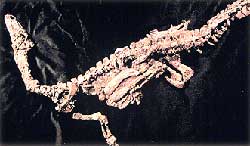
Paul Sereno Eoraptor
- the most primitive dinosaur lived 228 million years ago
and was a small fierce predator.
|
It was this last discovery
that set the scene for the human imagination to run wild. It has
led to all kinds of speculation about their locomotion, behaviour
and physiology. Imagine if we had to share our planet with creatures
that could run up to 26 miles an hour, weighed up to 100 tonnes
and had a taste for human flesh. In reality many of them were probably
vegetarian, but it’s the flesh eaters that have fuelled our
fears. By the 1840s they were officially named the ‘Dinosauria’:
meaning Greek for ‘terrible lizard’.
Dinosaur footprints
reveal that many of them walked erect in a fashion similar to modern
birds, putting one foot in front of the other. The earliest dinosaurs
were small, light carnivores and omnivores, probably extremely quick
and agile to avoid any large predators. During the Jurassic and
Cretaceous periods they evolved into many different types, some
of them reaching colossal size. The largest dinosaur we have ever
found is Seismosaurus in New Mexico. Its fossil bones reveal
an animal that may have weighed in at 30 tonnes and was up to an
incredible 170 feet long; 2 times longer than today’s largest
animal, the blue whale.
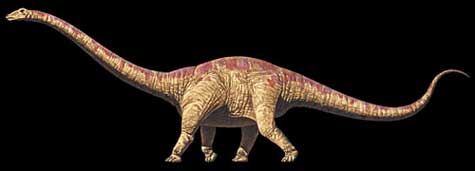
Joe Tucciarone At
nearly 170ft long the Seismosaurus was the largest animal
to ever walk the earth.
|
Sauropods like Argentinosaurus
had long necks and reached giant proportions, weighing up to 100
tonnes. Their immense size kept them firmly on all four feet lumbering
along like giant elephants. Wild elephant can be killers but frequent
childhood visits to zoos have left us all with the belief that elephants
are gentle, kind creatures capable of weeping. This anthropomorphic
approach may not only be misleading about elephants it may be even
more misleading about long extinct creatures like Diplocodus.
They may have lived in harmonious groups and they may have been
gentle giants, protected by their size rather than by their aggression.
If they had met humans they may, like elephants, have become our
best friends offering small children rides at the local zoo. But
the truth is we simply don’t know. They may have been highly
aggressive, intent on decimating anything in their path: monster
gardeners with small brains.
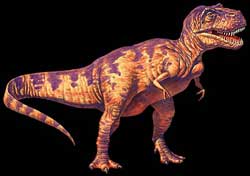
Joe Tucciarone
The
Tyrannosaurus Rex -the film maker's dream
|
Where our imagination
really runs wild is with the king of the dinosaurs, the Tyrannosaurus.
Just their appearance - large heads, sharp claws, backward curving,
doubly serrated teeth all fill us with fear. From just a few early
bones Victorian palaeontologists soon built up a picture of a powerful
creature with small front limbs, massive powerful rear legs, capable
of grasping its prey in its jaws and casually ripping meat off in
much the same way we might tackle a chicken leg. This fearsome creature
has been a story teller’s dream, a monster from our worst nightmares,
a beast that already lurked in the deep primeval forest of our darkest
dreams. This fear is part of our genetic makeup, part of our primal
instinct. Film makers and television producers have long understood
the fatal attraction we have for these creatures from hell. It’s
hard to imagine but perhaps Tyrannosaurus was timid and docile
and that all along we have been completely wrong. We will never
know, but like the lion tamer it would be a brave person that volunteered
to be in the same cage as a 6 tonne reptile most scientists agree
was a ferocious carnivore.
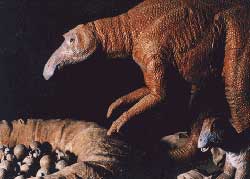
Miami
museum Maiasaurus
- the 'mother' dinosaur, an image we find comforting.
|
The fact that dinosaurs are long extinct adds to their intrigue.
Like a murder hunt it needs careful forensic work to unlock the
secrets of how they walked, ate and bred. Fossil evidence tells
us that like most other reptiles and birds the dinosaurs built nests
and laid eggs. The remains of nests and newly hatched plant eating
dinosaurs have been found in Montana in the USA. Layer upon layer
of fossilised nests in the Gobi Desert suggest that the dinosaurs
returned to the same nesting sites year after year. Nests, young
helpless chicks and caring parents all are images that we find familiar
and comforting. It reassures us that even a creature as strange
and alien as a dinosaur was capable of the nurturing, social behaviour
that we find so reassuring and essential in our own lives.
There is also the vexed
question of whether dinosaurs were cold or warm blooded. Reptiles
are cold but birds are warm blooded. But again, short of cloning
a modern dinosaur from ancient original DNA molecules (as portrayed
in Michael Crichton brilliant book "Jurassic Park" later
turned into a Hollywood block buster by Steven Spielberg) we can
never know the absolute truth. But perhaps the greatest mystery
of all is how they became extinct. What force of nature was so powerful
that it managed to kill off the most successful group of animals
of all time? Theories about their demise range from asteroid impact,
rising sea levels to today’s main contender: massive volcanic
eruptions. Read our previous article "Extinction!"
which points to an intriguing balance of all three factors. Whatever
killed them must have been catastrophic. A highly successful group
of animals that roamed the Earth for over 150 million years, more
than seventy times longer than humans, were wiped off the surface
of the planet forever.
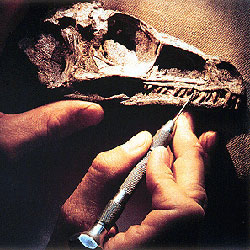
Paul Sereno
It
may have been small but the Eoraptor had razor sharp teeth.
|
A whole branch of scientific
study has grown up around the study of dinosaur fossils. An even
bigger entertainment industry has jumped on to a bandwagon quite
literally 'full of old bones'. Palaeontologists may have been highly
imaginative in the way they have built exotic creatures from fossil
fragments but the producers of the highly acclaimed television series
‘Walking With Dinosaurs’ have taken it much further by
personalising and humanising these ancient leviathans wherever possible.
By brilliantly recreating
the past with computer animated dinosaurs superimposed onto real
life backdrops (for intimate close-ups they brought on up market
hand puppets) they have made perfect natural history documentaries,
telling stories of individuals and of families. They told of the
perils faced by baby dinosaurs, the love of a mother for her child,
the unselfish act of heroism for the needs of the herd. They painted
a picture of the life and death struggle that all living creatures
face - of animals capable of much more than just reaction and instinct.
The reality is we can never know how this fascinating and successful
group of extinct animals really behaved. The scientists have to
make sure that the distinction between reality and what we would
like to imagine happened remains clear and truthful.
Our fascination with
dinosaurs will never diminish. Reflected in the lives of the dinosaurs
we can see the same struggles that we face in our own lives. As
an added bonus we can also confront the monsters hidden in our deep
subconscious. New waves of technologies will improve the way we
can recreate the past and breathe fresh life into our dino-mania.
Soon we will be able to interact with them on the web or merge with
them on giant screens in our living rooms; the land of the dinosaurs
will become the ultimate virtual holiday destination. Imagine a
world where we can smell, touch and be chased by monsters from our
distant past...

