A volcanic eruption is the most
spectacular and frightening phenomenon we can witness on Earth –
but terrestrial volcanoes are dwarfed by the monsters recently discovered
on other worlds.
by Duncan Copp
Volcanism, in its various
guises, is without doubt one of Nature’s most spectacular and
fearsome displays of power. Volcanic eruptions – like those
of Krakatoa, Mount St Helens or Montserrat – destroy huge areas
of land and can kill thousands of people.
Volcanic activity is
also, arguably, the most important of all geological processes.
It makes its presence felt from hundreds of kilometres below the
Earth’s crust up to the cruising altitudes of commercial airliners.
It resurfaces continents, alters climate patterns and – in
the long term - may cause mass extinctions of life. For geologists,
volcanoes also serve as windows through which they can peer into
the heart of the Earth - windows that give invaluable insights into
the processes churning away below our feet.
But Earth is far from
being the only planet where volcanism has played a salient role.
For over thirty-five years a
flotilla of interplanetary spacecraft has set sail for new worlds
beyond our own. These intricate robots, bristling with sophisticated
instruments, act as our remote senses: seeing, listening, and in
some cases touching the surfaces and smelling atmospheres of other
distant bodies. They have presented us with conclusive evidence
that the effects of volcanism are ubiquitous throughout the Solar
System.
Many of these volcanic constructs
dwarf anything we find on Earth. And, by studying extraterrestrial
volcanoes and the material they throw out, planetary scientists
are slowly unravelling the complex geological processes that have
sculpted other worlds.
The volcanic power plant
What causes volcanism? There are two basic ingredients
needed to make a volcano: heat, and something to melt. The latter
is straightforward. Be it rock or ice or a mixture of both, if you
add enough heat it will eventually melt. This gives you the molten
stuff – magma. When magma escapes to the surface it erupts
to form lava flows, which - along with ash and larger boulders -
constructs a volcanic cone.
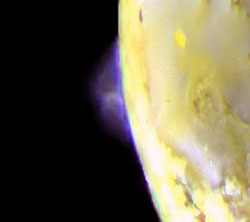
NASA Volcanic
plumes spew forth from the surface of Io.
|
But where does the heat originate?
The first source is primordial heat, the energy left over from a
planet’s formation. It was generated when immeasurable numbers
of planetesimals (comets and asteroids of all shapes and sizes)
collided at hyper-velocities to build up the planet. The impacts
liberated large amounts of energy, mainly in the form of heat.
A second source is important
in providing a slow but continuous source of heat. It’s the
natural decay of radioactive elements such as uranium, thorium and
potassium. These elements release subatomic particles, which give
up heat energy as they are slowed down by the surrounding rock.
Recently, planetary exploration
has led to the identification of a third heat source, unsuspected
by Earth-based geologists. It is tidal energy released in moons
as they orbit in the powerful gravitational field of their parent
planet.
Hell-planet Venus
By studying the shape, distribution and location
of the plethora of volcanic features on other worlds, we can start
to piece together their unique geological jigsaw in the same way
we do on Earth. Much has been learnt about extraterrestrial volcanism
from missions to Earth’s siblings, Venus and Mars.
Between 1990 and 1994 NASA’s Magellan mission
mapped the surface of Earth’s nearest planetary neighbour,
Venus. The orbiting spacecraft used radar to cut through the all-enveloping
clouds that permanently hide a twisted and tormented surface where
volcanism has run rife. Over 80% of the planet’s surface is
covered with volcanic plains called planitia - vast coalescing lava
flows, subsequently warped and fractured by movements of the planet’s
crust. Researchers believe the planitia formed from relatively fluid
lava, similar to the Earth’s basaltic lavas that form the Deccan
Traps in India and the Columbia River Plateau in America.
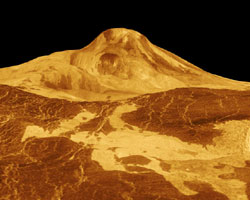
NASA
The
volcano 'Maat Mons' on Venus is 5 miles high and named for
an Egyptian goddess of truth and justice.
|
Magellan mapped huge volcanoes
hundreds of kilometres across and thousands of metres high. These
are ‘shield’ volcanoes, so called because their convex-upward
shape resembles that of a Roman shield, and they are similar to
the volcanoes that make up the Hawaiian Islands. Height measurements
from Magellan show that the large volcanoes are generally located
on large bulges in Venus’s crust. These are thought to represent
‘hot spots’ - plumes of molten rock and heat which well
up from deep within the planet’s interior.
Among other volcanic features
are coronae, circular blisters on the Venusian surface hundreds
of kilometres across which are also formed by up-welling heat from
below. And on a smaller scale, 10-20 kilometres across, the surface
is peppered with literally millions of cone, dome, and shield volcanoes.
The Magellan radar images also
reveal that Venus’s crust is fundamentally different from the
Earth’s, in that it shows no sign of plate tectonics. On our
planet, the process of plate tectonics drives large slabs of the
crust – plates – in perpetual motion around the Earth,
jostling and diving below each other as they go. The action of plate
tectonics is fundamental in cooling the Earth’s molten interior.
First, a vast amount of heat energy is consumed in melting old cold
crust that descends into the hot mantle below. Second, heat escapes
via volcanic eruptions which are concentrated along the margins
of the plates.
Venus appears to be a one-plate
planet, so how does it cool off? Presently there are two main theories.
Venus may lose its internal heat mainly through hot-spot volcanism,
at the large shield volcanoes and coronae, in a controlled gradual
process. Or, periodically, Venus may literally boil over like an
oven pot with a lid, spilling vast quantities of lava onto its surface
and releasing heat in the process. Perhaps this is how the extensive
planitia were formed. The jury is still out on this controversy.
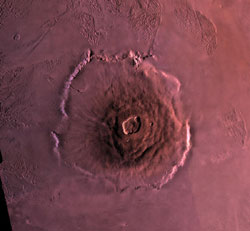
NASA
Olympus
Mons on Mars is the largest volcano in the solar system.
It is three times the height of Mauna Loa and its area is
as large as the entire Hawaiian archipelago.
|
Gigantic volcanoes of
Mars
Mars has also been the target
for numerous robotic Earth emissaries. They have revealed that Mars
today is almost volcanically extinct - but that hasn’t always
been the case. The Mariner 9 spacecraft in 1971 and the two Viking
spacecraft in 1976 first returned images that tell a story of more
dynamic times. Like Venus, Mars boasts an impressive assortment
of volcanic features.
Indeed, the largest volcano
in the Solar System is found on Mars - Olympus Mons. Situated in
the Tharsis province, a huge bulge in the planet’s crust, Olympus
Mons towers some 27 km high, three times higher than Mauna Loa,
Earth’s largest volcano. At least twelve other volcanoes are
found within the Tharsis province including Arsia Mons, Pavonis
Mons and Ascraeus Mons - three giants in their own right.
The Martian volcanoes are also
strikingly similar to the shield volcanoes found on Earth. They
are surrounded by numerous lava flows and channels, and have collapsed
pits or calderas at their summits. The main difference is size -
in every detail the Martian volcanoes are bigger, even though the
planet is only half the Earth’s diameter. Why?
Again the answer lies with plate
tectonics. On Earth, as a crustal plate moves over a hot spot, the
rising plume ‘burns’ a series of holes in the crust -
each hole being marked by a volcano. A good analogy is moving a
piece of paper over a candle. The candle’s heat will burn a
path as the paper moves above. The Hawaiian Islands have formed
as a chain of volcanoes where the Pacific Plate is moving over a
hot spot. Because the crust on Mars is stationary, and has been
some time, up-welling plumes simply continued to burn a larger hole
in the same area of crust, supplying the resulting volcanoes with
more magma that erupted in lava flows. This built up much larger
volcanoes with a longer history of activity, including the vast
bulk of Olympus Mons.
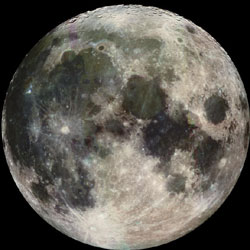
NASA
The
dark maria on the surface of the moon are not 'seas' of
water as once thought but of volcanic basalt flows.
|
Dead worlds, fossilised
eruptions
While there is some debate as
to whether Venus and Mars are volcanically active today, the general
consensus is that the Moon and Mercury are volcanically dead. But
this wasn’t always so.
Just glance at the Moon, and
you can’t fail to notice the large blue-grey patches on its
surface. These patches were once considered to be oceans of water,
hence the name ‘maria’ (Latin for ‘seas’). We
know differently today. In truth they are some of the Solar System’s
largest expanses of basalt, the most common volcanic rock. The lunar
basalts were erupted thousands of millions of years ago, at temperatures
as great as 1400 C. The very high temperatures meant the lavas were
as fluid as engine oil, allowing the flows to cover vast distances.
Mercury also shows evidence
for past volcanism, but you’ll need to look a lot harder to
find it. Masked by craters that pockmark its surface, Mercury hides
lava plains similar to the lunar maria. The craters themselves actually
give some indirect evidence for past volcanic activity on Mercury.
The planet lacks craters less than 50 km in diameter, and the simplest
interpretation is that lavas buried them thousands of millions of
years ago, when Mercury was a much fierier world.
How long ago did volcanism stop
on the Moon and Mercury - and why? Samples of lunar lava returned
by the Apollo astronauts have been dated at 3200 million years or
older - far more ancient than most rocks on the Earth. The cratering
record for both worlds confirms that most volcanic activity ended
over 3000 million years ago.
The reason is simple. Both worlds
are small, compared to the Earth, Venus and Mars. A golden rule
in physics, which applies to volcanic activity on a planet, is that
small bodies cool more quickly than larger bodies. The Moon and
Mercury have cooled faster than the Earth and Venus, hence their
quicker decline in volcanic activity.
Furthermore, because of their
smaller size, the Moon and Mercury had less primordial heat leftover
from their creation. They also contained a smaller fraction of radioactive
elements, the decay of which is all-important in providing planets
with a continued source of internal heat. The Moon and Mercury have
cooled to form thick solid crusts. While their interiors may be
molten, the magma is trapped beneath a deep rigid crust and is sealed
in forever.
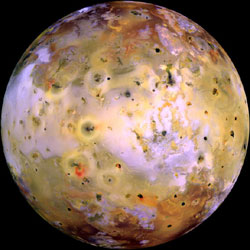
NASA
Io
- the most volcanically active place in the solar system.
|
Erupting moons
To the surprise of many scientists,
the spacecraft armada has revealed that volcanism is not confined
to the rocky planets of the inner Solar System. One of the highlights
of the Voyager missions to Jupiter in 1979 and 1980 was the discovery
of active volcanism on its moon Io. Navigation engineer Linda Morabito
was running a image processing technique to brighten an image returned
from the Voyager 1 spacecraft, when she was greeted by a huge semicircular
plume extending outward some 280 km above the moon’s multicoloured
surface. Previously invisible in the raw image, the faint plume
represented a huge volcanic eruption, spewing a fountain of molten
rock faster than the speed of sound. Further careful processing
of other images revealed no less than eight active volcanoes on
this world.
Io is about the same size as
our Moon, which is now volcanically dead. Why, then, should Io be
the most active volcanic world in the Solar System?
The answer comes the third option
for internal heat, tidal forces. Io is under constant stress. It
orbits Jupiter at approximately the same distance the Moon orbits
Earth - but Jupiter is 318 times more massive. As a result, Io is
constantly stretched by Jupiter’s immense gravitational pull,
and - to make matters worse - its sister moons Europa and Ganymede
tug on Io in the opposite direction. This repetitive tug-of-war
raises and lowers Io’s surface by up to 100 metres as it revolves
around Jupiter. Such tidal forces produce enormous amounts of energy,
in the form of heat in the moon’s interior. Although Io contains
some radioactive elements, it’s the heat liberated in the continuous
flexing that has melted the moon’s interior, resulting in a
surface peppered with over 300 volcanoes, some of which are active
today.
Could similar volcanism be found
on Jupiter’s other large moons, Europa, Ganymede and Callisto?
These moons do undergo tidal heating, but to a lesser extent, as
they lie at greater distances from Jupiter where gravitational forces
are weaker. The answer may lie in recent images from the Galileo
spaceprobe, currently in orbit around Jupiter. They show evidence
for a bizarre form of icy volcanism on Europa and Ganymede. This
‘cryovolcanism’ involves slushy, oozing ices and brines
driven to the surface by interior heat. These moons might also suffer
more dynamic eruptions, with geysers spraying fluid high into a
jet-black sky.
Moving yet further afield, the
Cassini spaceprobe, currently en route to the ringed world Saturn,
may find volcanism on the many moons which circle this gas giant.
Voyager 1 and 2 sped past Saturn with only hours to image the surfaces
of the planet’s moons. Like Galileo at Jupiter, Cassini will
enter orbit around Saturn and repeatedly encounter a selection of
satellites. Who knows what volcanic features its sharp-eyed cameras
may bring into focus?
Cosmic perspective
The new technology that permits planetary exploration
has expanded the science of volcanology far beyond the well-worn
terrestrial field localities of Hawaii and Iceland - the cradles
of volcanic research. Spacecraft have shown that similar kinds of
volcanoes, and also more exotic styles of volcanism, occur throughout
the Solar System.
If we are to fully understand the geological processes
that have shaped our dynamic planet - and others beyond it - we
must be prepared to go looking for the answers. Fortunately we stand
at a revolutionary time, a time where rapid advances in technology
provide us with the means to search, to unravel and eventually to
understand why worlds erupt.

