|
The month of July 2004 has two full
moons, which means one of them is a Blue Moon. But will it really
be blue? Believe it or not, scientists say blue-coloured
moons are real.
By Dr Tony Phillips
When you hear someone
say "Once in a Blue Moon…" you know what they mean: Rare. Seldom.
Maybe even absurd. After all, when was the last time you saw the
moon turn blue?
On July 31st, you should
look, because there's going to be a Blue Moon.
According to modern
folklore, a Blue Moon is the second full moon in a calendar month.
Usually months have only one full moon, but occasionally a second
one sneaks in. Full moons are separated by 29 days, while most months
are 30 or 31 days long; so it is possible to fit two full moons
in a single month. This happens every two and a half years, on average.
July has already had
one full moon on July 2nd. The next, on July 31st, is by definition
a Blue Moon.
But will it really
be blue? Probably not. The date of a full moon, all by
itself, doesn't affect the moon's color. The moon on July 31st will
be pearly-gray, as usual. Unless....
There was a time, not
long ago, when people saw blue moons almost every night. Full moons,
half moons, crescent moons--they were all blue, except some nights
when they were green.
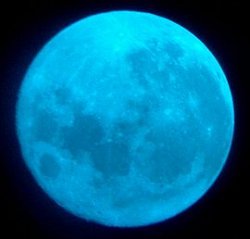
One way to make a blue moon: use a blue filter. That's what
Kostian Iftica did on July 2nd when he photographed this
full moon rising over Brighton, Mass.
|
The time was 1883,
the year an Indonesian volcano named Krakatoa exploded. Scientists
liken the blast to a 100-megaton nuclear bomb. Fully 600 km away,
people heard the noise as loud as a cannon shot. Plumes of ash rose
to the very top of Earth's atmosphere. And the moon turned blue.
Krakatoa's ash is the
reason. Some of the ash-clouds were filled with particles about
1 micron (one millionth of a meter) wide--the right size to strongly
scatter red light, while allowing other colors to pass. White moonbeams
shining through the clouds emerged blue, and sometimes green.
Blue moons persisted
for years after the eruption. People also saw lavender suns and,
for the first time, noctilucent clouds. The ash caused "such vivid
red sunsets that fire engines were called out in New York, Poughkeepsie,
and New Haven to quench the apparent conflagration," according to
volcanologist Scott Rowland at the University of Hawaii.
Other less potent volcanos
have turned the moon blue, too. People saw blue moons in 1983, for
instance, after the eruption of the El Chichon volcano in Mexico.
And there are reports of blue moons caused by Mt. St. Helens in
1980 and Mount Pinatubo in 1991.
The key to a blue moon
is having in the air lots of particles slightly wider than the wavelength
of red light (0.7 micron)--and no other sizes present. This is rare,
but volcanoes sometimes spit out such clouds, as do forest fires:
"On September 23, 1950,
several muskeg fires that had been quietly smoldering for several
years in Alberta suddenly blew up into major--and very smoky--fires,"
writes physics professor Sue Ann Bowling of the University of Alaska.
"Winds carried the smoke eastward and southward with unusual speed,
and the conditions of the fire produced large quantities of oily
droplets of just the right size (about 1 micron in diameter) to
scatter red and yellow light. Wherever the smoke cleared enough
so that the sun was visible, it was lavender or blue. Ontario and
much of the east coast of the U.S. were affected by the following
day, but the smoke kept going. Two days later, observers in England
reported an indigo sun in smoke-dimmed skies, followed by an equally
blue moon that evening."
Credit John McColgan of the Bureau of Land
Management, Alaska Fire Service
Smoke
from forest fires can cause blue moons, too.
|
In the western U.S.,
there will be wildfires burning on July 31st. If any of those fires
produce ash or oily-smoke containing lots of 1-micron particles,
the Blue Moon there could be blue.
More likely, it'll
be red. Ash and dust clouds thrown into the atmosphere by fires
and storms usually contain a mixture of particles with a wide range
of sizes. Most are smaller than 1 micron, and they tend to scatter
blue light. This kind of cloud makes the Moon turn red; indeed,
red Blue Moons are far more common than blue Blue
Moons.
Absurd? Yes, but that's
what a Blue Moon is all about. Step outside at sunset on July 31st,
look east, and see for yourself.
Author's
note: The definition of a Blue Moon used in this story,
"the second full moon in a calendar month," is a curious bit of
modern folklore. How it emerged is a long story involving old almanacs,
a mistake in Sky & Telescope magazine, and the board game Trivial
Pursuit.
|

