|
Astronauts onboard the International Space
Station are capturing some amazing photos of the night sky.
by Dr Tony Phillips
It's a weird place
for an astronomer. Meteors fly underfoot. Auroras appear just inches
in front of your nose. City lights twinkle, but stars don't.
Astronaut Don Pettit
loves every minute of it.
"There's always something
good to see out the window of the space station," says Pettit, who
happens to be an amateur astronomer as well as the science officer
of the International Space Station (ISS).
"Lately we've been
having some extraordinary auroras," he reports. "They meander like
big green amoebas crawling across the sky. Sometimes there is a
faint touch of red layered above the green. These lights are constantly
changing. They swirl. Bright spots come and go. Green blobs transform
into upward-directed rays topped by red feathery structures."
Long before he went
to live onboard the space station, Pettit was an avid aurora watcher.
"I've taken photos of the Northern Lights from Alaska and Canada,"
he says. Some of those displays were magnificent, but "the view
from the station is even better."
Auroras are caused
by electrons and protons from space raining down on Earth's atmosphere.
The solar wind, through a set of complex and fascinating interactions
with the Earth's magnetic field, is the ultimate source of energy
that drives these particles toward our planet. When they hit the
top of the atmosphere, they excite atoms and molecules and make
the air glow. Reds and greens come from atomic oxygen, blues from
nitrogen.
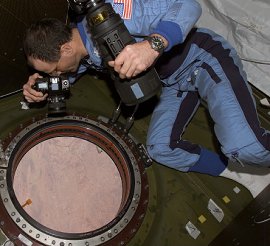
more
Astronaut
Don Pettit, Expedition Six ISS science officer, takes pictures
of Earth through a window in the Destiny laboratory on the
International Space Station (ISS)
|
These colourful lights
range in altitude from 80 km to 500 km above Earth's surface. The
ISS orbits our planet about 400 km high, so the space station can
actually fly through auroras. There's no danger to astronauts, though.
The aurora-causing electrons and protons are thousands of times
less powerful than potentially hazardous cosmic rays.
"Last January 2002
we flew through an auroral curtain over Canada," recalls Pettit.
The station was surrounded by a dimly glowing red fog. Just below
were green rivers of light. "It was like I had been shrunk down
to some miniature dimension and inserted into a tube of a neon sign.
And it was just on the other side of the window pane. I wanted to
reach out and touch, but of course I couldn't."
"Afterwards I had to
clean my nose print off the window."
Auroras aren't all:
"I've seen an occasional meteor while looking down through the Destiny
Lab window," he says. Meteors disintegrate in Earth's atmosphere
below the space station, so you have to look down to see them! "You
can also see space junk orbiting nearby. Sometimes it flickers due
to an irregularity catching light as it rotates. And there are satellites,
too. A flash of sunlight glinting off an Iridium satellite near
the Southern Cross really brought a smile to my face."
| Auroras
over Canada with the Manicouagan
impact crater in the foreground. Clouds and Earth's
surface are illuminated by moonlight. "Here in the same
picture we have two interesting space phenomena: asteroid
impact damage on the surface of Earth and auroras," notes
Pettit.
|
Pettit recently took
some lovely pictures of star fields in the southern hemisphere:
the Large Magellanic Cloud (a nearby galaxy that orbits our own
Milky Way galaxy), the Coal Sack Nebula (an inky-black interstellar
cloud), and the Southern Cross.
"These pictures show
how wonderfully stable the space station is," says Pettit. "When
the camera is mounted to the window, the ISS itself serves as a
tripod. Any movement would cause streaks in the star images." But
the station's Control Moment Gyros maintain attitude with rock-solid
precision. "I don't believe that the ISS was designed for astronomy,"
adds Pettit, "but it functions very well as a platform for astrophotography."
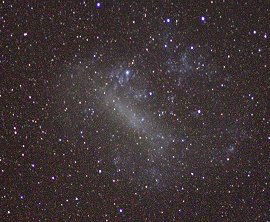
Credit: NASA and Don Pettit
A snapshot
of the Large
Magellanic Cloud - an irregular galaxy visible from
Earth's southern hemisphere.
|
One of the curious
things about sky watching from orbit is the appearance of stars.
"They don't twinkle," says Pettit. Twinkling is caused by irregularities
in Earth's atmosphere that refract starlight to and fro. But in
orbit there is no atmosphere. Stars are remarkably steady and piercing.
City lights, on the
other hand, do twinkle. "From the space station we can see city
lights when it's night-time on the planet below," explains Pettit.
"Shining upwards through the atmosphere, they twinkle like stars.
They're beautiful."
When Pettit tried to
take pictures of city lights he quickly realized it wasn't as easy
as photographing the stars. The station, traveling 17,500 mph, races
around Earth in only 90 minutes. Lights on Earth's surface move
through the window too quickly for long exposures. Stars, on the
other hand, appear nearly motionless because they're so far away.
It's like driving down a highway in a fast-moving car: Distant mountains
and trees don't appear to move much, but the fringe of the road
is a blur.
"I needed something
to help me track the city lights, to cancel the orbital motion of
the station."
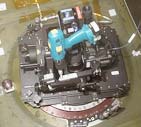
Don Pettit's
homemade "barn door tracker" onboard the ISS.
|
I assembled a 'barn
door tracker'," says Pettit. "It's based on the fine gimbal movements
in the IMAX camera mount for the Destiny Lab window. I figured out
a way to mount a threaded screw and nut (scavenged from a Progress
rocket) and drive it with a Makita drill driver." The drill turns
the screw, which moves the camera and its spotting scope. "All of
these modifications clamp on to the IMAX mount and do not change
its original function in any way," notes Pettit.
"I manually compensate
for the station's motion by looking through the spotting scope and
running the drill at the same time. It takes a bit of practice,
but you do learn to track."
Pettit has since photographed
cities and towns around the world. "With tracking we can see individual
city blocks - no blurring." Some towns are well-organized like checkerboards.
Others are more ... organic. London, for example, resembles a glittering
luminous spider web splayed across the landscape. "Really nice,"
says Pettit.
For sheer beauty, though,
"my favourite is still auroras," he says. "I can't get enough of
them."
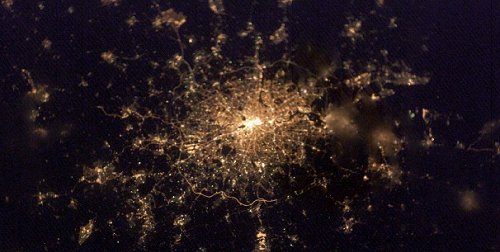
more
London,
England, photographed by Don Pettit from
Earth orbit in February, 2003.
|
Pettit is scheduled
to remain onboard the ISS until May 2003. Until then, in his spare
time, he plans to continue taking pictures and sending them to Earth.
There'll be more auroras, more meteors and star clouds and city
lights.
And probably lots more
nose prints on the window....
|

