|
One hundred years ago, Albert Einstein
revolutionized physics.
by Dr Tony Philips
Albert Einstein was
exhausted. For the third night in a row, his baby son Hans, crying,
kept the household awake until dawn. When Albert finally dozed off
… it was time to get up and go to work. He couldn't skip a
day. He needed the job to support his young family.
Walking briskly to
the Patent Office, where he was a "Technical Expert, Third
Class," Albert worried about his mother. She was getting older
and frail, and she didn't approve of his marriage to Mileva. Relations
were strained. Albert glanced at a passing shop window. His hair
was a mess; he had forgotten to comb it again.
Work. Family. Making
ends meet. Albert felt all the pressure and responsibility of any
young husband and father.
To relax, he revolutionized
physics.
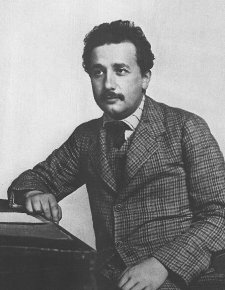
Bushy-haired
superthinker ... ordinary man ... or both?
|
In 1905, at the age
of 26 and four years before he was able to get a job as a professor
of physics, Einstein published five of the most important papers
in the history of science - all written in his "spare time."
He proved that atoms and molecules existed. Before 1905, scientists
weren't sure about that. He argued that light came in little bits
(later called "photons") and thus laid the foundation
for quantum mechanics. He described his theory of special relativity:
space and time were threads in a common fabric, he proposed, which
could be bent, stretched and twisted.
Oh, and by the way,
E=mc2.
Before Einstein, the
last scientist who had such a creative outburst was Sir Isaac Newton.
It happened in 1666 when Newton secluded himself at his mother's
farm to avoid an outbreak of plague at Cambridge. With nothing better
to do, he developed his Theory of Universal Gravitation.
For centuries historians
called 1666 Newton's annus mirabilis, or "miracle
year." Now those words have a different meaning: Einstein and
1905. The United Nations has declared 2005 "The World Year
of Physics" to celebrate the 100th anniversary of Einstein's
annus mirabilis.
Modern pop culture
paints Einstein as a bushy-haired superthinker. His ideas, we're
told, were improbably far ahead of other scientists. He must
have come from some other planet - maybe the same one Newton grew
up on.
"Einstein was
no space alien," laughs Harvard University physicist and science
historian Peter Galison. "He was a man of his time." All
of his 1905 papers unraveled problems being worked on, with mixed
success, by other scientists. "If Einstein hadn't been born,
[those papers] would have been written in some form, eventually,
by others," Galison believes.
What's remarkable about
1905 is that a single person authored all five papers, plus the
original, irreverent way Einstein came to his conclusions.
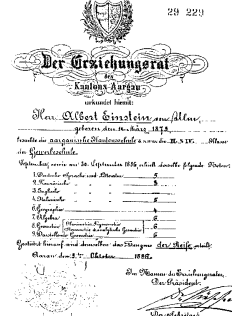
Einstein's
High School Diploma. Contrary to urban legend, Albert
did well in school.
|
For example: the photoelectric
effect. This was a puzzle in the early 1900s. When light hits a
metal, like zinc, electrons fly off. This can happen only if light
comes in little packets concentrated enough to knock an electron
loose. A spread-out wave wouldn't do the photoelectric trick.
The solution seems
simple - light is particulate. Indeed, this is the solution Einstein
proposed in 1905 and won the Nobel Prize for in 1921. Other physicists
like Max Planck (working on a related problem: blackbody radiation),
more senior and experienced than Einstein, were closing in on the
answer, but Einstein got there first. Why?
It's a question of
authority.
"In Einstein's
day, if you tried to say that light was made of particles, you found
yourself disagreeing with physicist James Clerk Maxwell. Nobody
wanted to do that," says Galison. Maxwell's equations were
enormously successful, unifying the physics of electricity, magnetism
and optics. Maxwell had proved beyond any doubt that light was an
electromagnetic wave. Maxwell was an Authority Figure.
Einstein didn't give
a fig for authority. He didn't resist being told what to do,
not so much, but he hated being told what was true. Even
as a child he was constantly doubting and questioning. "Your
mere presence here undermines the class's respect for me,"
spat his 7th grade teacher, Dr. Joseph Degenhart. (Degenhart also
predicted that Einstein "would never get anywhere in life.")
This character flaw was to be a key ingredient in Einstein's discoveries.
"In 1905,"
notes Galison, "Einstein had just received his Ph.D. He wasn't
beholden to a thesis advisor or any other authority figure."
His mind was free to roam accordingly.
In retrospect, Maxwell
was right. Light is a wave. But Einstein was right, too. Light is
a particle. This bizarre duality baffles Physics 101 students today
just as it baffled Einstein in 1905. How can light be both? Einstein
had no idea.
That didn't slow him
down. Disdaining caution, Einstein adopted the intuitive leap as
a basic tool. "I believe in intuition and inspiration,"
he wrote in 1931. "At times I feel certain I am right while
not knowing the reason."
Although Einstein's
five papers were published in a single year, he had been thinking
about physics, deeply, since childhood. "Science was dinner-table
conversation in the Einstein household," explains Galison.
Albert's father Hermann and uncle Jakob ran a German company making
such things as dynamos, arc lamps, light bulbs and telephones. This
was high-tech at the turn of the century, "like a Silicon Valley
company would be today," notes Galison. "Albert's interest
in science and technology came naturally."
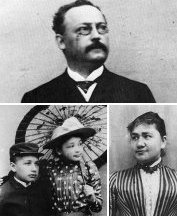
more
Einstein's
family: Albert and sister Maja (bottom left), father Hermann
(top), and mother Pauline (bottom right).
|
Einstein's parents
sometimes took Albert to parties. No babysitter was required: Albert
sat on the couch, totally absorbed, quietly doing math problems
while others danced around him. Pencil and paper were Albert's GameBoy!
He had impressive powers
of concentration. Einstein's sister, Maja, recalled "...even
when there was a lot of noise, he could lie down on the sofa, pick
up a pen and paper, precariously balance an inkwell on the backrest
and engross himself in a problem so much that the background noise
stimulated rather than disturbed him."
Einstein was clearly
intelligent, but not outlandishly more so than his peers. "I
have no special talents," he claimed, "I am only passionately
curious." And again: "The contrast between the popular
assessment of my powers ... and the reality is simply grotesque."
Einstein credited his discoveries to imagination and pesky questioning
more so than orthodox intelligence.
Later in life, it should
be remembered, he struggled mightily to produce a unified field
theory, combining gravity with other forces of nature. He failed.
Einstein's brainpower was not limitless.
Neither was Einstein's
brain. It was removed without permission by Dr. Thomas Harvey in
1955 when Einstein died. He probably expected to find something
extraordinary: Einstein's mother Pauline had famously worried that
baby Einstein's head was lopsided. (Einstein's grandmother had a
different concern: "Much too fat!") But Einstein's brain
looked much like any other, gray, crinkly, and, if anything, a trifle
smaller than average.
Detailed studies of
Einstein's brain are few and recent. In 1985, for instance, Prof.
Marian Diamond of UC Berkeley reported an above-average number of
glial cells (which nourish neurons) in areas of the left hemisphere
thought to control math skills. In 1999, neuroscientist Sandra Witelson
reported that Einstein's inferior parietal lobe, an area related
to mathematical reasoning, was 15% wider than normal. Furthermore,
she found, the Slyvian fissure, a groove that normally extends from
the front of the brain to the back, did not go all the way in Einstein's
case. Might this have allowed greater connectivity among different
parts of Einstein's brain?
No one knows.
Not knowing.
It makes some researchers feel uncomfortable. It exhilarated Einstein:
"The fairest thing we can experience is the mysterious,"
he said. "It is the fundamental emotion that stands at the
cradle of true art and true science."
It's the fundamental
emotion that Einstein felt, walking to work, awake with the baby,
sitting at the dinner table. Wonder beat exhaustion, every day.
|

