|
In this story a scientist describes his down-to-earth
encounters with poisonous snakes, charging elephants and more ...
as he tested a high-flying satellite from the wilds of Africa.
by Patrick L.Barry
You're awake at 5 a.m. After dressing,
you wait for the game guard to show up with his .50-calibre elephant
rifle. He's going to escort you from the gate in the electrified
fence -- the one that keeps the lions out at night -- to your waiting
truck.
As you drive along, avoiding crater-like
pot holes and reckless cab drivers, you spot a few zebras crossing
the road ahead. To keep a safe distance you slow down -- but not
for long. A few kilometres later, you're frantically accelerating
to outrun a charging elephant.
Talk about rush hour traffic!
When you finally arrive at work (50
miles and a couple of detours later) you're careful to lock the
truck. That way baboons can't get inside and tear things up.
There's not much time to lose now.
The instruments have to be ready before 10:30 a.m. That's when the
satellite passes overhead.
Despite a close encounter with a poisonous
snake, you have everything assembled and ready to go half an hour
early.
Then, one of the scientists from the
airfield radios to say the reconnaissance planes are grounded --
bad weather strikes again. They've cancelled today's mission. Oh
well, there's always tomorrow! Another day, another adventure for
NASA researcher Mark Helmlinger.
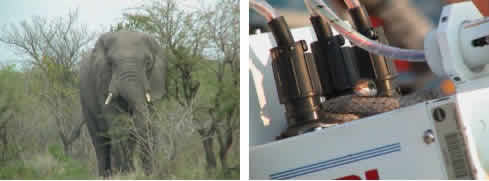
Photos by Mark Helmlinger.Both of these
photos were taken by Mark Helmlinger during his field research
in Africa. The left image was taken while accelerating in
reverse to escape the bull elephant's mock charge. Did you
notice the snake in the image on the right? Mark didn't notice
this poisonous snake either until a colleague pointed it out
-- after Mark's head had passed within inches of the snake!
|
Mark, who works for NASA's Jet Propulsion
Laboratory, is one of hundreds of researchers involved in SAFARI
2000, an international campaign to study the impact of human activities
on southern Africa's unusually self-contained environment. Using
instruments on the ground, on airplanes, and on satellites, the
scientists hope to understand how gases released into the atmosphere
by industrial and biological sources affect phenomena ranging from
regional crop productivity to global climate change.
But first, people like Mark must go
out in the field to gather the data.
"You learn really quickly the extraordinary
means you have to go through to get the job done," Mark said.
Coping with the dangers of African
wildlife kept Mark on his toes. His team conducted some of their
experiments at an instrument tower in Krugar National Park in South
Africa. The park offered favourable conditions for the measurements,
but working there meant dealing with the ever-present threat of
lions.
"The lions own the place," Mark said.
"You don't get out of your car at all, and you don't go out at night."
"When I went out to the tower site,
I had to park the car some distance away so that the instruments
were not measuring the car. I had to hire a game guard -- a big
guy with a big gun -- and his job was to keep his eyes open and
scare off any big game."
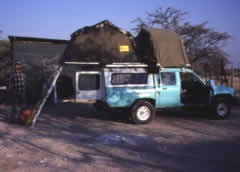
Even when travelling outside of wildlife
preserves, Mark and his colleagues would pitch their tents on
top of their truck just to be safe.
"The tents are on top so that lions
don't get you when you go camping across the countryside," he said.
"They won't climb the ladders. Lions don't like to climb things,
and they haven't figured out yet that tents have yummy things inside."
With so many lions about, one thing
you don't want to run short of is gasoline.
"Unleaded gas is not very common in
that part of the world," he recalled, "and the rental company rented
me a truck that ran only on unleaded gasoline. Boy, was that a pain!
I had to take some empty 55-gallon drums from the airstrip [all
the way] to a gas station 100 kilometres away, fill them all up,
and bring them back so I could have my own fuel dump."
Far from home "you get into situations
where one crucial thing that you need just isn't there, and you
have to go way out of your way to make do with something else. So
you've got to be clever."
On top of all the logistical challenges
and the constant distraction of wildlife, Mark and the rest of the
scientists still had to do their science -- itself a logistical
nightmare.
The tricky part was
that scientists wanted to measure
the same aspects of the environment from the ground, from airplanes,
and from space, all three at the same place and at the same time.
Imagine all that complex technology coming together with perfect
timing to pull off such a feat!
"That means all of your instruments
have to be installed and working on the ground, the airplane has
to be able to make it to the site with all of its instruments running
-- and there are usually several airplanes -- and then of course
the space platform, Terra, must be overhead," Mark explained.
"The metaphor that Dr. Jim Conel, a
colleague of mine at JPL, uses is that it's like trying to balance
several pencils on top of each other on the end of your finger --
each pencil representing one of the factors that has to go right
before the whole thing gets pulled off."
When the weather co-operates and everything
goes just right, the scientists called it a "Golden Day."
"In this business, if you get one Golden
Day a month you're doing good," said Mark, "even though you had
every day of that month as an opportunity to do your mission."
During his most recent trip to Africa,
Mark's project enjoyed three Golden Days.
Dealing with potentially life-threatening
circumstances for months to obtain just three days of peak data
certainly reflects the commitment these scientists have for the
work they do.
"A lot of these professionals could
be making a whole lot more money somewhere else," Mark said. "But
they're studying a problem that's ultimately for the benefit of
humanity. I think to a small extent that's in the back of everyone's
mind, and that's kind of what holds everybody together and keeps
us focused."
That and a charging elephant will do
wonders for your concentration!
|