|
Long before the International Space Station (ISS) project was actually
underway, a permanent space station where people live and work existed
in the minds of science fiction writers and the imaginations of
those who read their books.
by Patrick Barry
Orbiting 1,075 miles above the Earth,
a 250-foot-wide inflated "wheel" of reinforced nylon was conceived
in the early 1950s to function as a navigational aid, meteorological
station, military platform, and way station for space exploration
by rocket pioneer Wernher von Braun.
Among those fascinated
by tales of women and men living in space was a teenage boy growing
up in Germany in the 1920s. Young Wernher von Braun was so inspired
by the dream of space travel that he devoted his life to space science
and rocketry. After a circuitous path that led through Nazi Germany
(the SS and the Gestapo once arrested von Braun for crimes against
the state because he persisted in talking about building rockets
which would go into orbit around the Earth and perhaps go to the
Moon), Wernher von Braun went on to become one of the leaders of
the American space program and a celebrity for his early predictions
of the coming Space Age.
In a groundbreaking
1952 article in Collier's magazine -- five years before Sputnik
-- von Braun wedded fantasy to physics in his vision of how then-existing
technology could be used to put a permanent space station into orbit
around the Earth.
Soon after, von Braun
appeared in a three part Disney television show, which he helped
to produce, on the future of space travel. The shows -- "Man in
Space," "Man and the Moon" and "Mars and Beyond" -- were enormously
popular.
 NASA
NASA
Wernher
von Braun (right) poses next to Walt Disney.
|
In 1950, von Braun
and his team were transferred to Huntsville, Alabama, his home for
the next twenty years. Between 1950 and 1956, von Braun led the
Army's development team at Redstone Arsenal, resulting in the Arsenal's
namesake: the Redstone rocket.
Still dreaming of a
world in which rockets would be used for peaceful exploration, in
1952 Dr. von Braun published his concept of a space station in Collier's
magazine. This station would have a diameter of 250 feet, orbit
in a 1075 mile-high orbit, and spin to provide artificial gravity.
In his vision, it would be the perfect jumping-off point for lunar
expeditions.
Dr. Von Braun also
worked with Disney studios as a technical director for three television
films about Space Exploration. Over the years von Braun continued
his work with Disney, hoping that Disney's involvement would bring
about greater public interest in the future of the space program.
As Director of the
Development Operations Division of the Army Ballistic Missile Agency
(ABMA), von Braun's team then developed the Jupiter-C, a modified
Redstone rocket. The Jupiter-C successfully launched the western
hemisphere's first satellite, Explorer 1, on January 31, 1958. This
event signaled the birth of America's space program.
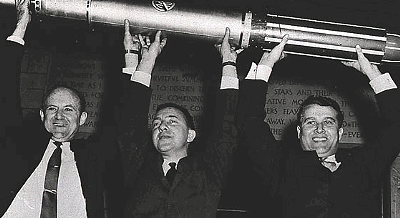
NASA
Displaying
a model of the Explorer 1 are (l-r): Jet Propulsion Laboratory
(JPL) Director Dr. William Pickering, Dr. James van Allen
of the State University of Iowa, and Dr. von Braun.
|
NASA was established by law on July 29, 1958. One day later, the
50th Redstone rocket was successfully fired off Johnson Island in
the South Pacific as part of Project Hardtack. Two years later NASA
opened the new Marshall Space Flight Center in Huntsville, Alabama
and transferred von Braun and his development team from the ABMA
at Redstone Arsenal to NASA. Dr. von Braun was the center's first
Director, from July 1960 to February 1970.
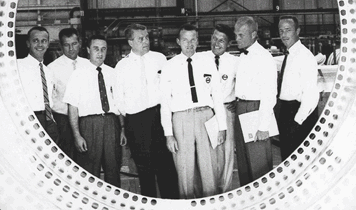
NASA
Von Braun
with the original Mercury Astronauts in ABMA's Fabrication
Laboratory during a 1959 visit.
|
The public enthusiasm
sparked by the shows and the Collier's article, which ran 4 million
copies, is considered a turning point in the American pursuit of
space travel by some historians.
"Von Braun (caused)
a great shift in public opinion in terms of space flight," said
Mike Wright, historian for NASA's Marshall Space Flight Center in
Huntsville, Ala., where von Braun conducted much of his work.
"(He moved) that view
of peaceful space exploration -- the idea of going to other planets
-- into the realm of a potential, of a reality," Wright said.
People took von Braun's
predictions very seriously, Wright said. After all, von Braun was
the technical director for the Army Ordnance Guided Missiles Development
Group at the time, and later became the director of NASA's Marshall
Space Flight Center.
In other words, he
knew what he was talking about.
Still, von Braun's
space station concept looks considerably different from the International
Space Station's design.
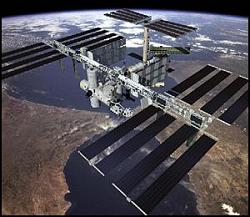
NASA
A digital
artist's concept of the International Space Station.
|
While the ISS resembles
something constructed from an Erector Set, the paintings in the
Collier's article look more like the space station in the movie
2001: A Space Odyssey. Shaped like a wheel with two spokes, von
Braun's space station would spin like a carnival ride to create
centrifugal force that would act as a false gravity. Inside the
wheel, three decks would provide room for the communications equipment,
earth observatories, military control centers, weather forecasting
centers, navigational equipment, living space and mercury-vapor
power generating turbines that would facilitate the many functions
that von Braun imagined the station would perform.
Many of these details
were devised by von Braun, but the concept of a spinning wheel-shaped
space station had been thought of before.
In the 1928 book The
Problem of Space Travel, Herman Potocnik laid out detailed plans
for a wheel-like space station that he called the "Habitat Wheel."
In 1926, when he was
14 years old, von Braun found inspiration in German physicist Hermann
Oberth's The Rocket Into Planetary Space. (Just four years later,
von Braun would be working as an assistant to Oberth in his rocket
program.) The science fiction works of Jules Verne, such as From
the Earth to the Moon, also inspired the young von Braun, according
to Wright. That story was published in English in 1873.
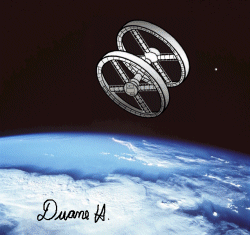
NASA
Duane Hilton's
recollection of the famous space station from the movie
2001: A Space Odyssey.
|
Stanley Kubrick's movie
2001: A Space Odyssey popularized the idea of space stations in
the Apollo and post-Apollo eras, but fictional accounts of a space
station appear as early as 1869, when Edward Everett Hale published
a story called The Brick Moon. In that story, Hale depicted a manned
satellite that functioned as a navigational aide to ships at sea.
Before that, fantasies about traveling in space date back as early
as the second century, when the Greek rhetorician Lucian wrote an
account of a voyage to the Moon.
But while space travel
and space stations had appeared frequently in writings of science
fiction and scientific speculation, von Braun brought charisma and
political savvy to the cause.
"He was revolutionary
in his science and his engineering, but he was also revolutionary
in this approach of going directly to the public," Wright said.
"Von Braun said we (scientists) can publish scientific papers and
treatises until hell freezes over, but if we don't get the attention
of the tax payer, we're not going anywhere."
The first sentence
of the 1952 Collier's article certainly got people's attention.
In the shadow of the growing Cold War, von Braun began his space
prophecy:
"Within the next 10
or 15 years, the earth will have a new companion in the skies, a
man-made satellite that could be either the greatest force for peace
ever devised, or one of the most terrible weapons of war -- depending
on who makes and controls it."
Certainly von Braun
would have been happy to see that one of his dreams -- the International
Space Station -- is finally becoming a reality. Best of all, the
space station of 2000 is not a weapon of war, as von Braun feared,
but an unprecedented cooperative effort of 16 nations including
the United States and Russia.
|

