|
Scientists are crafting microscopic vessels
that can venture into the human body and repair problems – one cell
at a time.
by Patrick Barry
It's like a scene from the movie Fantastic
Voyage. A tiny vessel - far smaller than a human cell - tumbles through
a patient's bloodstream, hunting down diseased cells and penetrating
their membranes to deliver precise doses of medicines.
Only this isn't Hollywood. This is real science.
Researchers funded by a grant from NASA recently
began a project to make this futuristic scenario a reality. If successful,
the "vessels" developed by these scientists - called nanoparticles
or nanocapsules - could help make another science fiction story
come true: human exploration of Mars and other long-term habitation
of space.
While space applications will be the researchers'
primary focus, nanoparticles also hold great potential for many
fields of medicine, particularly cancer treatment. The tantalizing
promise of delivering tumor-killing poisons directly to cancerous
cells, thus averting the ravaging side-effects of chemotherapy,
has generated a lot of interest in nanoparticles among the medical
community.
"The purpose of these nanoparticles is to introduce
a new type of therapy - to actually go inside individual cells ...
and repair them, or, if there's a lot of damage, to get rid of those
cells," explains James Leary of the University of Texas Medical
Branch. Leary is leading the research along with Stephen Lloyd,
and Massoud Motamedi, also from the University of Texas; Nicholas
Kotov of Oklahoma State University; and Yuri Lvov of Louisiana Tech
University.
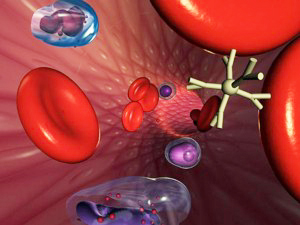
Copyright 1999, Daniel Higgins, University of Illinois at
Chicago.
Tiny capsules much smaller than these blood cells may someday
be injected into people's bloodstreams to treat conditions
ranging from cancer to radiation damage.
|
Their project will focus on a problem related to
cancer - the high radiation doses experienced by astronauts in space,
especially on journeys to the Moon or to Mars, which require leaving
the protective umbrella of the giant magnetic field surrounding
the Earth.
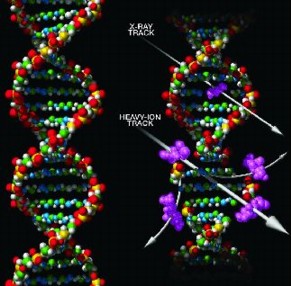
Image courtesy NASA/OBPR.
High-energy cosmic radiation can cause damage DNA and make
cells behave erratically.
|
Even the advanced materials used for radiation
shielding on spacecraft can't fully insulate astronauts from the
high-energy radiation of space. These photons and particles pierce
the astronauts' bodies like infinitesimal bullets, blasting apart
molecules in their path. When DNA is damaged by this radiation,
cells can behave erratically, sometimes leading to cancers.
"This is an important problem," Leary says.
"If humans are going to live in space, we have to figure out how
to protect them from radiation better."
Because shielding alone probably won't solve
the problem, scientists must find some way to make the astronauts
themselves more resistant to radiation damage.
Nanoparticles offer an elegant solution. These
drug-delivery capsules are tiny - only a few hundred nanometers,
which is smaller than a bacterium and smaller even than the wavelengths
of visible light. (A nanometer is one-millionth of a millimeter.)
A simple injection with a hypodermic needle
can release thousands or millions of these capsules into a person's
bloodstream. Once there, nanoparticles will take advantage of the
body's natural cellular signaling system to find radiation-damaged
cells.
The trillions of cells in a human body identify
themselves and communicate with each other via complex molecules
embedded in their outer membranes. These molecules act as chemical
"flags" for communicating to other cells or as chemical "gates"
that control entrance to the cell for molecules in the bloodstream
(such as hormones).
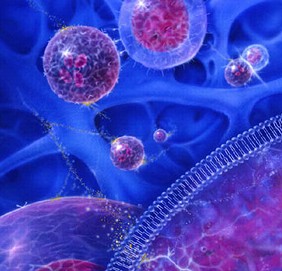
Image copyright Scott Barrows, University of
Illinois at Chicago.
A two-layered membrane separates the cell interior in the
bottom-right of this image from the surrounding environment.
Complex molecules in this outer membrane control how the
underlying cell interacts with its surroundings.
|
When cells become damaged by radiation, they
produce markers in a particular class of proteins called "CD-95"
and place these on their outer surfaces.
"It's how the cell speaks to other cells and
says, 'Hey, I'm injured,'" Leary says.
By implanting molecules in the outer surface
of the nanoparticles that bind to these CD-95 markers, scientists
can "program" the nanoparticles to seek out these radiation-damaged
cells.
If the radiation damage is very bad, nanoparticles
can enter the damaged cells and release enzymes that initiate the
cell's "auto-destruct sequence," known as apoptosis. Otherwise,
they can release DNA-repair enzymes to try to fix the cell and return
it to normal functioning.
Humans and other organisms have natural enzymes
that tend to DNA and repair mistakes, but some do a better job than
others. "There are organisms that can [absorb high] radiation
doses and do just fine," Leary says. By studying such species,
scientists have already fashioned DNA-repairing enzymes that could
be delivered by nanoparticles.
Leary's team is also studying ways to attach
fluorescent molecules to the nanoparticles. These could be designed
to light up at certain stages of the process, even employing different
colors for different stages. These fluorescent tags would provide
a way to monitor the nanoparticles within the body.
"To assess the degree of radiation damage, an
astronaut would put on something like a pair of glasses, but those
glasses peer inward onto the retina," Leary explains. "And you use
the flowing of [fluorescent] nanoparticles on cells through the
retina as sort of an in vivo assessment instrument." (In
vivo means "within the organism.")
Related technology already exists - it's used
to measure blood flow changes in the retina due to various diseases.
NASA is interested in such non-invasive ways to monitor health because
astronauts might need to act as their own doctors on extended missions.
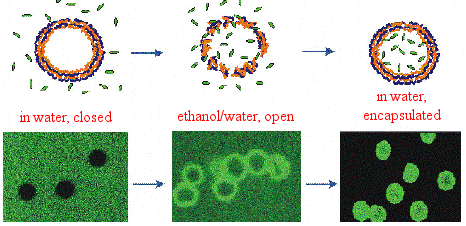
Courtesy Yuri Lvov, Louisiana Tech University.
In this illustration nanocapsule walls are partially dissolved,
then allowed to reform, trapping fluorescent-tagged drug
molecules inside. Such vessels can be made of self-assembling
polymers or of semiconductor materials such as cadmium telluride.
|
"Eventually, astronauts might wear these glasses
to sample what's going on in their bloodstream. And then if they
need treatment, they have a hypodermic needle with the appropriate
nanoparticles for the job," he says.
Nanoparticles are a radically new approach to
biosensing and medicine delivery, and as such the technology will
require many more years to become mature and dependable. But it's
not a pie-in-the-sky fantasy. All the elements of this idea have
already been demonstrated separately - the DNA-repair enzymes, the
nanoparticles, the fluorescent tags. The trick is getting them all
to work together reliably.
"This is a very difficult problem, and we're
not going to be able to do it all in three years," which is the
duration of the grant. "We're trying to do some pretty innovative
science here - it's a bit of a jump," says Leary. "But that's why
it's a lot of fun to work on."
|

