|
A picture of our
universe from the first moments of its existence helps explain why
it looks the way it does.
by Jo Locke
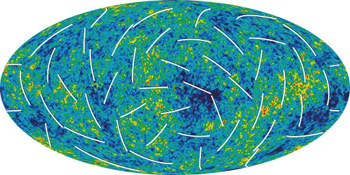 Photo courtesy
of NASA/WMAP Science Team
Photo courtesy
of NASA/WMAP Science Team
The new
picture of the early universe shows tiny temperature fluctuations
in CMB, where red and blue colours indicate warmer and cooler
spots. The white lines show the direction of polarisation
of the oldest light.
|
|
For centuries, people have looked up
at the stars and wondered why they are scattered the way they are
in the night sky. Scientists still haven't completely solved this,
but in March 2006 some researchers came a whole lot closer to understanding
how our universe came to look the way it does. Using data from a
NASA satellite, they were able to capture in the greatest detail
yet a picture of the light from our universe dating back to instants
after the Big Bang when it was first created. It's a breakthrough
in cosmological research since it has allowed scientists to gaze
back to the first trillionth of a second of our universe and distinguish
between different versions of what happened in those crucial instants
after the Big Bang.
The light that scientists are observing
is cosmic microwave background radiation (CMB), or the afterglow
of light that still remains from the Big Bang 13.7 billion years
ago. The Wilkinson Microwave Anisotropy Probe (WMAP) satellite,
launched in 2001 and now a million miles from Earth in the direction
opposite the sun, has been measuring minute temperature fluctuations
in the afterglow for three years. In 2003, the temperature fluctuations
it had recorded had produced a very detailed picture of the early
universe and allowed scientists to get answers to questions about
the age of the universe, its composition and how it developed. Since
then, the satellite has been looking at polarisation, or the pattern
of the residual afterglow, a signal less than a hundred times weaker
that the previous temperature maps. This data has added detail to
the picture obtained in 2003 and has determined that the first stars
were formed 400 million years after the Big Bang. "This is brand
new territory," said Princeton University physicist Lyman Page,
a WMAP team member. "We are quantifying the cosmos in a different
way to open up a new window for understanding the universe in its
earliest times."
 Photo
courtesy of NASA/WMAP Science Team
Photo
courtesy of NASA/WMAP Science Team
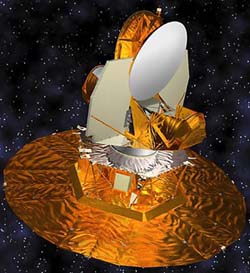
Artist's rendition of the WMAP spacecraft.
|
This recent data is groundbreaking
since it is the first evidence to support the theory of inflation,
first proposed 25 years ago. The theory states that in the instants
after the Big Bang, the universe expanded at an incredible rate.
This rapid expansion, which is thought to have caused the volume
of the universe to expand from just a few centimetres to about 18
billion light years in a fleeting moment, left its mark as rips
or tears, called quantum fluctuations, in the very early universe.
These were thought to have been amplified in the CMB radiation,
and in the images from the WMAP satellite, scientists were able
to see evidence of this as variations in brightness.
In addition to supporting the inflation
theory, the new WMAP data also supports theories of what happened
to matter and energy in the 13.7 billion years since the Big Bang.
Fluctuations in density seen in the images are considered to be
a sort of template for star and galaxy formation and life. They
reveal that only 4% of our universe is made up of atoms, whereas
74% is a mysterious dark energy and 22% is unidentified dark matter.
Dark energy is thought to be what is causing our universe to continue
to expand, albeit much more slowly than during the moments of inflation.
 Photo
courtesy of NASA/WMAP Science Team
Photo
courtesy of NASA/WMAP Science Team
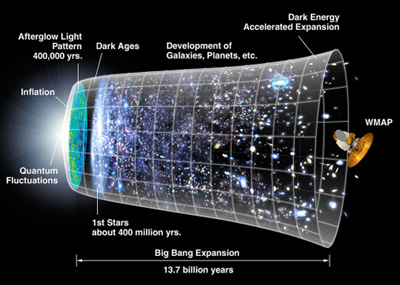
Universe Timeline: This image shows that the expansion of the universe has been quite gradual after the initial period of inflation.
|
Obtaining data that supports cosmological theories is a big step forward in truly understanding the universe. Since the accidental discovery of CMB radiation in 1978, researchers have been slowly filling in the picture of how the universe was formed. As WMAP scientist David Spergel says: "When I started in this field we had lots of competing ideas about what was going on, we didn't know what the shape of the universe was, we didn't understand where galaxies come from, and now all the pieces seem to fit, and we seem to have a coherent model that ties with what we see in the early universe".
For more info, visit:
WMAP Press Release
http://wmap.gsfc.nasa.gov/m_or/PressRelease_03_06.html
WMAP reveals infant universe
http://www.astronomy.com/asy/default.aspx?c=a&id=4051
|

