|
A cutting-edge science experiment
left behind in the Sea of Tranquility on the moon by Apollo 11 astronauts
is still running today.
by Ron Koczor
The most famous thing Neil Armstrong
left on the moon 35 years ago is a footprint, a boot-shaped depression
in the gray moondust. Millions of people have seen pictures of it,
and one day, years from now, lunar tourists will flock to the Sea
of Tranquility to see it in person. Peering over the rails … "hey,
mum, is that the first one?"
Will anyone notice,
100 feet away, something else Armstrong left behind?
Ringed by footprints,
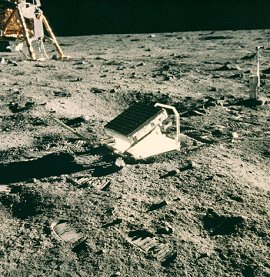
sitting in the moondust, lies a 2-foot wide panel studded with 100
mirrors pointing at Earth: the "lunar laser ranging retroreflector
array." Apollo 11 astronauts Buzz Aldrin and Neil Armstrong put
it there on July 21, 1969, about an hour before the end of their
final moonwalk. Thirty-five years later, it's the only Apollo science
experiment still running.
University of Maryland
physics professor Carroll Alley was the project's principal investigator
during the Apollo years, and he follows its progress today. "Using
these mirrors," explains Alley, "we can 'ping' the moon with laser
pulses and measure the Earth-moon distance very precisely. This
is a wonderful way to learn about the moon's orbit and to test theories
of gravity."
more
The Apollo 11 lunar laser ranging retroreflector array.
|
Here's how it works:
A laser pulse shoots out of a telescope on Earth, crosses the Earth-moon
divide, and hits the array. Because the mirrors are "corner-cube
reflectors," they send the pulse straight back where it came from.
"It's like hitting a ball into the corner of a squash court," explains
Alley. Back on Earth, telescopes intercept the returning pulse--"usually
just a single photon," he marvels.
The round-trip travel
time pinpoints the moon's distance with staggering precision: better
than a few centimeters out of 385,000 km, typically.
Targeting the mirrors
and catching their faint reflections is a challenge, but astronomers
have been doing it for 35 years. A key observing site is the McDonald
Observatory in Texas where a 0.7 meter telescope regularly pings
reflectors in the Sea of Tranquility (Apollo 11), at Fra Mauro (Apollo
14) and Hadley Rille (Apollo 15), and, sometimes, in the Sea of
Serenity. There's a set of mirrors there onboard the parked Soviet
Lunokhud 2 moon rover--maybe the coolest-looking
robot ever built.
In this way, for decades,
researchers have carefully traced the moon's orbit, and they've
learned some remarkable things, among them:
(1) The moon is spiraling
away from Earth at a rate of 3.8 cm per year. Why? Earth's ocean
tides are responsible.
(2) The moon probably
has a liquid core.
(3) The universal
force of gravity is very stable. Newton's gravitational constant
G has changed less than 1 part in 100-billion since the
laser experiments began.

more
Lunar laser ranging at the McDonald Observatory.
|
Physicists have also
used the laser results to check Einstein's theory of gravity, the
general theory of relativity. So far, so good: Einstein's equations
predict the shape of the moon's orbit as well as laser ranging can
measure it. But Einstein, constantly tested, isn't out of the woods
yet. Some physicists (Alley is one of them) believe his general
theory of relativity is flawed. If there is a flaw, lunar laser
ranging might yet find it.
NASA and the National
Science Foundation are funding a new facility in New Mexico, the
Apache Point Observatory Lunar Laser-ranging Operation or, appropriately,
"APOLLO" for short. Using a 3.5-meter telescope with good atmospheric
"seeing," researchers there will examine the moon's orbit with millimeter
precision, 10 times better than before.
"Who knows what they'll
discover?" wonders Alley.
More and better data
could reveal strange fluctuations in gravity, amendments to Einstein,
the "sloshing" of the moon's core. Time will tell ... and there's
plenty of time. Lunar mirrors require no power source. They haven't
been covered with moondust or pelted by meteoroids, as early Apollo
planners feared. Lunar ranging should continue for decades, perhaps
for centuries.
Picture this: Tourists
in the Sea of Tranquility, looking up at Earth. Half of the planet
is dark, including New Mexico where a pinprick of light appears.
A laser.
"Hey, mum," stepping
over a footprint, "what's that star?"
Writer's
Note: Among many early contributors to the the lunar laser ranging
retroreflector array project, Prof. Alley credits Robert Henry Dicke,
James Faller, Peter Bender, Douglas Currie and Bendix Corporation.
A complete list may be found in Alley's account of the project,
"Laser ranging to retro-reflectors on the Moon as a test of theories
of gravity," published in Quantum Optics, Experimental Gravitation,
and Measurement Theory, Eds. P Meystre and M.O. Scully, Plenum
Publishing (1982).
|

