|
A hardy microbe from Earth might one day transform
the barren ground of Mars into arable soil.
By Dr Tony Phillips
Although Mars may once have been warm
and wet, the Red Planet today is a frozen wasteland. Most scientists
agree, it's highly unlikely that any living creature - even a microbe -
could survive for long on the surface of Mars.
When the first humans travel there
to explore the Red Planet up close, they will have to grow their
food in airtight, heated greenhouses. The Martian atmosphere is
far too cold and dry for edible plants to grow in the open air.
But if humans ever hope to establish long-term colonies on their
planetary neighbour, they will no doubt want to find a way to farm
outdoors. Imre Friedmann has an idea of how they might take the
first step.
Friedmann is a microbiologist on the
NASA Astrobiology Institute team at the Ames Research Centre. Friedmann
was one of the invited speakers at a NASA-sponsored conference,
"The Physics and Biology of Making Mars Habitable," held at Ames
late last year. His talk focused on an organism that could be used
to begin the process of converting the Martian surface into arable
soil.
Mars is covered by a layer of ground-up
rock and fine dust, known as regolith. To convert regolith into
soil, it will be necessary to add organic matter, much as organic
farmers on Earth fertilise their soil by adding compost to it.
On Earth, compost is made up primarily
of decayed vegetable matter. Micro-organisms play an important role
in breaking down dead plants, recycling their nutrients back into
the soil so that living plants can reuse them. But on Mars, says
Friedmann, where there is no vegetation to decay, the dead bodies
of the micro-organisms themselves will provide the organic matter
needed to build up the soil.
The trick is finding the right microbe.
"Among the organisms that are known
today," says Friedmann, "Chroococcidiopsis is most suitable"
for the task.
Chroococcidiopsis is one of
the most primitive bacteria known. What makes it such a good candidate
is its ability to survive in a wide range of extreme environments
that are hostile to most other forms of life. Chroococcidiopsis
has been found growing in hot springs, in hypersaline (high-salt)
habitats, in a number of hot, arid deserts throughout the world,
and in the frigid Ross Desert in Antarctica.
"Chroococcidiopsis is the constantly
appearing organism in nearly all extreme environments," Friedmann
points out, "at least extreme dry, extreme cold, and extremely salty
environments. This is the one which always comes up."
Moreover, where Chroococcidiopsis
survives, it is often the only living thing that does. But it gladly
gives up its dominance when conditions enable other, more complex
forms of life to thrive.
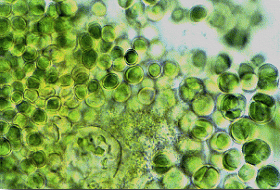
A photomicrograph
of Chroococcidiopsis, enlarged 100 times.
|
For clues on how to farm Chroococcidiopsis
on Mars, Friedmann looks to its growth habits in arid regions on
Earth. In desert environments, Chroococcidiopsis grows either
inside porous rocks, or just underground, on the lower surfaces
of translucent pebbles.
The pebbles provide an ideal microenvironment
for Chroococcidiopsis in two ways. First, they trap moisture
underneath them. Experiments have shown that small amounts of moisture
can cling to the undersurfaces of rocks for weeks after their above-ground
surfaces have dried out. Second, because the pebbles are translucent,
they allow just enough light to reach the organisms to sustain growth.
Friedmann envisions large farms where
the bacteria are cultured on the underside of strips of glass that
are treated to achieve the proper light-transmission characteristics.
Mars today, however, is too cold for this technique to work effectively.
Before even as hardy a microbe as Chroococcidiopsis could
be farmed on Mars, the planet would have to be warmed up considerably,
to just below the freezing point.
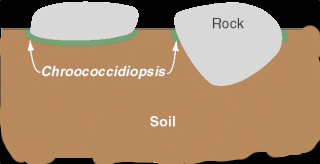
In many
desert environments, Chroococcidiopsis grows on the
undersides of transparent rocks, just below the surface.
|
Friedmann, admits that his ideas about
growing Chroococcidiopsis are, at this point, merely a thought
experiment.
"I don't think any of us alive today
will see this happen," he muses. When the time does come to make
Mars a more habitable place, "the technology will be so different
that everything we plan today... will be ridiculously outdated."
Friedmann fully expects that genetic
engineering will eventually develop designer organisms to do the
job. Even if Chroococcidiopsis is ultimately used as the
basis, it will be a vastly improved version of today's microbe.
|