|
A
recently-discovered fossil could explain how animals transitioned
from water to land over 375 million years ago.
by Jen Schripsema
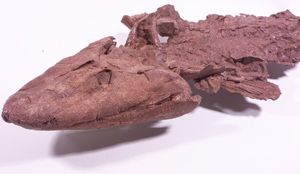 Photo courtesy
of The Academy of Natural Sciences
Photo courtesy
of The Academy of Natural Sciences
Credit: Ted Daeschler
Tiktaalik roseae: The most complete fossils ever found of a transitional fish with limbs.
|
|
To some, the story sounds fishy. Evolutionists believe that about 400 million years ago, animals started to make the transition from living in water to living on land. In those early days, it is thought that animals dwelling in water slowly started to evolve certain features, like limbs and lungs, which allowed them to live on land. Fossils found in Greenland in the past 15 years have shown some evidence of these creatures, but in April 2006, the discovery of a fossil called Tiktaalik roseae is the most compelling evidence to date of the transition.
The fossil was found on Ellesmere Island in Canada's Nunavut Territory by a team of scientists led by Neil Shubin of the University of Chicago. At the suggestion of Inuit elders, they named the fossil Tiktaalik which means "large shallow water fish" in Inuktitut. This creature lived about 370 million years ago during the late Devonian Period, also called the "Age of Fishes." At this time, Ellesmere Island was part of a large landmass straddling the Equator. Competition among fish in the oceans was intense, but the land was largely unexploited. Additionally, the expansion of terrestrial plants transformed the land, setting the stage for its colonization by tetrapods, or four-legged animals.
Scales and fins still qualify Tiktaalik
as a fish, but several other characteristics set it apart. The bones in Tiktaalik's fins formed jointed wrists, the primary
characteristic that scientists believe makes Tiktaalik a transitional
species. Also, its flat skull was disconnected from its shoulders,
giving it the ability to turn its neck. Based on the shape of Tiktaalik's
head and its eyes positioned on the top of its head, scientists
believe it probably spent most of its time in shallow water. "Tiktaalik
was probably an unwieldy swimmer," John Maisey, a paleontologist
at the American Museum of Natural History in New York, told Nature
Online News. "Tetrapods did not so much conquer the land, as escape
from the water."
The discovery of this fossil is groundbreaking because it is so well-preserved and complete. Researchers are confident that Tiktaalik is an intermediary between fish and tetrapods and they believe it will become the same kind of evolutionary icon as Archaeopteryx, the species linking reptiles and birds. Archaeopteryx lived about 150 million years ago and had fully-formed feathers, although it may or may not have been able to fly. The first Archaeopteryx skeleton was discovered in Germany in 1861.
 Photo
courtesy of The Academy of Natural Sciences
Photo
courtesy of The Academy of Natural Sciences
Credit: Ted Daeschler
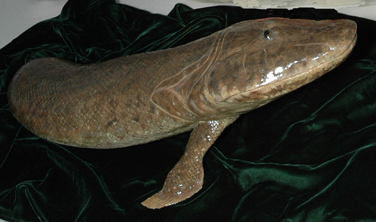
A model of what Tiktaalik probably looked like 375 million years ago.
|
In terms of the evolution versus creation
debate, will the Tiktaalik fossil provide the necessary proof to
non-believers? Dr. Shubin's team has tried to avoid commenting on
the implications the fossil has for the debate, but many other scientists
have not been so quiet. They say Tiktaalik should quell the criticism
by creationists, people believing that all matter and life were
created by God as described in the Bible, that the fossil record
lacks a transitional species. However, many creationists remain
unconvinced.
In the United States, creationists make up a large proportion of the population. A Gallup poll last November showed that only one third of Americans believe there is strong evidence supporting the theory of evolution and almost half believe that God created man in his present form about 10,000 years ago. The Supreme Court ruled in 1987 that creationism was a religion and, therefore, could not be taught in schools.
However, many anti-evolutionists, including President Bush, have promoted teaching intelligent design as an alternative to evolution. This idea, pushed primarily by the Discovery Institute of Seattle, posits that the complexity of the universe and living things are best explained by an intelligent designer. Because they never specify the designer, they argue that the theory is scientific, not religious.
Most scientists are skeptical, saying that intelligent design is just creationism disguised as scientific theory. Eugenie Scott of the National Center for Science Education said to PBS, "You have this mysterious intelligent agent who, of course, is God." Of course, the debate in the U.S. over teaching evolution in schools goes back to the Scopes trial of the 1920s. The implication of discoveries like Tiktaalik for education are likely to be debated well into the future.
Therefore, most scientists are focusing
primarily on the new insight into tetrapod evolution that Tiktaalik
provides. This fossil fills in the gaps of prior fossil evidence,
showing scientists the order in which certain structures evolved.
The jaw of Tiktaalik, for example, remains very fishlike despite
it having evolved limb-like structures. By knowing which features
evolved first, scientists hope to learn more about the history of
evolution on Earth.
For more information about the Tiktaalik discovery:
Tiktaalik roseae
http://tiktaalik.uchicago.edu/
PBS - Fossil Discovery
http://www.pbs.org/newshour/bb/science/jan-june06/fossils_4-6.html
|

