|
Researchers are reviving an old but wild
idea to protect astronauts from space radiation
by Patrick L Barry
Opposite charges attract.
Like charges repel. It's the first lesson of electromagnetism and,
someday, it could save the lives of astronauts.
NASA's Vision for Space
Exploration calls for a return to the Moon as preparation for even
longer journeys to Mars and beyond. But there's a potential showstopper:
radiation.
Space beyond low-Earth
orbit is awash with intense radiation from the Sun and from deep
galactic sources such as supernovas. Astronauts en route to the
Moon and Mars are going to be exposed to this radiation, increasing
their risk of getting cancer and other maladies. Finding a good
shield is important.
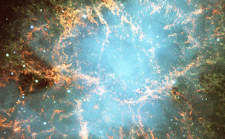
Supernovas
produce dangerous radiation.
|
The most common way
to deal with radiation is simply to physically block it, as the
thick concrete around a nuclear reactor does. But making spaceships
from concrete is not an option. (Interestingly, it might be possible
to build a moonbase from a concrete mixture of moondust and water,
if water can be found on the Moon, but that's another story.) NASA
scientists are investigating many radiation-blocking materials such
as aluminum, advanced plastics and liquid hydrogen. Each has its
own advantages and disadvantages.
Those are all physical
solutions. There is another possibility, one with no physical substance
but plenty of shielding power: a force field.
Most of the dangerous
radiation in space consists of electrically charged particles: high-speed
electrons and protons from the Sun, and massive, positively charged
atomic nuclei from distant supernovas.
Like charges repel.
So why not protect astronauts by surrounding them with a powerful
electric field that has the same charge as the incoming radiation,
thus deflecting the radiation away?

Image courtesy ASRC Aerospace
Artist’s
concept of an electrostatic radiation shield, consisting
of positively charged inner spheres and negatively charged
outer spheres. The screen net is connected to ground.
|
Many experts are skeptical
that electric fields can be made to protect astronauts. But Charles
Buhler and John Lane, both scientists with ASRC Aerospace Corporation
at NASA's Kennedy Space Center, believe it can be done. They've
received support from the NASA Institute for Advanced Concepts,
whose job is to fund studies of far-out ideas, to investigate the
possibility of electric shields for lunar bases.
"Using electric
fields to repel radiation was one of the first ideas back in the
1950s, when scientists started to look at the problem of protecting
astronauts from radiation," Buhler says. "They quickly
dropped the idea, though, because it seemed like the high voltages
needed and the awkward designs that they thought would be necessary
(for example, putting the astronauts inside two concentric metal
spheres) would make such an electric shield impractical."

How the
voltage would vary above a lunar base for the sphere configuration
shown above.
|
Buhler and Lane's approach
is different. In their concept, a lunar base would have a half dozen
or so inflatable, conductive spheres about 5 meters across mounted
above the base. The spheres would then be charged up to a very high
static-electrical potential: 100 megavolts or more. This voltage
is very large but because there would be very little current flowing
(the charge would sit statically on the spheres), not much power
would be needed to maintain the charge.
The spheres would be
made of a thin, strong fabric (such as Vectran, which was used for
the landing balloons that cushioned the impact for the Mars Exploration
Rovers) and coated with a very thin layer of a conductor such as
gold. The fabric spheres could be folded up for transport and then
inflated by simply loading them with an electric charge; the like
charges of the electrons in the gold layer repel each other and
force the sphere to expand outward.
Right: How the voltage
would vary above a lunar base for the sphere configuration shown
above. You can learn more about this and other configurations in
the report Analysis of a Lunar Base Electrostatic Radiation Shield
Concept.
Placing the spheres
far overhead would reduce the danger of astronauts touching them.
By carefully choosing the arrangement of the spheres, scientists
can maximize their effectiveness at repelling radiation while minimizing
their impact on astronauts and equipment at the ground. In some
designs, in fact, the net electric field at ground level is zero,
thus alleviating any potential health risks from these strong electric
fields.
Buhler and Lane are
still searching for the best arrangement: Part of the challenge
is that radiation comes as both positively and negatively charged
particles. The spheres must be arranged so that the electric field
is, say, negative far above the base (to repel negative particles)
and positive closer to the ground (to repel the positive particles).
"We've already simulated three geometries that might work,"
says Buhler.

Image courtesy ASRC Aerospace.
One scenario
for how an electrostatic radiation shield could be deployed
for mobile lunar exploration vehicles. Inverted green
cones denote regions of partial radiation protection.
|
Portable designs might
even be mounted onto "moon buggy" lunar rovers to offer
protection for astronauts as they explore the surface, Buhler imagines.
It sounds wonderful,
but there are many scientific and engineering problems yet to be
solved. For example, skeptics note that an electrostatic shielOne
scenario for how an electrostatic radiation shield could be deployed
for mobile lunar exploration vehicles. Inverted green cones denote
regions of partial radiation protection. d on the Moon is susceptible
to being short circuited by floating moondust, which is itself charged
by solar ultraviolet radiation. Solar wind blowing across the shield
can cause problems, too. Electrons and protons in the wind could
become trapped by the maze of forces that make up the shield, leading
to strong and unintended electrical currents right above the heads
of the astronauts.
The research is still
preliminary, Buhler stresses. Moondust, solar wind and other problems
are still being investigated. It may be that a different kind of
shield would work better, for instance, a superconducting magnetic
field. These wild ideas have yet to sort themselves out.
But, who knows, perhaps
one day astronauts on the Moon and Mars will work safely, protected
by a simple principle of electromagnetism even a child can understand.
|

