|
Recent
evidence shows that the universe is expanding at an accelerating
rate. Furthermore, the data strongly suggest that an unidentified
form of energy is the cause of the accelerating expansion. This
"dark energy" has been deemed perhaps "the most fundamentally mysterious
thing in basic science." Light from distant exploding stars carries
telltale clues that can resolve this enigma.
by Paul Preuss.
The puzzle: what is the nature of the dark energy that fills the
universe? To solve it, Berkeley Lab physicists, astronomers, and
engineers, working with colleagues from the University of California
at Berkeley and other institutions, propose to launch a satellite
named SNAP - the SuperNova/Acceleration Probe.
Through Berkeley Lab's Physics Division the Department of Energy
has funded a year of development for the project, which is meant
to explain what one prominent theorist, Frank Wilczek of MIT, calls
"maybe the most fundamentally mysterious thing in basic science"
- a conundrum that, more colorfully, cosmologist Michael Turner
of the University of Chicago refers to as "the biggest embarrassment
in theoretical physics."
SNAP would orbit a three-mirror, 2-meter reflecting telescope in
a high orbit over Earth's poles, circling the globe every week or
14 days. By repeatedly imaging 20 square degrees of the sky, SNAP
will discover and accurately measure 2,000 type Ia supernovae a
year, 20 times the number of these unique exploding stars - the
key evidence in the dark-energy mystery - that were found in a decade
of ground-based search.
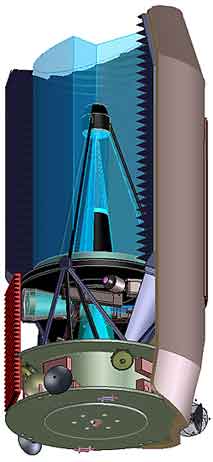
LBL
Engineering
sketch of the supernova acceleration probe. More details can
be found in this
Adobe© Acrobat™ doument (7Mb).
|
Studies of this type of supernova by the international Supernova
Cosmology Project headquartered at Berkeley Lab and the High-Z Supernova
Search Team centered in Australia led to the announcement, in 1998,
of what Science magazine named its "breakthrough of the year" -
that the universe is expanding at an accelerating rate.
Combined with other cosmological studies, such as the BOOMERANG
and MAXIMA cosmic microwave background radiation results reported
earlier this year, the supernova data strongly suggest that the
universe is geometrically "flat" and that as much as two-thirds
of its density is due to an unidentified form of energy - the cause
of the accelerating expansion.
To confirm these results, SNAP would discover many type Ia supernovae
at redshifts greater than any yet found. Because of SNAP's ability
to measure their light curves and spectra to high precision, any
uncertainties concerning the brightness and redshift of very distant
supernovae can be minimized.
SNAP's optics will serve a set of precision instruments:
- a billion-pixel
CCD camera with a 1-square-degree field of view and quantum efficiency
greater than 80 percent, with wavelength coverage from 350 nanometers
to 1 micrometer
- an infrared
imager with up to 10 x 10 arcminutes field of view
- a 3-arm spectrograph
sensitive to wavelengths from the near ultraviolet to the near
infrared
Unlike most astronomical CCDs currently in use, which have relatively
poor response to red and infrared light and are difficult to combine
in large arrays, SNAP will use radiation-tolerant, high-resistivity
CCDs based on Berkeley Lab's experience with detectors developed
for high-energy physics. These can be combined in large-format mosaics
and will extend sensitivity into the infrared, creating an ideal
tool for finding distant, high-redshift supernovae.
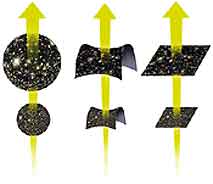
Illustration
by Flavio Robles
Scientists
refer to the shape of the universe as closed, open or flat.
A breif explanation of these terms, is here.
|
Prelude to discovery
For over ten years the Supernova Cosmology Project, supported by
the Department of Energy, the National Science Foundation, and NASA,
has been studying the expansion of the universe by measuring the
redshift and brightness of distant type Ia supernovae.
Type Ia supernovae - stars that explode in thermonuclear cataclysms
brighter than entire galaxies - make ideal "standard candles" with
which to survey the universe. Their light curves and spectra are
all nearly alike and they are bright enough to be seen across billions
of light years.
By 1998 a few score type Ia supernovae had been analyzed in detail,
enough to lead the Supernova Cosmology Project and their colleagues
in the High-Z Supernova Search Team to the startling discovery that
the expansion of the universe is not slowing, as had been expected,
but accelerating.
Redshift in an accelerating universe
As light travels through space, space itself is expanding. The
effect is to stretch light waves and shift their color toward the
red end of the spectrum.

LBL
While
light from a distant galaxy travels across space, space itself,
like this ballon is expanding. As it expands, the wavelength
of the light increases, and its spectrum shifts towards red.
|
Light from the most distant galaxies has traveled billions of years,
giving a snapshot of the universe at a fraction of its present age.
If expansion were slowing under the influence of gravity, supernovae
in distant galaxies should appear brighter and closer than their
high redshifts suggest.
The distant supernovae found so far tell a different story. At
high redshifts, the most distant are dimmer than they would be if
expansion were slowing; they must be located farther away than would
be expected for a given redshift - powerful evidence that the expansion
rate of the universe is accelerating.
The cosmological constant
In the very dense early universe, when matter was close together,
gravitational attraction was strong and expansion was slowing. Today,
because of continued expansion, matter is farther apart and the
density of the universe is low - so low that it has apparently dropped
below the density of some unidentified dark energy now causing it
to expand ever faster.
The dark energy may be what Albert Einstein called the "cosmological
constant," an arbitrary term he added to the general theory of relativity
to make sure it described a static universe. Although Einstein later
abandoned the idea, evidence for an accelerating universe has forced
cosmologists to consider the existence of a cosmological constant
once again.
In a typical galaxy, type Ia supernovae occur only a few times
in a millennium, and so far only several dozen have been measured
with enough precision to answer key cosmological questions. Before
the nature of the dark energy can be determined with confidence,
observations of many more supernovae over a wider range of redshifts
are needed - observations with much better control on systematic
uncertainties.
Enter SNAP, the SuperNova/Acceleration Probe. Not only will SNAP
be able to find thousands of type Ia supernovae every year, it will
also shed new light on galaxy clusters, gamma-ray bursters, cold
dark matter, weak lensing, asteroids, astronomical transients, and
many other phenomena. But its primary mission is to discover the
nature of the dark energy that accelerates the expansion of the
universe.
In the ancient light from thousands of exploding stars, the mysterious
energy that fills the universe will be unveiled.
|

